

Track these top 10 pipeline metrics to predict conversion and speed: number of qualified appointments scheduled, lead-to-appointment conversion rate, number of product demos delivered, demo-to-appointment conversion, demo engagement score, write-up completion rate, average time from appointment to demo, appointment no-show and reschedule rate, pipeline value from appointments and demos, and rep-level appointment and demo win rate. Use these to spot bottlenecks, prioritize coaching, and optimize velocity—keep going to see how to benchmark and act on each.
Key Takeaways
- Track Qualified Appointments weekly to forecast pipeline health and spot drops in scheduled opportunity volume.
- Monitor Lead-to-Appointment Conversion by source to identify high-performing channels and qualification gaps.
- Measure Appointment-to-Demo Conversion per rep to reveal coaching needs and optimize engagement effectiveness.
- Report Demo-to-Deal Win Rate and demo duration trends to connect demo quality with close outcomes.
- Track Write-Up Completion rate and time-to-complete (target <24 hrs) to accelerate deal momentum and knowledge sharing.
Number of Qualified Appointments Scheduled
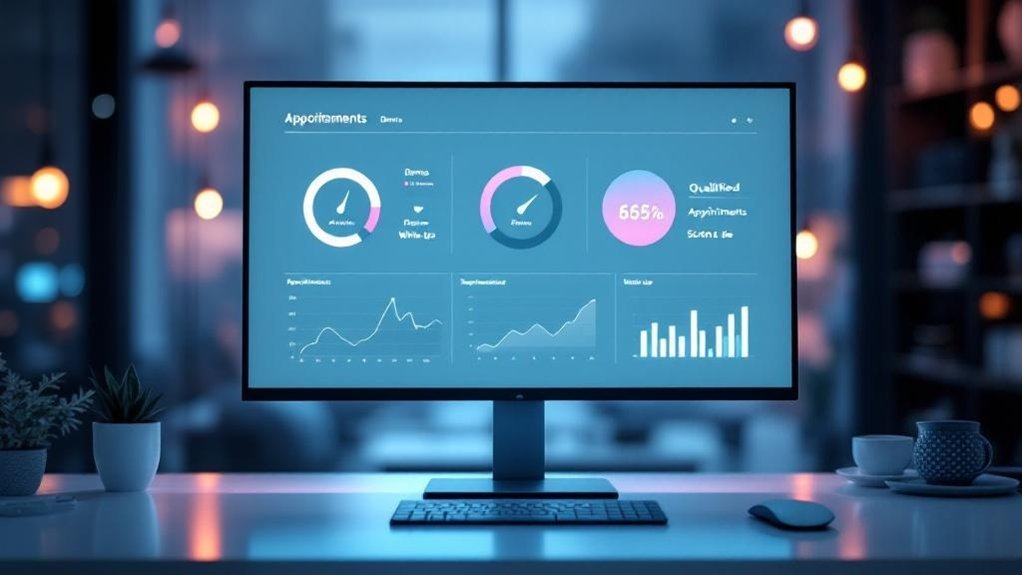
Track the number of qualified appointments scheduled each week or month to gauge how effectively your lead generation and outreach are converting interest into intent; this metric directly reflects pipeline health, predicts conversion volume, and lets you adjust resources or messaging quickly when appointment rates dip, since well-structured appointments can boost close likelihood by roughly 20%. You’ll monitor trends in the number of qualified appointments to spot bottlenecks and seasonality, linking fluctuations to specific lead generation channels and outreach cadences. Use the metric to forecast expected closes by applying observed conversion rate benchmarks, and segment by source to prioritize high-yield campaigns. Operationalize findings: refine qualification criteria, shorten scheduling latency, and reallocate reps to sustain a steady, predictable pipeline.
Demo-to-Appointment Conversion Rate
After you’ve measured how many qualified appointments are getting booked, the next logical metric is the demo-to-appointment conversion rate: the percentage of demos that result in a scheduled follow-up appointment. You’ll calculate it as (appointments after demos ÷ total demos) × 100 to quantify how well demos secure next-step commitment. Track sales with this KPI to spot declines or gains; median benchmarks sit between 20%–40%. A low rate flags issues with targeting, demo messaging, or follow-up cadence. Regularly reporting it helps sales teams make data-driven changes to demo content and outreach. Use this quick reference to contextualize performance.
| Metric | Formula | Benchmark |
|---|---|---|
| Demo-to-Appointment | appointments/demos ×100 | 20%–40% |
| Frequency | weekly/monthly | — |
Number of Product Demos Delivered

Track the number of demos you deliver alongside the demo delivery rate to spot scheduling bottlenecks and rep consistency. Measure demo-to-opportunity conversion and demo duration trends to see which formats and lengths drive the most pipeline progression. Use these signals to set benchmarks and iterate your demo playbook for higher conversion efficiency.
Demo Delivery Rate
When you measure Demo Delivery Rate—the number of product demos actually delivered—you’ll see how effectively your team converts qualified interest into hands-on experiences that drive deals; a healthy rate (often 30–50% of qualified leads) signals strong engagement and predictable pipeline progression. You’ll track demo delivery rate to quantify how many qualified leads reach the demo stage, since higher values typically correlate with improved conversion rates and clearer sales performance signals. Use this metric to spot funnel drop-off, test outreach cadences, and prioritize reps or segments that deliver more demos. Compare the rate to win rate and average deal size to assess demo quality versus quantity. Set targets, monitor trends, and adjust resourcing to maximize demos that meaningfully advance opportunities.
Demo-to-Opportunity Conversion
Because the Demo-to-Opportunity Conversion Rate shows what share of delivered demos become qualified sales opportunities, it’s the clearest signal of whether your demos are convincing and aligned to buyer needs. You should track demo-to-opportunity conversion as a core sales pipeline management metric: it quantifies effectiveness, guides coaching, and improves forecasting. Benchmark against the typical 20–30% range, segment by rep and industry, and prioritize fixes where conversion rates lag. Use findings to refine scripts, focus value messaging, and qualify leads earlier. Consistent monitoring reveals trends and operational gaps, helping you boost pipeline velocity and predictability.
| Metric | Action | Target |
|---|---|---|
| Conversion rates | Coach reps on value focus | 20–30% |
| Trends | Segment by industry | Improve by 10% |
Demo Duration Trends
After measuring how many demos turn into qualified opportunities, you should examine demo duration trends to understand how demo length and volume affect conversion and velocity. Track average demo length alongside the number of product demos delivered weekly or monthly to spot patterns: do longer demos increase lead conversion rates or dilute focus? Use cohort analysis to compare demo length to win rates and time-to-close, isolating formats that accelerate sales velocity. Monitor volume to gauge rep activity and identify bottlenecks where lengthy demos slow pipeline throughput. Feed these insights into targeted training — shorten or expand segments that correlate with higher conversions, standardize successful cadences, and set duration benchmarks. That lets you optimize demo cadence for maximum conversion and pipeline velocity.
Demo Engagement Score
A Demo Engagement Score quantifies how actively a prospect participates during your product demonstration—tracking engagement duration, questions asked, and post-demo actions—to predict conversion likelihood and surface which demo elements drive wins. You’ll compute this demo engagement score from engagement time, question count, and follow-up behaviors to create a single predictive metric. Higher scores correlate with improved win rate, so you can prioritize leads and coach reps. Monitor trends to identify effective demo segments and optimize content, pacing, or interactive moments. Use tools like Mural to aggregate qualitative feedback and spot patterns across reps.
- Measure engagement duration vs. outcomes to validate thresholds.
- Track question types to reveal buyer intent signals.
- Correlate post-demo actions with conversion velocity.
- Run cohort tests to optimize demo variants for higher conversion.
Write-Up Completion Rate
Track the Percentage of Completed Write-Ups alongside Time-to-Write-Up Completion to see both throughput and speed in your documentation process. Use the completion rate formula ((completed ÷ initiated)×100) and median or 95th percentile time to spot where write-ups stall. Those two metrics together tell you whether issues are about follow-through, capacity, or process friction so you can target training or tooling.
Percentage of Completed Write-Ups
Because consistent documentation drives collaboration and accountability, the Write-Up Completion Rate measures the percentage of initiated write-ups that are finished, calculated as (completed write-ups ÷ total initiated) × 100. You’ll use this sales metrics indicator to quantify how reliably reps capture customer interactions and to benchmark documentation performance. Track it weekly, compare by rep or region, and set realistic targets that drive follow-through without creating busywork. A rising rate signals better knowledge sharing; a falling rate flags training or process gaps. Use the metric to prioritize coaching, simplify templates, or automate reminders.
- Calculate: (completed write-ups / total initiated) × 100 for clear tracking
- Segment by rep, team, or deal stage for focused insights
- Set targets to motivate and measure improvement
- Link trends to coaching or process changes
Time-To-Write-Up Completion
1 metric to watch closely is Time‑To‑Write‑Up Completion, which measures the average time it takes reps to finalize a write‑up after a demo or appointment and reveals how quickly your team converts interactions into actionable next steps. You should target under 24 hours: shorter Time‑To‑Write‑Up Completion correlates with faster follow‑up and improved conversion rates. Track this metric regularly to spot bottlenecks in your sales process—delays often indicate documentation, approval, or tooling inefficiencies. Use time-series charts and segment by rep, team, and deal size to prioritize interventions. Set SLAs, streamline templates, and automate data capture to cut friction without sacrificing accuracy. Measuring and optimizing Time‑To‑Write‑Up Completion drives responsiveness, increases engagement, and supports higher close rates.
Lead-to-Appointment Conversion Rate

A strong Lead-to-Appointment Conversion Rate tells you how effectively your team turns raw leads into scheduled conversations; calculate it as (Appointments ÷ Leads) × 100 to quantify initial outreach and qualification performance. You’ll use this metric to spot qualification gaps, compare channels, and prioritize resources. Benchmarks (15–30%) give a target range, but you should segment by source and lead quality. Track trends weekly to catch deterioration early and iterate on messaging and targeting.
A strong Lead-to-Appointment Conversion Rate shows how well leads become scheduled conversations—track by source, rep, and weekly trends.
- Measure conversion by source to reveal high-performing channels.
- Compare rep-level rates to identify coaching needs.
- Use rolling averages to smooth short-term volatility.
- Set achievable targets based on historical data and campaign intent.
This metric drives disciplined lead management and better appointment predictability.
Average Time From Appointment to Demo
The average time from appointment to demo—typically 3 to 10 days—measures how quickly prospects move from an initial conversation to a product walkthrough, and you should track it because shorter intervals often boost close rates (sometimes by ~20%). You’ll use this metric to shorten the average sales cycle length, improve conversion, and prioritize pipeline metrics to track that affect velocity. Track trends weekly, segment by rep and product complexity, and set targets to cut delay. Analyze bottlenecks in scheduling, follow-up cadence, and resource availability. A disciplined follow-up process reduces lag and raises conversion probability.
| Segment | Median Days | Action |
|---|---|---|
| Low complexity | 3 | Schedule fast demos |
| High complexity | 8 | Prep resources |
Appointment No-Show and Reschedule Rate
While missed appointments and frequent reschedules may seem like minor nuisances, they quietly erode pipeline efficiency: the Appointment No-Show Rate measures the share of scheduled demos prospects skip, and when it tops 20% it often signals poor qualification or engagement; pairing that with the Reschedule Rate lets you distinguish disinterest from timing conflicts, so you can target reminders, adjust cadence, and reallocate reps to recover capacity and improve conversion. You should track appointment no-show rate alongside reschedule rate and analyze root causes — bad lead qualification, unclear value props, or scheduling friction. Use reminders and follow-ups to cut no-shows (up to 50%), and apply patterns to refine lead qualification and scheduling policies.
- Monitor no-show and reschedule trends by segment
- Correlate reasons with lead qualification scores
- Test reminder cadences and channels
- Reallocate reps based on recovered capacity
Pipeline Value From Appointments and Demos
One strong demo can change a deal’s trajectory: appointments and demos are measurable levers that drive pipeline value, with structured demo processes often lifting sales performance by ~30% and conversion from qualified lead to close commonly exceeding 20%. You should treat appointments as the gateway metric—track volume, source, and conversion to demos to quantify upstream impact. For demos, capture outcome, demo type, and follow-up actions so you can attribute closed revenue accurately. Analyze correlations between scheduled demos and win rates to prioritize lead segments and refine messaging. Use these insights to forecast near-term pipeline value and to allocate reps to high-potential accounts. By operationalizing appointments and demos metrics, you’ll convert activity into predictable pipeline value and smarter sales decisions.
Rep-Level Appointment and Demo Win Rate
You should track appointment-to-demo conversion to see which reps consistently move prospects into active product evaluations and where lead qualification needs tightening. Compare each rep’s demo-to-deal win rate to spot those who close at industry-standard levels (30–40%) versus those needing coaching. Use these two ratios together to prioritize training, optimize handoffs, and raise overall pipeline efficiency.
Appointment-to-Demo Conversion
Tracking Appointment-to-Demo Conversion at the rep level gives you a precise view of how effectively scheduled meetings turn into product demos, calculated as (Demos Conducted / Appointments Scheduled) × 100. You’ll use appointment-to-demo conversion as a core metric to evaluate rep performance and refine your sales strategy. Benchmarks vary, but beating 50% signals strong initial engagement. Measure per-rep rates to spot top performers and those needing coaching. Regular review of these metrics will help you optimize scheduling and qualification processes so more appointments actually become demos.
- Calculate conversion per rep weekly or monthly to track trends.
- Compare reps against a 50% benchmark to prioritize coaching.
- Use findings to adjust lead qualification and scheduling rules.
- Tie improvements to specific process or script changes.
Demo-to-Deal Win Rate
Metrics like the Demo-to-Deal Win Rate give you a clear lens into how effectively demos turn interest into revenue: calculate it as (Closed Deals from Demos / Total Demos Conducted) × 100 to quantify demo impact at the rep level. You’ll track rep-level demo-to-deal win rate to spot who consistently converts demos into closed deals and who needs coaching. Use the metric to diagnose whether failures stem from demo execution, qualification, or mismatch with customer pain points. Benchmark top reps, share best practices, and tailor training around objection handling and value messaging. Regularly review trends, set realistic targets, and tie improvements to revenue outcomes so coaching and process changes directly raise your conversion rate.
Frequently Asked Questions
What Are Pipeline Metrics?
Pipeline metrics are pipeline performance indicators you use to monitor opportunities across stages; they fuel sales funnel analysis and conversion rate tracking, letting you spot bottlenecks, prioritize actions, forecast revenue, and drive data-driven sales improvements.
How to Visualize a Sales Pipeline?
You’ll visualize a sales pipeline with a gigantic, clear sales funnel visualization: use pipeline stage analysis via kanban boards, dashboards and visual metrics tools tied to CRM, color-code stages, and review data frequently for strategic action.
Which Metric Is Commonly Used to Measure the Efficiency of the Pipeline?
The common metric is Win Rate — it measures pipeline efficiency by tracking conversion rates of opportunities to closed deals; you should also monitor lead velocity to spot flow changes and optimize conversion processes strategically.
What Key Sales Metrics Do You Track to Evaluate Pipeline Trends and Revenue Forecasts?
Think of your pipeline as a garden: you’ll track lead conversion, sales cycle length, win rate, average deal size, pipeline velocity, and forecast accuracy to drive revenue growth, identify bottlenecks, and optimize predictable outcomes.
Conclusion
You’ve seen the key metrics — appointments, demos, write-ups — that actually move deals forward. Focus on the conversion funnels and time-to-demo like a surgeon: small delays kill outcomes. Track demo engagement and rep-level win rates to expose bottlenecks and replicate winners. Prioritize metrics that predict revenue, not vanity. In short, measure what matters, act fast, and watch your pipeline transform — because numbers don’t lie, they guide.