

Track five cross-functional, data-driven metrics to boost your on-time promise: On-Time Delivery (OTD) rate to measure reliability, cycle time broken into processing/picking/shipping, backorder rate to spot inventory gaps, fill rate to guarantee complete first shipments, and end-to-end lead time with variability analysis. Use dashboards and cross-team reviews to prioritize fixes, tighten forecasts, and cut expedited costs. Keep monitoring these KPIs regularly and you’ll see where to focus next for measurable improvement.
Key Takeaways
- On-Time Delivery (OTD) Rate — measure and track (Delivered on-time ÷ Total Deliveries) to quantify promise reliability and prioritize fixes.
- Cycle Time — monitor order-to-delivery duration and its processing, picking/packing, and shipping subcomponents to identify bottlenecks.
- Backorder Rate — track percentage of orders delayed by stockouts to improve replenishment and reduce promise failures.
- Fill Rate — measure orders shipped complete on first shipment to reduce split shipments and missed promises.
- Lead Time and Variability — track mean lead time and its variability to set realistic promises and improve customer trust.
On-Time Delivery (OTD) Rate

When you track On‑Time Delivery (OTD) Rate—calculated as (Total Deliveries − Delayed Deliveries) / Total Deliveries—you get a clear, quantifiable measure of delivery reliability that leaders across operations, inventory, and logistics can act on. You’ll use On-Time Delivery Metrics to track and measure performance indicators that tie directly to customer satisfaction and repeat business. Monitor OTD rate regularly to identify areas for improvement in the order fulfillment and delivery process; trends will reveal whether inventory management, fulfillment pacing, or routing are the root cause. Set internal OTD goals, align incentives, and run cross-functional reviews to drive operational efficiency. Data-driven dashboards let you prioritize fixes, quantify impact, and sustain gains—some organizations report up to 44% improvement after focused interventions.
Cycle Time
OTD rate tells you how reliable your delivery promises are; cycle time shows why you hit—or miss—them. You should measure cycle time from order placement to delivery, breaking it into order processing, picking/packing and shipping to reveal where fulfillment efficiency lags. Shorter cycle time boosts on-time delivery performance and customer satisfaction, so you’ll prioritize interventions that optimize processes and delivery timelines.
- Map cycle time components to clear performance metrics
- Use automation in order processing to cut delays
- Implement real-time inventory tracking to prevent stock surprises
- Identify and remove bottlenecks through cross-functional analysis
- Run experiments to validate improvements and track impact on OTD
This strategic, data-driven view aligns operations, supply chain and customer teams.
Backorder Rate

Anyone who’s tracking fulfillment performance should watch backorder rate closely: it’s the share of orders you can’t fulfill immediately because stock’s unavailable, and it directly signals gaps in your inventory and supply planning. You’ll use backorder rate to measure inventory management and its impact on customer satisfaction—high rates mean delayed deliveries and eroded trust. Track trends versus industry benchmarks (10–20%) and make proactive adjustments through demand forecasting, tighter inventory replenishment, and supplier communication. This metric drives cross-functional alignment: ops, procurement, and sales must act on stock availability signals to improve supply chain efficiency. Focus on reducing backorders via data-driven forecasting and replenishment cadence to protect on-time promise performance.
| Metric | Action |
|---|---|
| Backorder rate | Monitor weekly |
| Stock availability | Improve forecasting |
| Delayed deliveries | Root-cause analysis |
| Suppliers | Faster replenishment |
Fill Rate
Fill rate is the percentage of customer orders you ship complete on the first shipment, and it’s one of the clearest indicators of inventory effectiveness and fulfillment efficiency. You’ll use the formula (Total Units Shipped / Total Units Ordered) × 100 for precise performance tracking. A target above 90% signals healthy inventory levels, fewer stockouts, stronger supply chain performance and improved customer satisfaction. Boosting fill rate reduces expedited shipping costs and improves delivery efficiency, directly supporting on-time delivery promises. Cross-functional teams should monitor fill rate alongside backorder and lead-time metrics to align procurement, warehousing, and fulfillment strategies for cost savings.
Fill rate measures orders shipped complete on first shipment — aim above 90% to cut stockouts, costs, and improve delivery.
- Calculate fill rate regularly for performance tracking
- Flag stockouts and root-cause issues
- Adjust inventory levels proactively
- Coordinate order fulfillment decisions
- Quantify delivery efficiency gains
Lead Time
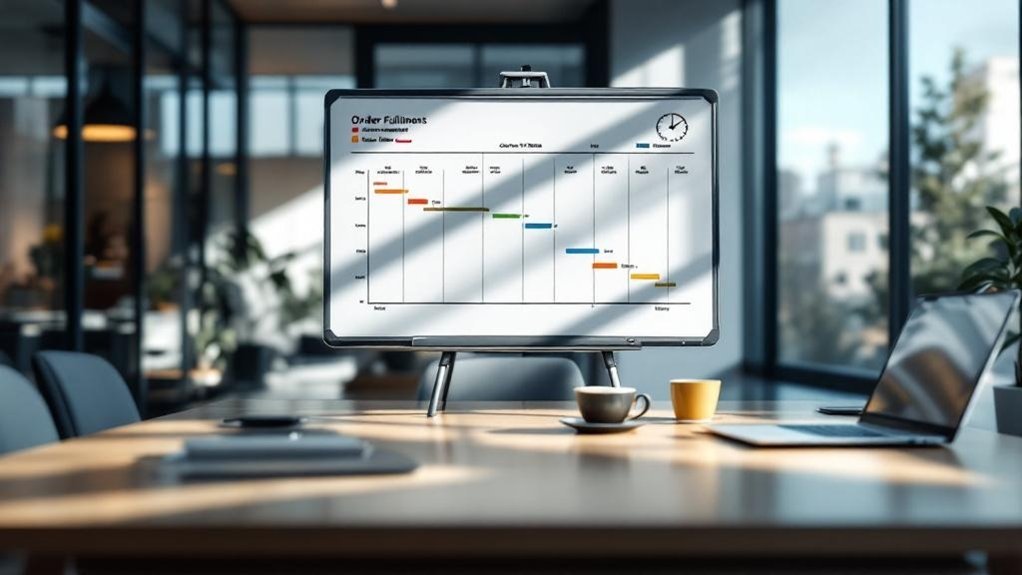
Lead time is the total elapsed time from when an order’s initiated until the customer gets it, and you should treat it as a cross-functional performance lever that ties procurement, production, and logistics together. You’ll track lead time as a core performance metric to improve on-time delivery and customer satisfaction. Use tracking metrics to surface bottlenecks across the fulfillment process, prioritize inventory management (JIT where appropriate), and align teams on delivery commitments. Shorter, consistent lead times raise trust and simplify forecasting. Measure mean and variability, map process steps, and target operational improvements that remove delays. Below is a quick diagnostic table to guide discussions and action.
| Metric | Purpose |
|---|---|
| Mean Lead Time | Baseline performance |
| Lead Time Variability | Predictability |
| Bottleneck Source | Root cause |
| Improvement Target | Action plan |
Frequently Asked Questions
What Are the 5 Most Important Metrics for Performance of the Product?
You should track Delivery Accuracy, Order Fulfillment, Shipping Times, Inventory Management and Production Efficiency — linking Supply Chain, Quality Control, Responsiveness Rate and Performance Benchmarking to boost Customer Satisfaction with data-driven, cross-functional decisions.
How to Measure On-Time Delivery Performance?
You’ll measure on-time delivery performance by using on time tracking and delivery accuracy metrics, comparing order fulfillment against performance benchmarks, analyzing shipment delays and supply chain data, aligning with customer expectations for continuous improvement and service reliability.
What Are the 3 A’s of Metrics?
They’re Accuracy, Availability, and Actionability: you’ll use Accuracy Analysis and Achievement Analytics for Accountability Assessment, guarantee Alignment Assurance with Assessment Avenues and Auditory Aids, enable Actionable Insights, Agile Adaptation, Automated Auditing and Anomaly Awareness.
What Are the Five Golden Metrics?
The five golden metrics are OTD, OTIF, Perfect Order Rate, Cycle Time, Lead Time — you’ll use these golden standards as performance benchmarks for delivery accuracy, efficiency indicators, tracking methodologies, improvement strategies, data visualization, reporting tools, stakeholder engagement.
Conclusion
Think of your supply chain as a clockwork system: by tracking On-Time Delivery, Cycle Time, Backorder Rate, Fill Rate, and Lead Time, you’ll tune each gear to beat latency and shrink variability. Use real-time metrics to spotlight bottlenecks, align procurement, production, and logistics, and prioritize interventions that move the needle. With cross-functional KPIs and data-driven experiments, you’ll turn missed promises into predictable outcomes and keep customers’ expectations set—and met—consistently.