

You should standardize seven KPIs to drive parts availability, cut costs, and boost store performance: inventory turnover, fill rate, lead time to delivery, on‑shelf availability (stock‑out rate), average order value for parts, warehouse utilization and handling efficiency, and forecast accuracy with demand variance. Track these to reduce carrying costs, shorten fulfillment times, and lift customer satisfaction. Use real‑time data and accountability at the store level to turn insights into actions — keep going to see how to implement them.
Key Takeaways
- Standardize Inventory Turnover Rate (COGS ÷ average inventory) to measure parts efficiency and reduce obsolete stock.
- Set a universal Fill Rate target (>95%) to ensure consistent order fulfillment and customer satisfaction across stores.
- Track Lead Time to Delivery from order placement to receipt to identify supplier or process delays.
- Monitor Forecast Accuracy (target 85–90%) and demand variance to reduce stockouts and optimize stocking levels.
- Implement real-time On-Shelf Availability metrics with RFID/IMS visibility to enforce under-5% stock-out targets.
Inventory Turnover Rate
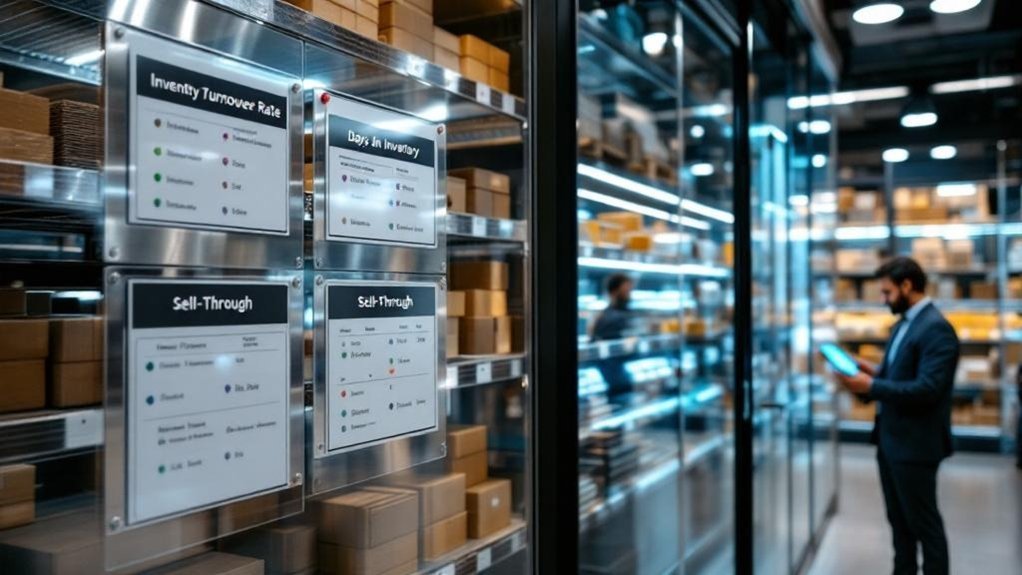
Inventory turnover measures how often you sell and replace stock over a period—calculated as COGS divided by average inventory—and it’s a direct indicator of how efficiently you’re managing merchandise. You’ll treat inventory turnover as a core KPI to gauge management performance: higher rates point to strong sales and alignment with customer demand, while low rates reveal overstocking or poor assortment. Benchmark by industry and monitor cost of goods sold against average inventory to spot deviations. Use analytics to forecast demand, shorten lead times, and set reorder points for ideal inventory. Regular review uncovers slow-moving items and areas for improvement—triggering markdowns, discontinuations, or supplier changes—to boost cash flow and overall efficiency across stores.
Fill Rate (Order Fulfillment Percentage)
Having a strong turnover rate only tells part of the story—you also need to measure whether customers actually get complete orders when they want them. You should track fill rate (order fulfillment percentage) by dividing units shipped by units ordered to quantify inventory availability and service level. Aim for >95% to protect customer satisfaction and loyalty. Benchmark fill rates across stores to reveal inventory management gaps and pinpoint stock issues driving emergency orders. Use that insight to rebalance safety stock, optimize replenishment rules, and reduce carrying costs without sacrificing availability. Consistent monitoring improves supply chain efficiency, lowers rush-order spend, and gives you a clear metric for operational accountability. Make fill rate a standardized KPI to drive predictable fulfillment performance.
Lead Time to Delivery

Because customers judge your operation by how quickly orders arrive, Lead Time to Delivery must be a standardized KPI across stores; it measures the time from order placement through processing, production and shipping, and shorter, consistent lead times drive higher satisfaction and lower carrying costs. You need to track lead time and delivery times end-to-end to assess supply chain health and improve customer satisfaction. Set a standardized lead time benchmark based on sector norms, then monitor deviations to find bottlenecks in processing, production or shipping. Use those insights to optimize inventory management, align reorder points and shrink excess inventory. Consistent measurement boosts operational performance, creates predictable delivery times for customers, and gives you a clear roadmap for targeted improvements.
On‑Shelf Availability (Stock‑Out Rate)
You need real-time inventory visibility to spot gaps the moment they occur and keep your stock-out rate under control. Use that live data to trace root-cause stockouts—whether from forecasting errors, supplier delays, or in-store handling—and prioritize fixes with the biggest ROI. Consistently monitoring these signals lets you reduce lost sales and keep customers loyal.
Real‑Time Inventory Visibility
When stores can see on‑shelf inventory in real time, you’ll cut stock-outs, boost sales, and improve customer trust. Real-time inventory visibility ties directly to on-shelf availability and lowers stock-out rate by updating inventory levels instantly. You’ll use technology solutions—RFID, sensors, and inventory management systems—to drive accurate counts, support demand forecasting, and trigger replenishment strategies. That reduces lost sales and raises customer satisfaction while giving managers actionable KPIs.
- Measure: live on-shelf availability percentage to track real-time inventory visibility.
- Target: keep stock-out rate below 5% as a standard across stores.
- System: deploy inventory management systems and RFID for instant inventory levels.
- Action: align replenishment strategies with demand forecasting to prevent shortages and optimize service levels.
Root‑Cause Stockouts
Real-time on-shelf visibility gives you the data to spot patterns, but fixing stockouts means tracing their root causes. You’ll measure on-shelf availability (OSA) against a 95% target for key SKUs, using standardized KPIs to compare performance across stores. Track stockouts by frequency, duration and lost-sales impact so forecasting and replenishment gaps become visible. Investigate management practices that drive shortages: reorder policies, safety stock settings, vendor reliability and store-level handling. Quantify how stockouts erode customer satisfaction and revenue—studies show up to 20% lost potential sales—and prioritize corrective actions where impact is highest. Use those KPIs to tighten forecasting, automate replenishment triggers and coach local teams, closing gaps and boosting availability and overall performance.
Average Order Value for Parts

Average Order Value (AOV) for parts tracks the mean dollar amount customers spend per parts order, and it’s a direct lever for revenue growth you can influence. You calculate AOV by dividing total parts revenue by order count to reveal sales trends and revenue per transaction. Use AOV to spot purchasing patterns, prioritize upselling opportunities, and align spare parts management with customer needs. Changes in AOV show whether marketing strategies or pricing tweaks move the needle, and higher AOV often signals improved customer satisfaction and loyalty.
- Measure AOV regularly to benchmark store performance.
- Analyze items commonly purchased together to drive upselling.
- Tie promotions to AOV increases and monitor sales trends.
- Use AOV insights to refine spare parts management and customer targeting.
Warehouse Utilization and Handling Efficiency
Upselling to raise parts AOV only pays off if your warehouse can fulfill higher-value orders quickly and accurately, so focus next on Warehouse Utilization and Handling Efficiency. You should target warehouse utilization at 70–85% to avoid warehouse saturation that slows fulfillment and hides parts. Treat handling efficiency as a core key performance indicator (KPIs) family: measure picking times, packing accuracy, and overall operational speed. Use inventory tracking and clear categorization to cut average picking times up to 25% and reduce errors. Regularly audit logistics processes to surface bottlenecks, then apply continuous improvement cycles to sustain gains. Dashboards must map these KPIs to service targets so you can scale upsell strategies without degrading delivery performance or increasing stockouts.
Forecast Accuracy and Demand Variance

Forecast accuracy is the linchpin that tells you how closely predicted demand matches actual sales, and tightening that gap directly reduces stockouts and excess inventory. You need to measure forecast accuracy and demand variance regularly to sharpen inventory management and boost customer satisfaction. Use historical sales data and advanced analytics to drive purchasing decisions and hit the 85–90% accuracy target most retailers aim for. Lower variance means fewer emergency orders and less excess inventory, improving supply chain responsiveness.
- Track forecast accuracy by SKU and store to identify outliers.
- Quantify demand variance to prioritize corrective actions.
- Adjust forecasts with real-time sales data and market signals.
- Link improvements to reduced stockouts, carrying costs, and happier customers.
Frequently Asked Questions
What Are the 4 P’s of KPI?
The 4 P’s of KPI are Purpose, People, Process, and Performance. You’ll use a KPI framework for strategic planning, goal alignment, benchmarking techniques, performance tracking, retail analysis, performance measurement, operational efficiency, and data visualization to drive results.
What Are the 5 Key Performance Indicators Examples?
The five key KPI examples are sales revenue, inventory turnover, customer satisfaction, employee efficiency, and profit margin; you’ll also track return on investment, lead time, order accuracy, and market share to drive strategic, results-driven performance improvements.
What Are the KPIS for a Retail Store?
Remember when one sale doubled after a weekend promo? You’ll track sales conversion, inventory turnover, customer satisfaction, foot traffic, average transaction, return rate, employee productivity, promotional effectiveness, and merchandise assortment to drive measurable retail results.
Which KPIS Do You Consider Essential for Measuring Operational Success Across Multiple Sectors?
You should track operational efficiency, inventory turnover, supply chain effectiveness, workforce productivity, cost control, sales growth, customer satisfaction, profitability analysis and market trends; they’ll drive strategic, results-driven decisions that boost performance and measurable outcomes.
Conclusion
You’ll drive consistency and profitability by standardizing these seven parts KPIs across stores. Focus on inventory turnover and forecast accuracy first — a 10% improvement in turnover can free up working capital for growth. Track fill rate and on‑shelf availability to cut lost sales, and tighten lead times to boost customer satisfaction. Use warehouse utilization metrics to lower handling costs and raise average order value. Measure, act, repeat for measurable, scalable results.