
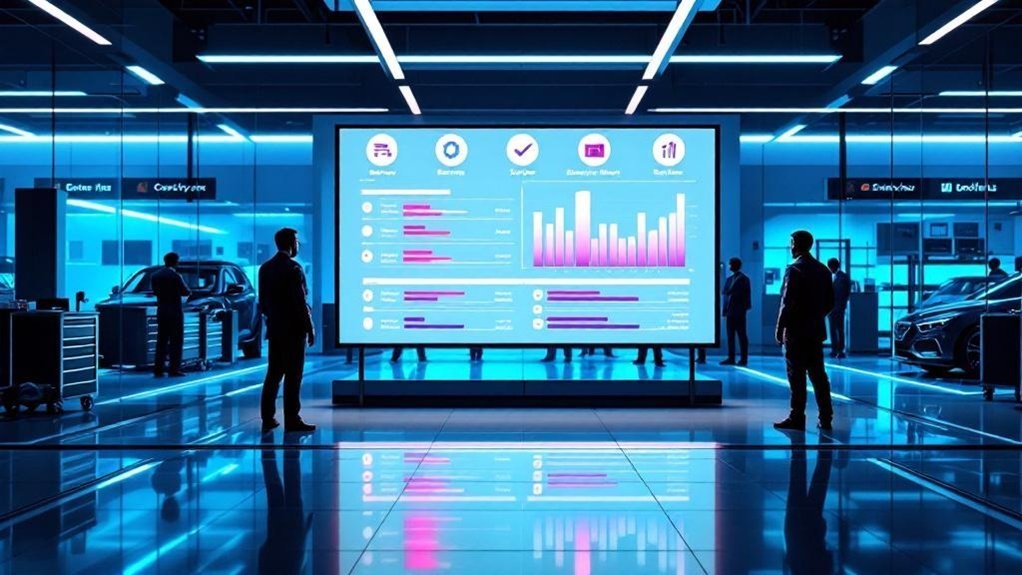
You need real-time service visibility because timely digital updates and milestone timestamps cut customer anxiety and inbound status calls, boosting staff efficiency. Clear, itemized pricing and service breakdowns build trust and speed approvals, while packaged offers and loyalty perks drive repeat revenue. Secure API integrations and multi-device compatibility keep workflows smooth and PII protected. These measurable improvements—higher retention, fewer inquiries, and increased upsell—translate into predictable fixed-ops gains; keep going to see how.
Key Takeaways
- Real-time digital updates reduce customer anxiety by showing automated timestamps and milestone progress during vehicle service.
- Clear, itemized service and pricing details on the board build trust and minimize billing disputes.
- Visible progress lowers inbound status calls, improving staff efficiency and shop throughput.
- Integrated API connections and data security ensure seamless cross-platform access while protecting customer PII.
- Transparent status boards increase repeat business and retention by demonstrating consistency and measurable service value.
Real-Time Status Updates That Reduce Customer Anxiety

Someone waiting on a car service is often anxious, and real-time digital status updates directly address that by keeping you informed of progress and expected completion times. You’ll see automated timestamps and milestone indicators that cut uncertainty—studies show 55% of customers prefer apps or texts—so you’re getting updates in the channel you want. Roughly one-third of customers still call for status; delivering ASU reduces those calls and boosts operational efficiency. By tracking tasks on your mobile device, you experience clearer expectations and measurable anxiety reduction, which raises satisfaction and customer engagement. Process-wise, continuous updates standardize communications, let service advisors manage workflow proactively, and create consistent metrics for turnaround time and perceived service quality.
Transparent Pricing and Service Breakdown for Trust-Building
Real-time status updates reduce anxiety by keeping you informed of timing and progress, and pairing those updates with a clear, itemized pricing menu completes the information loop so customers can see both what’s happening and what it’ll cost. You’ll see data: 96% customer appreciation for transparent breakdowns, consistent pricing that matches quotes and invoices, and a 20% lift in repeat business when costs are clear. That process-oriented transparency drives trust enhancement and operational consistency, reducing disputes and speeding approvals. Present line-item labor, parts, and taxes so you and the service team follow the same script.
| Item | Example Cost |
|---|---|
| Labor | $120 |
| Parts | $85 |
| Taxes/Fees | $20 |
| Total | $225 |
Showcasing Packages, Loyalty Programs, and Upsell Opportunities

When you present bundled services and loyalty perks clearly on a digital menu, customers understand value faster and spend more—studies show up to a 30% revenue lift from repeat clients and 96% of customers prefer transparent pricing—so your menu should prioritize concise package descriptions, visible discounts, and earned benefits alongside each service. You’ll use service bundles to simplify choices, reduce decision friction, and increase average repair order value by highlighting savings and complementary items. Show loyalty status, point balances, and redemption options next to packages to drive customer engagement and repeat visits. Operationally, update packages regularly, track conversion rates per bundle, and A/B test upsell prompts. This process-focused approach delivers measurable increases in sales, retention, and perceived dealership value.
Integrations, Device Compatibility, and Data Security
Because your digital service board needs to talk to other systems and work on any device, seamless API integrations, cross-platform compatibility, and strong data protections are non-negotiable: connect the menu to shop management software to push live job status and pricing updates, support smartphones, tablets, laptops, and kiosks for both customers and staff, and enforce encryption, access controls, and compliance checks to safeguard PII.
Because your digital service board must integrate across systems and devices, enable live updates, cross-platform access, and strict data protections.
You’ll want a process-driven approach that measures uptime, latency, and transaction integrity. Prioritize API connections that reduce manual entry and enable real-time reconciliations. Include multi language support in UI/UX flows to lower friction for diverse customers. Secure data pipelines with TLS, role-based access, and audit logs.
- Integration: automated syncs, standardized endpoints, versioning.
- Devices: responsive design, offline fallbacks, performance metrics.
- Security: encryption, access controls, compliance audits.
Measurable Impact on Retention, Revenue, and Staff Performance
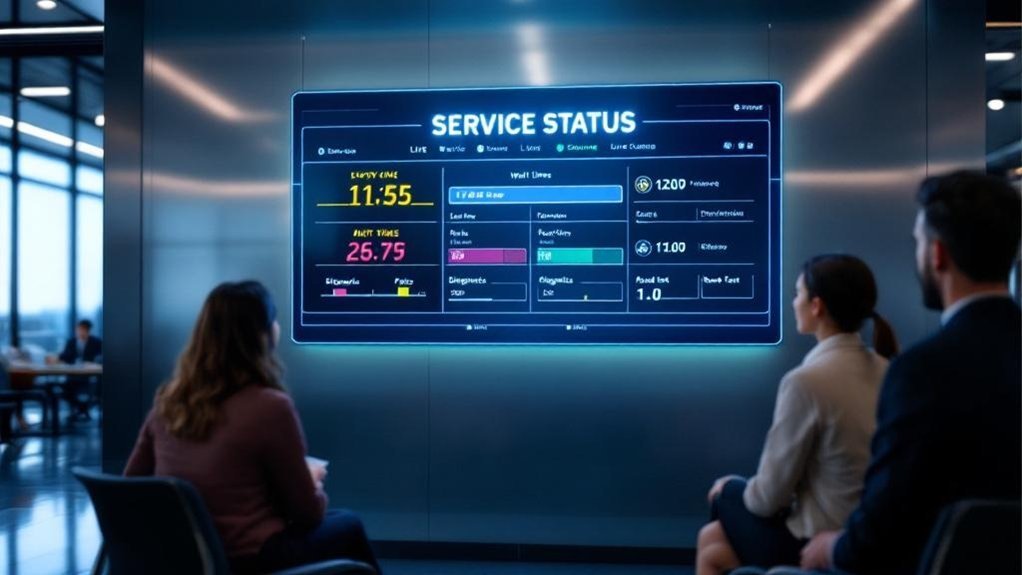
Although it’s easy to underestimate a single interface, a well-implemented digital service status menu board delivers measurable gains: up to 20% higher customer retention, a 30% lift in revenue from repeat buyers, and a one-third drop in inbound service inquiries, all of which free advisors to handle more customers and higher-value tasks while lowering admin costs. You’ll translate transparency into customer loyalty by reducing uncertainty and increasing trust, which drives repeat business. Operational efficiency improves as automated service updates cut manual communication, lowering administrative overhead and enabling higher throughput per technician. Staff performance rises because advisors spend less time answering status questions and more on diagnostics, upsells, and service quality. Track these KPIs to quantify ROI and optimize workflows continuously.
Frequently Asked Questions
How Customizable Is the Menu Board’s Visual Branding and Layout?
You’ll get extensive visual customization and layout flexibility: brand colors, fonts, logos, widget sizing, and preset templates. Data-driven options let you A/B test displays, monitor engagement, and adjust layouts through a centralized, service-focused configuration process.
Can Customers Receive Service Updates via SMS or Email Alerts?
Yes — you can receive service notifications via SMS or email; the system logs communication preferences, automates alerts based on status changes, tracks delivery metrics, and lets you adjust frequency, channels, and opt-in settings for reliable updates.
What Training Is Required for Staff to Operate the System?
Quick, concise coaching: you’ll need structured staff training covering system operation basics, data entry standards, alert workflows, performance metrics, hands-on practice, and periodic proficiency assessments to guarantee process-driven, service-focused, measurable outcomes.
How Does the Board Handle Multiple Technicians Working on One Vehicle?
It logs each technician’s tasks with timestamps, so you get multi technician coordination and service progress tracking; you’ll see real-time task ownership, status updates, timestamps, and aggregate progress metrics for efficient, auditable workflow management.
Is There an Offline Mode During Internet Outages?
Yes — you’ll have offline functionality: the board caches recent status data locally, syncs changes once internet reliability is restored, and logs technician updates so service workflows continue without disruption and data reconciles automatically.
Conclusion
You’ll see stronger satisfaction, steadier spend, and smoother service when a real-time digital status menu board delivers clear, continuous updates. By presenting precise pricing, package particulars, and personalized promotions, you’ll build trust and boost retention. Integrated, secure systems streamline staff workflows and supply measurable metrics—repair response rates, upsell conversion, and repeat visits—so you can optimize processes. Embrace transparent tech to foster faithful customers, facilitate faster fixes, and fuel financial growth through focused, data-driven decisions.