
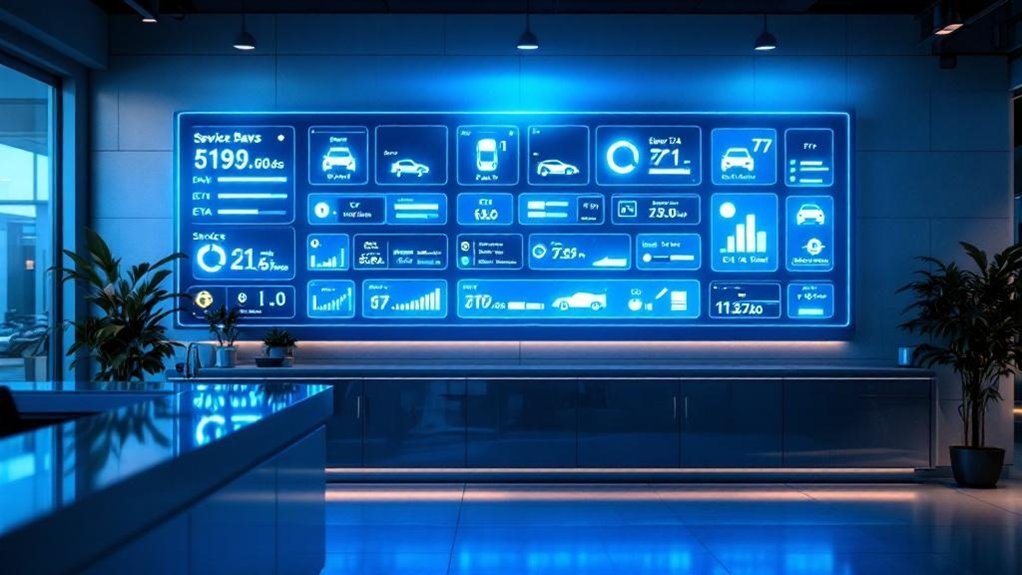
You’ll keep customers calm and cut drive-time calls by showing real-time repair status, ETAs and interactive payment options on synced lobby screens and mobile alerts. Clear, branded messages reduce perceived wait times by ~35% and lower inquiry volume, freeing advisors for higher-value work. Track opt-ins, update open rates, phone volume and CSAT to prove ROI. Start phased rollouts with vendor-managed hardware and you’ll see operational gains and learn practical next steps.
Key Takeaways
- Real-time repair updates and estimated completion times on lobby screens and mobile sync reduce uncertainty and unnecessary drive-time calls.
- Mobile notifications for status changes and payment-ready alerts cut follow-up inquiries and streamline pickup timing.
- Visible service lane progress and appointment displays lower perceived wait times and discourage repeated status calls.
- Interactive payment and pickup scheduling on boards prevent abandoned visits and shorten customer dwell time.
- Centralized, vendor-managed feeds and phased rollouts ensure reliable updates, measurable KPIs, and continuous improvement.
Why Real-Time Service Status Matters to Customers
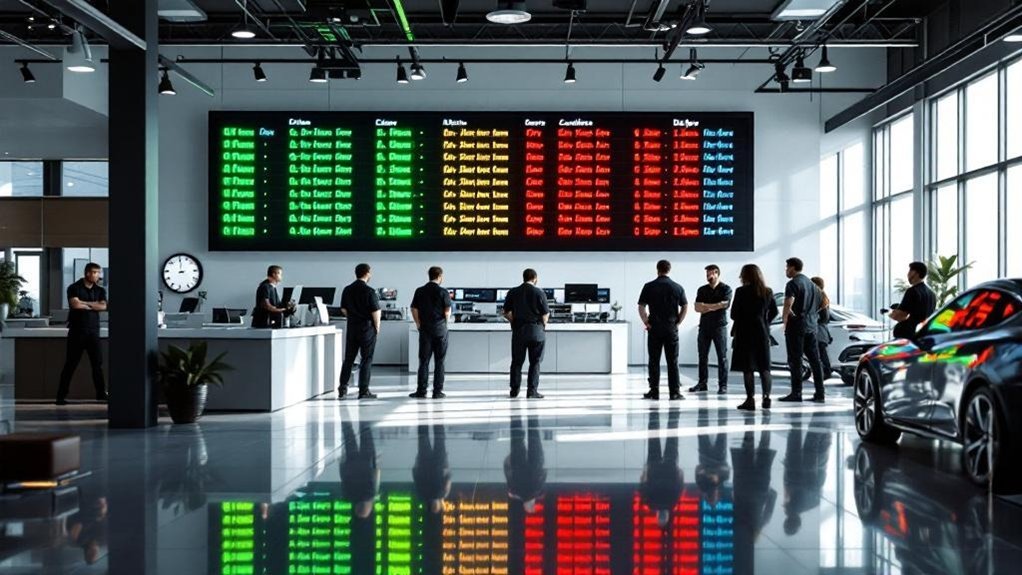
When you get real-time service status updates, uncertainty’s removed and customer anxiety drops—exactly what buyers want during a service visit. You’ll see one-third of customers otherwise calling for progress, so transparent communication removes friction and reduces inbound inquiries. Automated service updates via app or text meet the 55% preference for mobile updates, lifting satisfaction scores measurably. Operationally, ASU frees advisors to handle complex tasks, cutting unnecessary touchpoints and improving throughput. By setting accurate expectations in real time, you protect brand trust and drive repeat business — a direct line to improved profitability. Metrics you’ll track: inquiry volume, update open rates, CSAT, return rates and advisor time reallocated to revenue-generating work.
How Digital Menu Boards Reduce Perceived Wait Time
Real-time updates cut uncertainty, but digital service status menu boards take that effect further by visibly shortening perceived wait times—often by more than 35%—through live progress indicators and estimated completion times. You’ll see fewer interruptions because transparent timelines and appointment displays reduce the urge to ask for status updates, which smooths advisor workflows and increases throughput. By combining service transparency with targeted content, the board converts idle minutes into meaningful customer engagement, lowering anxiety and boosting satisfaction. Measurably, dealers report higher loyalty scores and fewer front-desk inquiries when boards are used consistently. For your brand, that means predictable service cycles, clearer communication, and a demonstrable ROI tied to reduced perceived wait and improved operational efficiency.
Key Features of an Effective Service Status Menu Board
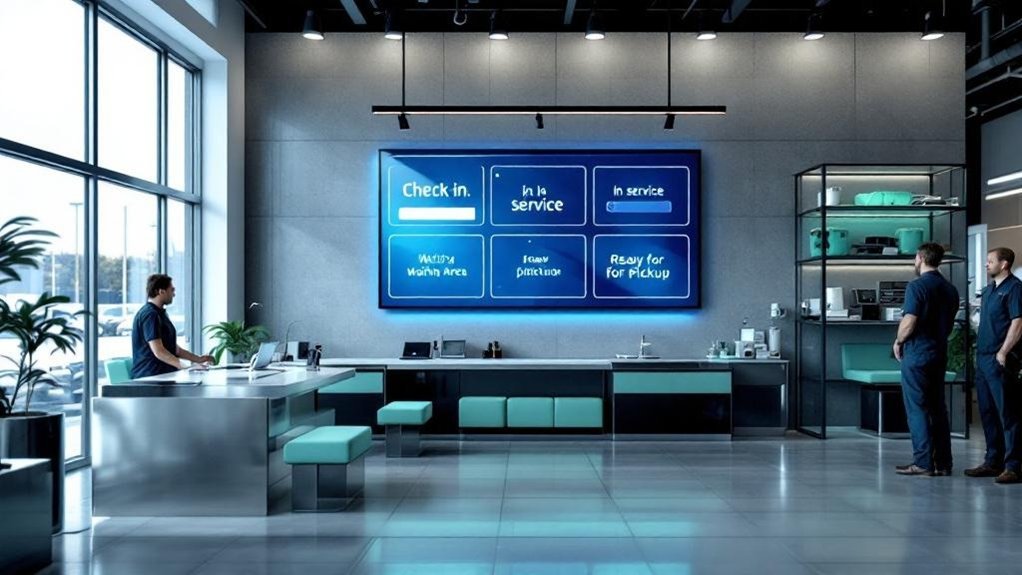
You’ll want real-time repair updates that push inspection findings, repair progress, and revised ETA to customers’ phones so expectations stay aligned and incoming update calls drop. Pair that with interactive payment options on the board and mobile channels to accelerate checkout, reduce abandoned pickups, and boost throughput. Together these features tighten operational KPIs — fewer calls, faster turnarounds, and higher customer trust.
Real-time Repair Updates
Many customers expect continuous visibility into their vehicle’s service, and real-time repair updates deliver that transparency by sending mobile links after check-in so they can track write-up, inspection, and repair progress. You’ll reduce a third of inbound update calls by deploying real time tracking via Automated Service Status Updates (ASU), cutting missed calls and voicemails while boosting service advisor productivity. This metric-driven approach improves customer communication, lifts trust scores, and shortens perceived wait times. The menu board centralizes status feeds so customers and staff see the same timestamps and notes, lowering follow-up friction and dispute risk. For your brand, consistent, measurable updates translate to higher satisfaction, repeat visits, and clearer operational KPIs you can optimize.
Interactive Payment Options
Three payment paths — card, digital wallet, and in-app financing — should be integrated into your service status menu board so customers can pay securely from their phones the moment work is approved. You’ll reduce dwell time and unanswered payment queries by offering interactive payment security with end-to-end encryption and real-time processing indicators. Track conversion rates and average time-to-pay to quantify impact on throughput and customer satisfaction. Provide customer payment flexibility so patrons choose preferred methods, customize service packages, and see precise pricing before authorizing work. Branding stays consistent through a streamlined UI that reinforces trust and minimizes support touchpoints. Measure reductions in drive-time follow-ups and payment disputes to validate ROI and refine payment flow iterations.
Integrating Mobile Access and In-Store Displays
When mobile access is synced with in-store digital signage, you’ll give customers real-time visibility into their vehicle’s service status—reducing uncertainty, lowering inquiry volume, and improving throughput metrics. You’ll push mobile notifications for status changes, estimated completion times, and recommended services while lobby screens mirror that info for waiting customers, boosting customer engagement. That dual channel reduces calls and counters, translating to measurable drops in drive-time questions and faster cycle times. Customers can also access service history on their phones, creating a seamless record that supports upsell and retention metrics. Brand perception improves as transparency rises, reflected in higher satisfaction scores and NPS. Implementing synchronized mobile and display systems is a strategic, data-driven move that enhances communication efficiency and customer trust.
Improving Staff Efficiency and Reducing Drive-Time Calls
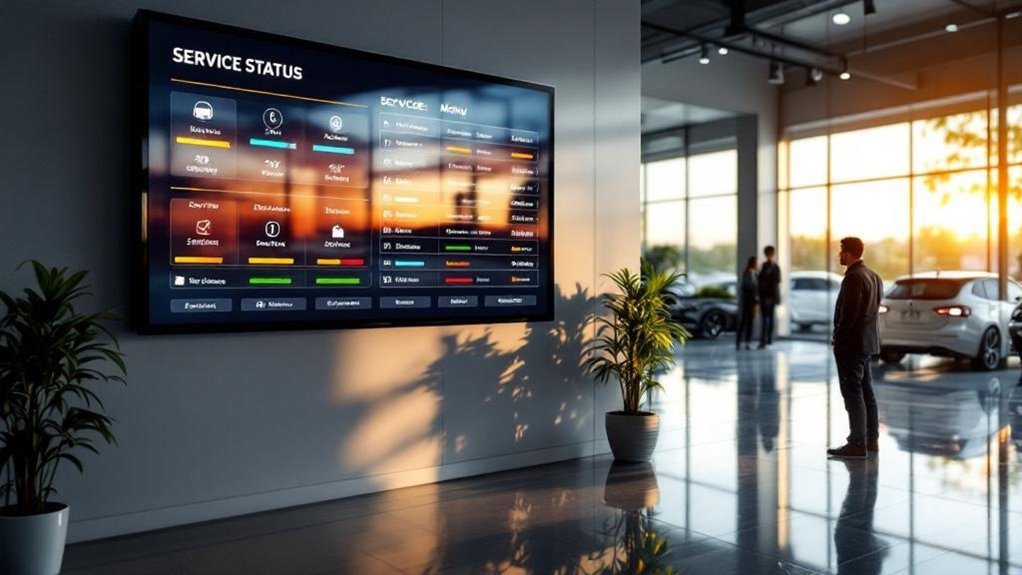
Syncing mobile alerts with lobby displays does more than keep customers informed—it frees your team to focus on high-value work. Automated Service Status Updates cut drive-time calls by giving real-time status to the 55% who prefer app or text, lowering phone traffic from the ~33% who otherwise call. That directly boosts staff productivity and customer satisfaction, reducing administrative load in fixed ops.
- Reduce inbound calls — fewer interruptions for advisors.
- Reallocate labor — more time for diagnostics, upsell, repairs.
- Measure impact — track call volume decline and throughput gains.
- Increase NPS — transparency drives repeat business.
You’ll see clearer resource allocation, faster service cycles, and quantifiable efficiency gains tied to the menu board.
Designing Clear, Customer-Friendly Status Messages
Because clear status messages cut customer uncertainty and phone traffic, your menu board should use concise, jargon‑free copy, real‑time updates, and visual cues so anyone can see if a vehicle is in inspection, being serviced, or ready for pickup at a glance. You’ll prioritize status clarity by using short, plain phrases, color-coded indicators, and predictable placement so customers don’t hunt for meaning. Personalize lines with name and vehicle details to boost customer engagement and perceived care. Automate updates from your shop management system to keep accuracy high and reduce staff interruptions. Design for scannability: large type, consistent verbs, and minimal text. That disciplined, brand-aligned approach lowers confusion, supports faster throughput, and reinforces a professional customer experience.
Measuring Impact: Metrics and Customer Feedback
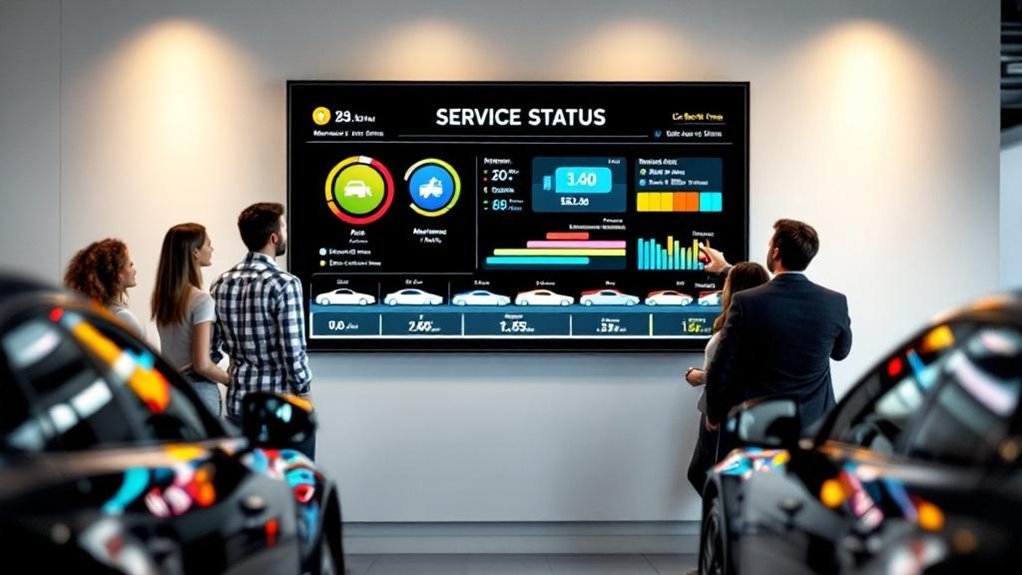
You’ll track wait-time and throughput to prove how the menu board trims service cycle time and boosts capacity. Measure engagement and conversion—clicks, update opt‑ins, and upsell acceptance—to link digital touchpoints with revenue. Use customer feedback and satisfaction lift as the brand signal that the system is improving perceived control and trust.
Wait-Time and Throughput
When dealerships track wait-time and throughput with clear metrics, they can quantify the impact of digital service status menu boards on both operational efficiency and customer experience. You’ll use wait time strategies and throughput optimization to turn a 56-minute average appointment wait into measurable gains: perceived wait drops >35%, fewer drive-time questions, and higher satisfaction. Real-time menu updates shift inquiries from advisors to screens, freeing staff and increasing job throughput.
- Measure baseline wait and target a 35% perceived reduction.
- Track status-update frequency and correlation to question volume.
- Monitor repeat visits and loyalty lifts from transparency.
- Survey the 55% who prefer digital updates for continuous improvement.
These metrics make ROI and brand impact clear.
Engagement and Conversion
While digital service status menu boards improve transparency across the service lane, you’ll need hard metrics to prove they boost engagement and convert that attention into better outcomes: track app/text opt-ins and update-click rates to see who’s checking status, measure the drop in drive-time and phone inquiries to quantify staff time reclaimed, and correlate those behaviors with post-visit satisfaction and repeat-visit rates to calculate true conversion and ROI. You’ll prioritize customer preferences—55% favor app or text—so optimize channels accordingly. Monitor digital engagement rates to understand frequency and timing of checks, then A/B test messaging and timing to lift opt-ins. Tie reduced inquiry volume to advisor productivity gains and improved satisfaction scores to demonstrate brand value and justify expansion of the system.
Overcoming Implementation Challenges and Budget Concerns
Although budget pressures can make a full-scale rollout feel out of reach, you can reduce risk and demonstrate ROI by phasing the digital service status menu board—starting with reliable, scalable hardware and vendor-managed software, tracking engagement and service throughput metrics, then expanding as performance and funding justify it. You’ll use implementation strategies that prioritize vendor partnerships to lower technical overhead and optimize budget allocation. Measure engagement, dwell time, and service-cycle improvements to justify next phases. Tactics include:
- Pilot one service lane with vendor-managed software and standard display hardware.
- Track KPIs: customer engagement rate, average wait perception, service throughput.
- Iterate content and UX based on feedback and measured lift.
- Scale hardware and licensing as KPIs prove ROI and free up capital.
Future Enhancements: Personalization and AI-Driven Updates
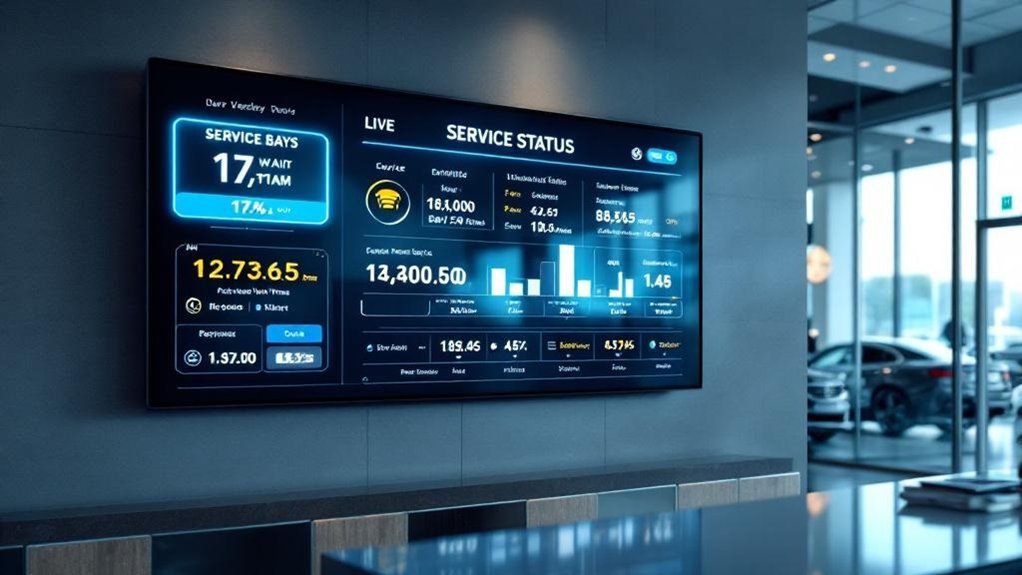
After proving ROI with a phased rollout, you can layer in personalization and AI-driven updates to turn the service status board from a static information source into a proactive customer engagement engine. You’ll deploy machine learning to analyze visit history and behavior, enabling personalized notifications that surface real-time status, dynamic ETAs, and predicted service needs. Metrics show personalized messaging can boost satisfaction ~30% and cut drive-time inquiries up to 40%, freeing staff for higher-value work. Design the experience around brand tone and KPIs: response rates, inquiry reduction, and average handle time. Iterate with A/B tests and retention cohorts, pushing automated maintenance reminders and upsell recommendations only when model confidence and customer preference align, preserving trust while improving operational efficiency.
Frequently Asked Questions
How Do Service Customers Increasingly Prefer to Communicate With Dealerships?
You’re increasingly preferring text messaging and online scheduling over calls; 55% favor digital updates, reducing call volume by one-third, letting dealerships deliver real-time ASU, boost efficiency, and drive loyalty with measurable service improvements.
Why Is It Essential to Focus on Local SEO in Digital Marketing for Car Dealerships?
You need local SEO because better local rankings boost search visibility, turning nearby queries into showroom visits; you’ll measure higher foot traffic, improved conversion rates, stronger brand trust from reviews, and clearer ROI on marketing spend.
How to Increase Traffic to Your Car Dealership?
You’ll increase traffic by deploying targeted digital marketing, optimizing local SEO, tracking conversion metrics, and boosting customer engagement with personalized signage, promotions, and interactive kiosks—measuring ROI regularly to refine campaigns and grow your dealership’s brand.
Which Step of the Sales Process Helps the Customer to Enhance Their Trust in the Car?
Metaphorically speaking, the delivery step boosts trust: you’ll use customer education and transparency building to show metrics, explain features, and validate value, so buyers feel confident, reducing objections and increasing loyalty and measurable conversions.
Conclusion
You’ll see immediate payoff when you use a real-time service status menu board: it turns uncertainty into clarity, cutting drive‑time calls and freeing staff for higher‑value work. Like a lighthouse guiding traffic, it reduces perceived waits, boosts satisfaction metrics, and strengthens your brand promise. Track resolution times, call volume, and NPS to prove ROI, iterate on clear status language, and scale mobile + in‑store displays to keep customers informed and operations lean.