

You need a DMS‑connected digital service status board because it gives real‑time visibility into tech assignments, timestamps, parts and labor so you can cut inbound status calls by about a third and speed throughput. Automated texts and app updates reduce anxiety, free advisors for exceptions, and lift CSI and repeat business. Integration trims manual entry and surfaces bottlenecks for continuous improvement. Keep going and you’ll see practical steps to implement, measure ROI, and maximize impact.
Key Takeaways
- Real-time status updates reduce customer anxiety and increase CSI by keeping owners informed throughout service.
- Automated notifications cut incoming status calls by about one-third, freeing staff for higher-value tasks.
- DMS integration provides accurate timestamps, labor tracking, and parts visibility for streamlined operations.
- Live job visibility optimizes technician assignments, shortens turnaround times, and uncovers workflow bottlenecks.
- Measurable KPIs (CSI, inquiry volume, throughput) enable clear ROI tracking and continuous process improvement.
Key Takeaways and Business Impact

Because transparency drives satisfaction, implementing a digital service status board gives your dealership measurable benefits: real-time updates cut customer anxiety and lift CSI scores, automated notifications eliminate roughly one-third of incoming status calls, and fewer missed calls/voicemails streamline operations. You’ll see direct business impact: improved customer engagement increases loyalty and repeat business, while service innovation reduces routine workload so advisors focus on revenue-generating tasks. Operational metrics improve — lower call volume, fewer escalations, and faster throughput — and employee morale rises as staff handle higher-value work. These changes translate into measurable KPIs: higher CSI, reduced call-handling time, and increased retention. Deploying this tool gives you a predictable ROI through efficiency gains and stronger customer relationships.
What a DMS-Connected Service Status Board Does
When your dealership connects its service status board to the DMS, you get live, actionable visibility into every job — technician assignments, current task stage, ETA and repair notes — so staff and customers can see the same authoritative status in real time. You’ll use data integration to feed the board with timestamps, labor hours, parts status and CSI-related metrics, enabling precise tracking and accountability. That real-time feed drives service optimization: you can reassign technicians, shorten wait times, and prioritize bottlenecked jobs based on measured impact. Universal accessibility keeps teams aligned off-site or shop-floor, and detailed metrics reveal trends for continuous improvement. The result is measurable efficiency gains, clearer workflows and higher operational performance tied directly to customer outcomes.
Real-Time Service Visibility and Customer Communication

You’ll get instant visibility into service progress and who’s assigned to each job, so you can spot bottlenecks and reallocate resources immediately. With 55% of customers preferring app or text updates, transparent technician assignments and ETA feeds cut inbound calls and reduce anxiety. That real-time clarity boosts CSI and lets your staff focus on repairs instead of status questions.
Instant Service Progress
If you want customers to stop calling for updates, give them real-time visibility into service progress via digital status boards that show technician assignments, current task stage, and estimated completion times. You’ll cut incoming calls—research shows about one-third of customers call for updates—and free staff to work on repairs instead of answering status questions. Use digital notifications and service tracking to push concise, automated updates that reduce anxiety and boost perceived value. The result: higher satisfaction, fewer delays, and measurable efficiency gains.
- Customers get instant ETA changes and task-stage updates.
- Automated alerts reduce manual outreach by staff.
- Clear progress lowers customer anxiety and builds trust.
- Service tracking data identifies bottlenecks for process improvement.
Transparent Technician Assignments
Because transparency builds trust, showing customers which technician is assigned to their vehicle gives them concrete reassurance and cuts status calls, while also increasing accountability on the shop floor. You’ll use a digital service status board to display real-time technician assignments, enabling transparent communication that reduces customer anxiety and elevates satisfaction. Data-driven updates let you manage expectations about duration and completion times, lowering inbound status inquiries by a measurable margin. Internally, visible assignments improve technician accountability and balance workloads, so staff coordinate better and focus on repairs instead of chasing information. The result: fewer interruptions, faster throughput, and clearer customer touchpoints. Implementing this visibility turns routine updates into a proactive communication strategy that delivers operational and customer-service ROI.
How Service Status Boards Improve Workflow Efficiency
You’ll get real-time task visibility that shows queued, in-progress, and completed jobs so you can cut idle time and reallocate labor where it’s needed most. With streamlined technician assignments tied to skill sets and bay availability, you can reduce turnaround by measurable minutes per job. Those two capabilities together lower customer wait inquiries and boost throughput, improving productivity and customer satisfaction.
Real-time Task Visibility
When service status boards give you real-time visibility into work-in-progress, technician assignments, and estimated completion times, your team stays coordinated and decision-making speeds up; automated updates cut customer calls, universal access means managers and technicians can monitor jobs from the shop floor or offsite, and integrated metrics highlight bottlenecks so you can eliminate recurring delays. You get clear task prioritization through visibility features that surface critical jobs and predicted finish times, so resources match demand. Automated feeds reduce admin overhead and let techs focus on repairs, improving throughput.
- Fewer customer calls thanks to automated status updates
- Remote access for managers to reassign or approve work
- Metrics that pinpoint recurring delays and cycle times
- Integration with DMS to cut duplicate data entry
Streamlined Technician Assignments
Although shop floors are busy and priorities shift constantly, a digital service status board gives you real-time visibility into who’s working on what so you can assign tasks based on current workload and skill set rather than guesswork. You’ll optimize task allocation by matching jobs to technicians with the right skills and availability, which increases technician productivity and cuts idle time. Instant progress updates let technicians reprioritize on the fly, reducing bottlenecks and accelerating throughput. Universal access keeps service advisors, managers, and remote staff aligned, minimizing miscommunication and ensuring customer promises are met. The result is measurable: fewer delays, higher CSI scores, and a tighter, data-driven workflow where staffing decisions are based on live performance metrics, not hunches.
Reducing Customer Anxiety With Automated Service Updates

Because uncertainty is one of the biggest stressors for service customers, automated service updates (ASU) cut anxiety by giving real-time progress tracking and precise completion estimates so you don’t have to guess when your vehicle will be ready. You get customer reassurance through continuous mobile alerts that replace the need to call — roughly one-third of customers otherwise reach out for updates. That anxiety reduction frees advisors to handle high-value tasks, improving throughput and morale. Data shows transparent, timely communication raises CSI and repeat business. Practical benefits include:
Automated service updates ease customer anxiety with real-time progress, precise ETAs, and continuous mobile alerts for reassurance.
- Immediate status visibility on your device for peace of mind
- Precise ETA updates that reduce unnecessary calls
- Fewer interruptions for advisors, improving efficiency
- Clear audit trail for accountability and trust
Boosting CSI and Customer Loyalty Through Transparency
Reducing anxiety with automated updates naturally leads to higher satisfaction, but the measurable lift in CSI comes from consistent transparency at every touchpoint. When you give customers real-time visibility into repairs, you build customer trust and cut incoming calls—data shows fewer inquiries and higher CSI where status boards are used. That frees advisors to handle exceptions, improving throughput and morale. Consistent service transparency also boosts repeat visits and referrals: customers who can self-serve updates are more likely to return and recommend you, directly impacting loyalty and retention metrics. Track CSI, repeat-rate, and average inbound calls before and after deployment to quantify ROI. Prioritize clear status labels, reliable timing estimates, and proactive alerts to turn transparency into tangible loyalty gains.
Implementing and Integrating With Your DMS
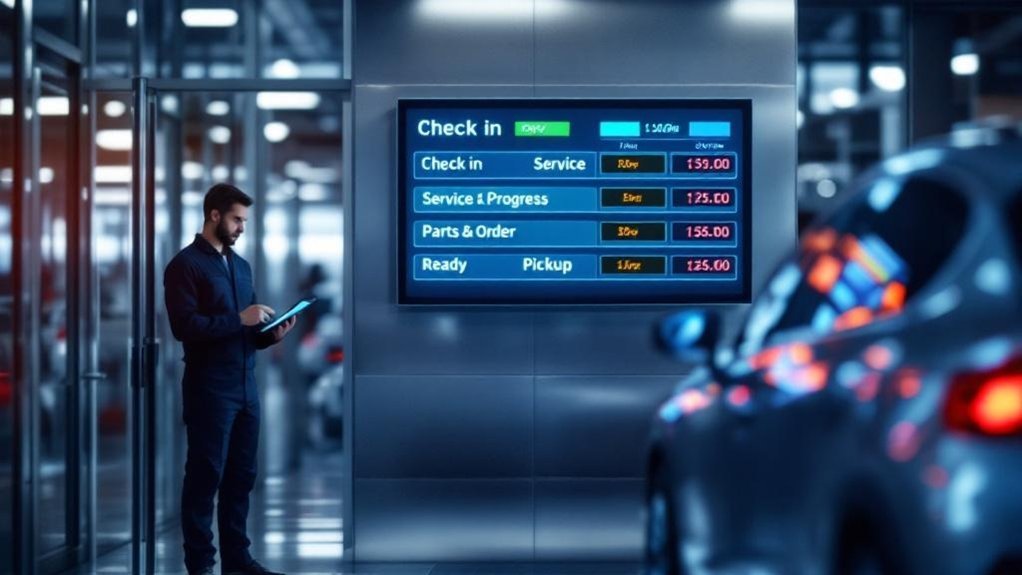
When you integrate a digital service status board with your DMS, you get real-time synchronization of RO status, technician assignments, and estimated completion times—so updates on a customer’s mobile device and the shop floor stay consistent and automatic. You’ll reduce manual entry, lower admin load, and improve CSI through transparent, timestamped updates. Focus on board selection that supports your DMS API, data schema, and workflow automation. Anticipate integration challenges like mapping fields, authentication, and latency, then validate with pilot data.
- Verify DMS compatibility and available APIs before purchase
- Map RO, technician, and ETA fields to prevent sync errors
- Test performance under peak load to spot latency issues
- Train staff on exceptions and manual override procedures
This approach yields measurable operational gains.
Measuring ROI and Continuous Improvement
If you want to prove value and drive steady gains, start by tying the digital service status board to a handful of measurable KPIs—CSI, inquiry volume, admin hours, throughput, and average repair lead time—and track them before and after rollout. Use baseline Performance metrics to run regular ROI analysis: quantify CSI improvements, reduction in inbound status inquiries, and hours reclaimed from administrative tasks. Translate throughput gains and shorter lead times into revenue uplift and labor-cost savings to calculate payback period. Monitor real-time dashboard alerts to spot bottlenecks, run targeted experiments, and iterate workflows. Report concise, month-over-month results to stakeholders, prioritize fixes with highest impact per dollar, and institutionalize continuous improvement cycles so gains compound and ROI keeps improving.
Frequently Asked Questions
Do All New Cars Have a Digital Dash?
No — you won’t get a digital dash in every new car; adoption varies by make and model. Consider digital dashboard features and benefits of digital dashes: personalization, real-time updates, app integration, and increasing prevalence (about 50% in 2023).
Why Does Every Car Dealership Have a Flag?
Symbolically, a flag signals trust and presence; you’re using flag significance to boost dealership branding, attract attention, promote events, and reinforce professionalism, so you’ll see measurable increases in visibility, foot traffic, and brand recall.
Can I Take off a Tracking Device Put on by a Dealership?
You can’t unilaterally do tracking device removal without checking dealership policies; violating terms risks warranty, legal, insurance and security issues. Contact the dealer, document approvals, and measure outcomes to avoid penalties and maintain coverage.
What Is the Four Square Trick at a Car Dealership?
Curious how deals get simplified? The four square is a one-sheet tool you’ll see in dealership negotiation showing vehicle price, trade-in, down payment, and monthly payment, letting you test adjustments quickly to speed closes and boost results.
Conclusion
You’ll find a DMS-connected service status board quietly transforms operations: it nudges technicians to stay on schedule, trims idle time, and feeds customers timely updates so anxiety eases and satisfaction rises. Measurable gains—shorter turn times, higher CSI scores, and repeat business—follow predictable patterns when you pair transparency with workflow discipline. Implementing one is a modest investment that delivers tangible, trackable returns, making your service lane noticeably more efficient and pleasantly less chaotic.