

You’ll boost CSI by using service-drive digital signs to give customers real-time status, transparent quotes and inspection visuals that cut uncertainty and perceived wait times. Dynamic content engages people in the queue, increases repair approvals by clarifying needs, and drives targeted aftercare offers. Integrated signs tied to your DMS keep updates accurate and trigger timely promotions, improving approval and retention metrics. Keep going and you’ll see actionable KPIs, ROI methods and deployment best practices next.
Key Takeaways
- Real-time service status updates reduce uncertainty and perceived wait times, directly improving customer satisfaction scores.
- Transparent inspection visuals and clear quotes increase trust and raise repair approval rates.
- Personalized, timely promotions and service recommendations enhance engagement and perceived service value.
- Integration with DMS ensures accurate, up-to-date messaging that aligns expectations and operational efficiency.
- On-screen surveys and analytics capture feedback, enabling targeted improvements that boost CSI over time.
How Digital Signs Boost Communication and Transparency

When you display real-time service status, wait times, and clear pricing on digital signs, you cut perceived wait times and boost customer satisfaction—studies show real-time visual updates and multi-point inspection photos/videos can raise satisfaction scores by about 31 points. You’ll use digital signage to present transparent quotes, inspection visuals, and targeted service promotions that increase repair approvals and trust. With 53% of customers preferring text updates, signs act as a visual complement that reinforces messages and captures attention in the service lane. You’ll collect customer feedback more effectively by prompting quick surveys on-screen and linking results to operational adjustments. Strategically, this data-driven approach reduces friction, improves communication, and drives measurable gains in satisfaction and conversion.
Reducing Perceived Wait Times With Engaging Content
Although customers expect to wait for service, strategically designed digital signs can cut perceived wait times by keeping them informed and engaged with real-time updates, vehicle feature highlights, and targeted promotions. You’ll see measurable benefits: studies link engaging digital content to higher customer engagement and improved CSI scores. By using visual storytelling to display service progress, safety tips, and tailored offers, you reduce anxiety and make waits feel shorter. Clear, dynamic displays communicate status quickly, so customers trust the process and report better experiences. Strategically timed promotions and feature demos also increase retention and aftercare uptake. Implementing data-driven content rotations and A/B testing guarantees the displays stay relevant, maximizing impact on satisfaction without disrupting operations.
Integrating Digital Signage With DMS and Service Workflows
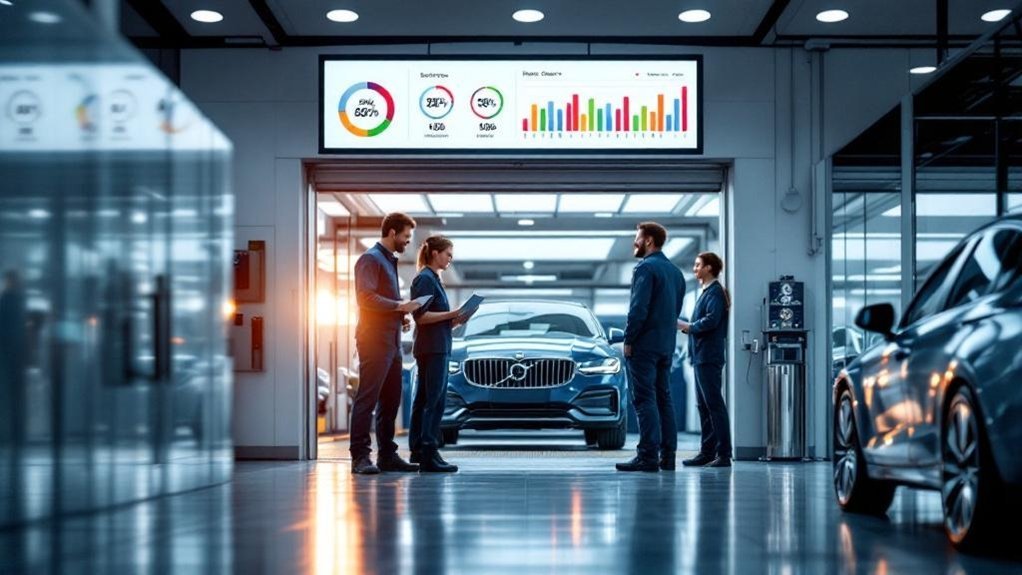
You’ve seen how engaging content cuts perceived wait times; now tie those displays directly into your Dealer Management System and service workflows to make updates immediate, accurate, and actionable. When your DMS feeds real-time service updates to digital signs, customers see precise vehicle status, upcoming steps, and estimated completion times — reducing uncertainty and boosting customer engagement. Data shows visual service recommendations increase repair approvals by clarifying needs, so map DMS codes to clear on-screen explanations. Embed workflow triggers so promotions or upsell opportunities appear only at appropriate stages, preserving trust while driving revenue. Strategically, integrate two-way acknowledgements (technician notes → sign) to keep messaging accurate. This approach aligns operational efficiency with transparency, improving perceptions and strengthening relationships through timely, relevant communication.
Measuring Impact: KPIS, CSI, and ROI From Digital Displays
Metrics matter: to prove digital displays move the needle you’ll want a focused set of KPIs — CSI lift, perceived wait-time reduction, repair approval rate, upsell conversion, and retention — tracked against baseline performance and tied to specific content and workflow integrations. You’ll measure CSI changes (expect ~5-point gains), track perceived wait-time via surveys and dwell analytics, and compare repair approval rates when visual DI reports are shown. Tie sales and retention lifts to campaign periods to calculate ROI, attributing revenue from upsells and repeat service. Use customer feedback loops to validate content strategy and iterate messaging that reduces uncertainty and increases approvals. Report outcomes as delta versus baseline, ROI months-to-payback, and ongoing KPI trends for strategic decisions.
Best Practices for Deploying Service Drive Digital Signage

Start with a clear plan: map high-traffic sightlines in the service drive, decide screen sizes and mounting heights that match typical viewing distances, and set objectives tied to measurable outcomes (perceived wait-time reduction, repair approval lift, CSI). You’ll prioritize screen placement where customers queue or park to maximize visibility. Use content personalization to show relevant promotions, real-time status updates, and vehicle-specific recommendations — this reduces perceived wait times and increases approval rates. Keep visuals dynamic, concise, and updated frequently; measure engagement and tie changes to CSI and ROI. Integrate quick feedback prompts so you can iterate content based on actual customer responses. Finally, document KPIs and run controlled tests to validate improvements before full rollout.
Frequently Asked Questions
What Is the Customer Satisfaction Index in the Automobile Industry?
The customer satisfaction index in the automobile industry scores owner satisfaction on a 1,000-point scale (e.g., 851 in 2024), measuring service quality, communication, wait times and facility experience to guide strategic improvements.
What Is the Four Square Trick at a Car Dealership?
Studies show clear pricing boosts trust by 30%. The Four Square’s a chart you’ll use to compare price, trade, down and monthly payment, improving Customer Experience by making financing transparent, data-driven, and customer-centric during negotiations.
Why Is It Essential to Focus on Local SEO in Digital Marketing for Car Dealerships?
You should prioritize local SEO in digital marketing because it drives nearby traffic, boosts conversions—78% of mobile local searches convert—improves trust via reviews, increases website visits up to 70%, and strategically raises dealership visibility and footfall.
What Is CSI in a Dealership?
CSI’s a 1–1,000 score; think 851 average — it measures dealer service performance. You’ll use customer feedback and service experience metrics to drive data-driven, customer-centric strategies that boost loyalty and operational effectiveness.
Conclusion
You probably think a flashy sign won’t move your CSI needle — and you’d be right if it only flashed. But when digital displays deliver real-time status, wait estimates and tailored offers tied to your DMS, customers feel informed and respected, and your metrics prove it: shorter perceived waits, higher service upsell rates and measurable CSI gains. Ironically, investing in clear, data-driven communication does the human work you hoped technology would replace.