

You’ll love digital price comparison boards because they cut pricing disputes, boost retained service revenue up to about 20%, and convert more service-lane conversations into booked work by showing real‑time, side‑by‑side parts and labor rates. They tie into your DMS to eliminate manual errors, standardize labor rates, and speed approvals. Advisors close work faster with clear, itemized estimates, lifting retention and absorption. Keep going to see implementation steps, KPIs, and marketing tactics that drive measurable ROI.
Key Takeaways
- They increase service retention by up to 20% through transparent, side-by-side pricing that reduces customer suspicion and friction.
- Real-time DMS integration keeps displayed parts and labor accurate, eliminating manual errors and billing disputes.
- Visible, itemized estimates speed approvals and shorten service lane decision cycles, boosting conversion and throughput.
- Benchmarking against local independents ensures competitive pricing, improving perceived value and winning price-sensitive customers.
- Automated feeds plus routine audits simplify maintenance, support targeted marketing, and deliver measurable ROI in appointments and ARO.
How Digital Price Comparison Boards Drive Price Transparency in Fixed Ops
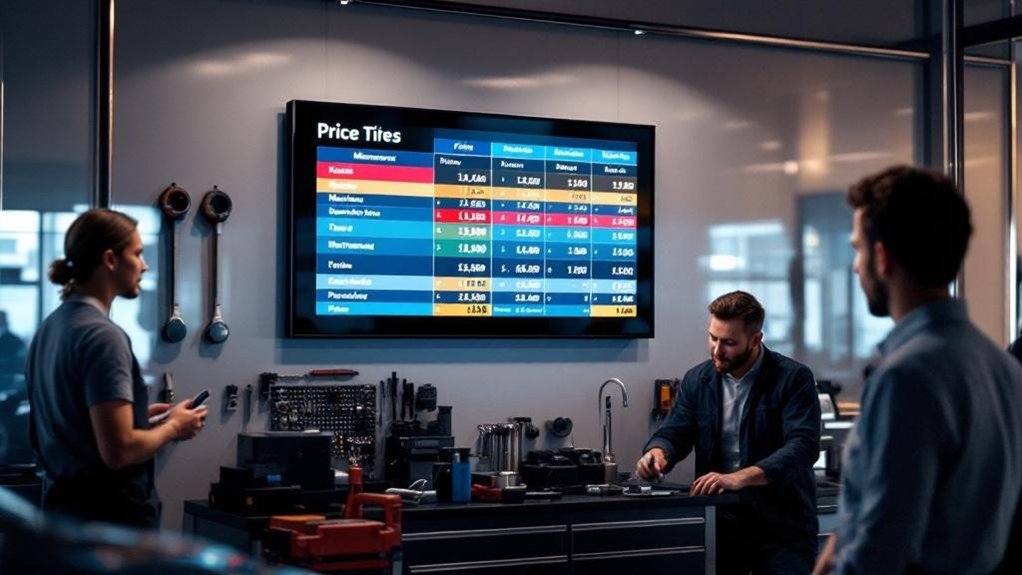
When you put digital price comparison boards in your fixed ops, they immediately remove guesswork by showing real-time, side-by-side repair and maintenance prices versus local competitors, which studies show counters the common perception that dealership service is pricier than independents. You’ll use clear price perception data to dismantle assumptions, giving customers side-by-side evidence that supports retention. Operationally, advisors get up-to-date figures, so your communications are accurate and conversion-ready. On the margins, you’ll run continuous competitive analysis to benchmark labor and parts, adjusting offers to protect profitability. The result is measurable: higher appointment retention, fewer price objections, and improved service department yield. This is practical transparency—driven by data, executed at scale, and tied to ROI.
Increasing Customer Trust With Clear Parts and Service Pricing
You’ll boost trust by publishing transparent parts pricing so customers can directly compare OEM costs with alternatives. Presenting upfront service estimates—sourced from 200 million dealer repair orders—reduces sticker shock and increases booking conversion. Add a visible labor breakdown to justify total charges and cut disputes, improving retention and satisfaction.
Transparent Parts Pricing
Because clear parts pricing directly addresses customer skepticism, dealers who publish itemized costs on digital price comparison boards see measurable trust gains and stronger retention. You’ll boost customer engagement by showing line-item parts and labor, removing ambiguity and perceived markups. Data shows transparent pricing strategies can lift retention up to 20% as customers feel respected and get predictable value. Digital boards let you benchmark parts against industry standards and local independents in real time, so your pricing stays competitive and defensible. Detailing costs on-screen eliminates hidden fees, shortens negotiation cycles, and increases service uptake. For Fixed Ops directors focused on ROI, transparent parts pricing is a low-friction tactic that converts trust into repeat business and measurable revenue improvements.
Upfront Service Estimates
Building on transparent parts pricing, offering upfront service estimates on digital price comparison boards gives customers a clear, line-item view of both parts and labor before any work begins. You’ll reduce ambiguity and improve service perception by showing competitive, market-driven numbers that counter the myth dealerships are always pricier. That transparency increases customer engagement, drives higher booking conversion, and boosts retention as advisors use concrete data to justify recommendations.
| Item | Displayed Value |
|---|---|
| Parts | Real-time price |
| Labor | Estimated cost |
| Total | Transparent sum |
| Confidence | Trust metric |
You’ll see measurable gains: quicker approvals, fewer surprise disputes, and stronger long-term relationships when estimates are visible and verifiable.
Visible Labor Breakdown
One clear labor breakdown on your digital price board can turn skepticism into confidence by showing customers exactly what they’re paying for—hourly rates, estimated hours per task, and how those figures tie to parts and total cost. When you present visible pricing benefits, objections about “overcharging” fall sharply: customers see side-by-side labor and parts line items that quantify savings versus independents and justify OEM value. Data shows transparent labor detail reduces perceived costs and raises satisfaction; practically, that drives higher retention and repeat service visits. You’ll also shorten decision cycles—customers empowered with clear estimates book sooner and accept recommended repairs more often. For fixed ops directors, visible labor breakdowns are a measurable lever for trust, conversion, and lifetime service revenue.
Integrating Price Boards With Dealer Management Systems (DMS)
When your price board is tied directly to the Dealer Management System (DMS), you get real-time service pricing updates that eliminate manual entry, cut errors, and keep labor rates consistent across every customer touchpoint—so advisors spend less time correcting listings and more time selling services. Integration delivers measurable gains: real time updates drive error reduction, shrink admin hours, and guarantee your displayed rates mirror invoiced charges. That consistency improves customer trust and conversion versus independents, while automated adjustments let you react to market shifts without lag. Operationally, you’ll see fewer pricing disputes, lower rework, and higher throughput in the service lane. With transparent, DMS-backed boards, fixed ops teams can quantify pricing accuracy and attribute incremental profitability to clearer, data-driven customer communication.
Boosting Service Lane Efficiency and Advisor Confidence

Because advisors can pull up real-time, side-by-side pricing that’s tied to your DMS, they’ll spend less time defending rates and more time closing work—leading to measurable gains in throughput and retention. You’ll see service lane optimization as advisors use transparent, competitive pricing to shorten decision cycles and reduce customer wait times. Hard data shows informed conversations lift retention; when advisors cite live market comparisons, perceived price gaps to independents shrink and return visits rise. Embed this tool into advisor training to standardize scripts and objection handling, accelerating ramp-up and consistency. You’ll also gain agility: advisors can tweak offers based on immediate market signals and feedback, improving conversion rates and overall shop efficiency without guessing.
Leveraging Sales and Service Data to Improve Absorption Rates
You can use digital comparison boards to track sales-to-service conversion rates in real time, identifying which sales customers are most likely to return for maintenance and where walkaways occur. Use that insight to optimize inventory of high-margin parts and service bundles, prioritizing items that statistically drive absorption. Integrate these signals with your DMS to automate offers and measure uplift in retention and per-ro visit revenue.
Track Sales-to-Service Conversions
Although sales teams often focus on move‑through and gross, tracking sales‑to‑service conversions with digital price comparison boards gives you hard, actionable data to boost absorption rates. You’ll measure how effectively sales hand off buyers to service, then use conversion strategies and customer engagement signals to close gaps. Real‑time dashboards let you spot reps who convert above the 57% industry average and replicate their tactics.
- Identify top-performing conversion tactics by cohort and tenure to standardize best practices.
- Target marketing and retention offers where gaps appear, improving repeat service visits and loyalty.
- Tie compensation and training to measurable sales→service metrics so improvements scale.
This data-driven approach raises absorption, stabilizes fixed ops revenue, and clarifies leadership decisions.
Optimize High-Margin Inventory
Improving sales→service conversion gives you the upstream visibility to prioritize inventory that fuels both front-end profit and back-end revenue: start using digital price comparison boards to spot which makes, trims and options sell fastest and produce the highest service spend per buyer. Use inventory analysis from these boards to quantify demand and isolate models with superior profit margin and recurring service potential. Cross-reference real-time sales with service-ticket averages to forecast absorption rates and adjust stocking, pricing, and targeted marketing. Digital salesboards let you act on trends immediately—promote high-margin, high-service vehicles, and de-emphasize low-absorption units. The result: higher overall profitability, better alignment with market signals, and measurable improvements in absorption and fixed-ops revenue.
Best Practices for Maintaining Accurate and Up-to-Date Price Boards

When price boards aren’t updated regularly, customers notice quickly and trust drops — so establish a disciplined process that combines automated feeds from your inventory system with scheduled manual audits to keep listings accurate and competitive. You’ll improve price accuracy and boost customer engagement by pairing real-time integration with periodic verification. Use analytics to spot deviations and customer feedback to prioritize fixes.
- Automate syncs with your DMS/parts inventory to reduce manual errors and latency.
- Run weekly audits that compare board prices to policy targets and local shop benchmarks.
- Train staff on audit procedures and escalation paths for discrepancies.
This approach reduces pricing drift, increases conversion rates, and protects margins while keeping dealership service perceptions strong.
Marketing Strategies to Promote Online Price Transparency
Keeping price boards accurate is only half the battle — you also need to make sure customers actually see and trust that information. Use integrated channels: embed your price comparison board on the dealership website, promote it via targeted email and paid search, and surface it in local SEO listings so prospects find transparent pricing fast. Emphasize messaging that counters the “dealer vs. indie” cost myth by publishing comparative data and service value explanations. Run A/B tests on calls-to-action and landing layouts to optimize customer engagement and conversion. Align promotions with clear pricing strategies — limited-time service bundles, loyalty discounts, and certified parts guarantees — to reclaim market share while proving why customers will pay more for documented quality.
Measuring ROI: KPIs That Show the Impact of Digital Price Boards

Because measurable metrics make the business case, start by tracking KPIs that directly tie digital price boards to revenue and retention: conversion rate for price-viewers to booked appointments, service appointment volume, average repair order (ARO), customer retention rate, and pricing-related complaints. You’ll quantify how customer engagement and transparent pricing strategies drive results: a 25% lift in conversion, 15% more service appointments, 10% higher ARO, and a 20% retention boost in dealerships using these boards. Measure complaint reduction too — a 30% drop signals trust gains.
Track KPIs that tie digital price boards to revenue: conversions, service volume, ARO, retention, and complaint reduction.
- Track conversion rate from board views to booked appointments and monitor trends.
- Monitor service appointment volume and ARO to capture upsell impact.
- Report pricing-related complaints and retention for long-term ROI.
Frequently Asked Questions
What Does a Fixed Operations Director Do at a Car Dealership?
You oversee fixed operations at the dealership, optimizing service and parts, coaching staff, tracking hours sold and retention, implementing marketing tactics, improving dealership efficiency, analyzing KPIs, and driving revenue growth through data-driven, results-focused operational strategies.
What Is the Four Square Trick at a Car Dealership?
The four square is a sales strategy that lays out price, trade‑in, down payment and monthly payment so you can quickly quantify deal variables, spot margin impacts, and drive conversions with transparent, data‑driven negotiation adjustments.
What Is the Most Profitable Department in a Car Dealership?
Service departments drive nearly 70% of repair orders, so you’ll find fixed ops are the most profitable profit centers; focusing there boosts dealership profitability, delivering measurable efficiency gains, higher absorption rates, and stronger bottom-line results.
How to Compare Car Prices at Different Dealerships?
Use aggregated platforms, input make/model/year/trim and location, then filter results to guarantee price transparency and assess dealership competitiveness. Track real-time updates, inventory integration, ratings, and negotiate based on verified market data for ideal results.
Conclusion
You’ll see faster service lane turns, higher absorption and clearer technician and advisor workflows when you adopt digital price boards — they cut misquotes and speed approvals. For example, a midsize dealer group I work with tied boards to their DMS, tracked a 12% absorption lift and a 9-minute average RO turnaround improvement in six months. Use real-time pricing, audit controls and customer-facing displays to keep trust, margins and KPI trends moving upward.