

You get higher trust and faster decisions when you give service customers real‑time, visual price comparisons that highlight value beyond the sticker. With up‑to‑the‑minute feeds and mobile integration, shoppers compare options instantly and favor transparent sellers. Visual TCO breakdowns, verified ratings and UGC reduce perceived risk and boost conversion. Analytics let you test and optimize offers for repeat business. Keep going and you’ll see how concrete tactics and metrics drive those gains.
Key Takeaways
- Real-time comparisons build trust by showing up-to-the-minute prices and preventing surprise costs.
- Mobile-integrated boards reduce friction, letting customers compare and buy in seconds from their phones.
- Visual charts and badges clarify value differences, shifting focus from price to verified features and benefits.
- TCO-focused displays educate buyers on long-term savings, making higher upfront prices easier to justify.
- Interaction analytics enable continuous optimization, tailoring comparisons and offers to boost conversion and retention.
How Real-Time Transparency Builds Consumer Confidence

Trust grows from transparency, and real-time price comparison boards give shoppers the instant clarity they want. You’ll leverage clear, consistent pricing to influence consumer behavior: 31% of shoppers rank price comparisons as the top shopping priority, and 63% run quick searches for better deals. With 92% using mobile apps to check prices, providing immediate, accurate data aligns with pricing psychology that rewards certainty and reduces purchase friction. When you show up-to-the-minute prices, customers feel informed and confident, which increases satisfaction and loyalty. Strategically, real-time tools let you react to market shifts and tailor offers based on measurable behavior, turning transparency into a competitive advantage that drives repeat business and higher conversion rates.
Mobile Convenience and the Rise of On-the-Go Comparisons
You can perform instant price checks with mobile apps that 92% of shoppers already use, turning split-second decisions into data-backed choices. Seamless app integration and location-aware comparisons mean you’ll see real-time offers and nearby store pricing, helping the 63% who search for better prices on the spot. Prioritizing these mobile capabilities — especially since 31% rank price comparison as most important and 24% hunt for discounts — will boost conversion and customer trust.
Instant Price Checks
Because your phone puts prices in seconds, you’ll rarely buy without comparing: 92% of shoppers use mobile apps to check prices while shopping, and 63% still do quick Google searches for better deals, so instant, on-the-go comparisons have become a practical necessity for value-conscious buyers. You want tools that deliver user experience enhancement and a measurable competitive advantage; instant price checks do both by reducing friction and surfacing third-party savings (78% favor lower-priced sellers). You’ll stick to budgets better—31% rate comparisons as most critical—and trust data-driven snapshots to decide fast. Prioritize clear UI, real-time feeds, and relevance to foster conversion and loyalty. Key operational levers:
- Faster price refresh rates
- Simplified comparison displays
- Contextual deal alerts
Seamless App Integration
While shoppers increasingly expect speed and accuracy, seamless app integration is the linchpin that turns on-the-go price checks into actionable savings—88% of participants use mobile apps for shopping and 92% say apps simplify price comparisons, so you’ll want integrations that deliver real-time feeds, contextual alerts, and a frictionless UX to convert intent into purchases. You’ll prioritize app functionality that surfaces live pricing, promotions, and verified merchant data so decisions happen instantly. Design choices should minimize taps, reduce cognitive load, and align incentives—push offers only when relevant, prefill checkout details, and sync carts across channels. With 92% checking prices via apps in-store and online, a superior user experience directly increases conversion and loyalty by turning convenience into measurable savings and repeat behavior.
Location-Aware Comparisons
Building on seamless app integration, location-aware price comparisons bring real-time, context-sensitive savings directly to shoppers’ phones by leveraging GPS and push alerts—92% of shoppers already use mobile apps to check prices, and 63% run quick searches for better deals while in-store, so being location-aware converts those moments into immediate purchase decisions. You’ll use location advantages to trigger targeted promotions, compare local inventory, and surface timely coupons that nudge on-the-spot buys. This shifts competitive dynamics by turning passive window-shopping into active conversion opportunities and by rewarding retailers who respond faster with better local pricing.
- Triggered offers: push alerts based on proximity and inventory.
- Instant benchmarking: compare nearby competitors’ prices.
- Conversion lift: reduce friction for last-minute decisions.
Visual Tools That Clarify Value Beyond Price
When you pair clear comparison charts, videos, and interactive infographics with concise feature callouts, customers grasp product value faster than with price alone—92% of shoppers already prefer mobile apps for price comparisons, so visual tools that highlight unique benefits, social proof, and tailored interactivity turn attention from sticker shock to informed choice. You’ll leverage value visualization to map benefits against cost, making trade-offs explicit and reducing cognitive load. Feature differentiation becomes obvious when visuals isolate performance, warranty, and service levels side-by-side. Short demo clips build emotional relevance, nudging buyers from price sensitivity toward perceived ROI. Interactive filters let users prioritize what matters to them, increasing conversion rates. Implement these assets strategically and you’ll guide customers to decisions grounded in comparative value, not just the lowest price.
Trust Signals: Reviews, Ratings, and Social Proof

You should prioritize verified ratings display, since 92% of customers favor businesses with ratings above four stars and that clarity boosts conversion at-a-glance. Add third-party endorsement badges to increase search visibility and credibility, attracting customers from farther afield who rely on trusted seals. Tie in real-time social mentions and responsive review management to show engagement, which evidence suggests improves acquisition and lets customers justify paying up to 16% more for positive experiences.
Verified Ratings Display
One clear trust signal you should prioritize is a verified ratings display—star scores, curated testimonials, and recent review counts—because 92% of consumers prefer businesses above four stars and 70% trust online reviews like personal recommendations; showing these metrics prominently not only drives purchase decisions but also boosts search visibility and comparison traffic, since more reviews correlate with higher rankings and 63% of shoppers use quick review checks to compare price and quality. You’ll use verified ratings importance to build customer trust and lift conversion rates: concise, visible stars and recent review snippets reduce friction and speed decisions. Prioritize fresh, moderated feedback and respond publicly to show responsiveness.
- Surface average stars and count prominently.
- Show curated recent testimonials.
- Publish response rates and review recency.
Third-Party Endorsement Badges
Social proof matters: third-party endorsement badges—verified review stars, platform seals, and media logos—give shoppers quick, credible cues that cut through price noise and boost conversions; with 84% of people trusting online reviews like personal recommendations and conversions rising up to 270% when endorsements are prominent, these badges aren’t decorative, they’re strategic assets that increase engagement, reduce price sensitivity, and help your comparison board stand out in crowded search results. You should prioritize visible badges because endorsement effectiveness is measurable: over 90% of consumers read reviews and 72% are likelier to buy when trust signals appear. From a consumer psychology angle, badges trigger heuristic shortcuts, lower perceived risk, and shift focus from cost to value, improving click-through and conversion metrics.
Real-Time Social Mentions
Third-party badges get shoppers’ attention, but real-time social mentions keep them engaged and convert that interest into action. You’ll leverage real time feedback and consumer sentiment to show prospective buyers that your service consistently hits a 4+ star bar — a stat 92% of customers favor. Visible reviews boost search discoverability and let customers benchmark you against competitors, with 5-star cues signaling top quality. When you respond promptly to feedback you signal accountability, improving acquisition and trust.
- Surface recent high-rated reviews to capitalize on social proof.
- Highlight aggregated consumer sentiment metrics (average rating, trend).
- Display and respond to testimonials and UGC in real time to close conversion gaps.
Educating Buyers to Focus on Total Cost of Ownership
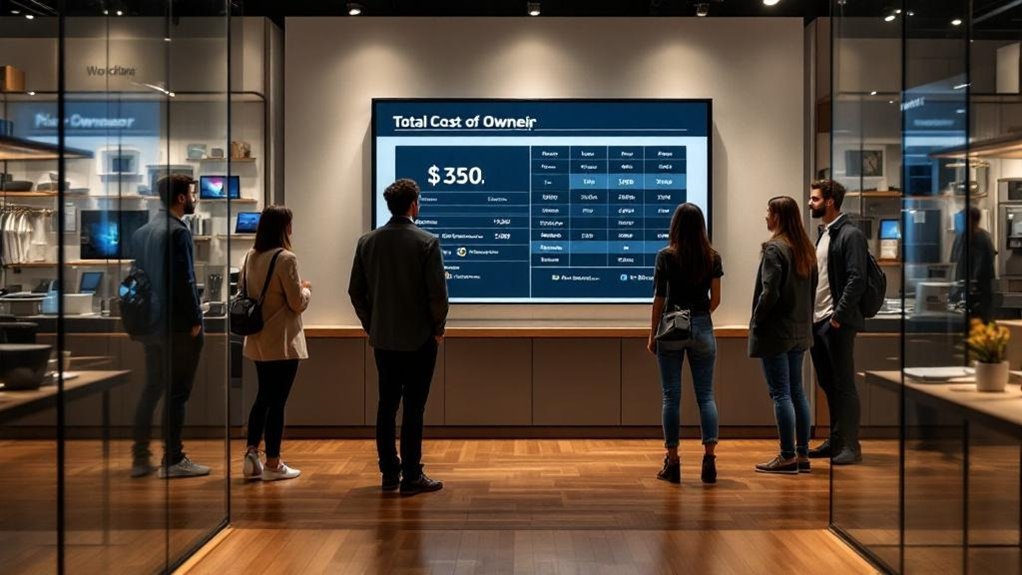
Although a low sticker price can be tempting, educating buyers about total cost of ownership (TCO) makes it clear that up-front savings often mask higher lifetime expenses, and data shows this shifts buying behavior: 64% of consumers say they’d pay more for products that lower long-term costs. You should frame decisions around total cost and ownership benefits, showing maintenance, energy, and resale impacts. Present concise comparisons on your digital price boards so buyers trade short-term savings for proven long-term value.
| Factor | Short-term | Lifetime impact |
|---|---|---|
| Purchase price | Low | May be higher overall |
| Energy & maintenance | Hidden | Cumulative savings |
| Resale value | Variable | Offsets costs |
Clear TCO visuals build trust and encourage better choices.
Measuring Impact: Analytics and Continuous Optimization
When you track how shoppers interact with your digital price comparison boards, you get the hard evidence needed to optimize performance and drive results. You’ll use analytics tracking to capture click paths, time on comparison, and feature toggles, then convert those signals into actionable changes. Data shows 92% of buyers use comparison tools, so sharpening your boards isn’t optional — it’s strategic. Continuous optimization informed by performance metrics can boost engagement 15–20% by refining displayed pricing and features. Implement feedback loops to adjust pricing in real time, improve satisfaction, and lift loyalty. Prioritize metrics that correlate with conversion and retention, run controlled tests, and scale proven tweaks fast.
Track shopper interactions on price boards, convert signals into tests and tweaks, and boost engagement and loyalty.
- Capture interaction data
- Test hypotheses
- Iterate based on metrics
Frequently Asked Questions
Why Do Customers Respond so Positively to Personalized Communication?
You respond positively because personalized messaging makes you feel seen and valued, boosting customer engagement with relevant offers; data shows tailored communication raises conversions, retention, and transaction rates, so you’re likelier to act and stay loyal.
What Is the Best Method for Evaluating Your Customer Service?
Use a mixed-methods approach: combine customer service metrics with feedback analysis, track NPS, SLAs, response times and churn, run benchmarking and mystery shopping, and iterate based on data so you’ll continuously improve service performance.
When Someone Wants to Take Advantage of a Price Comparison Service?
When you want to use a price comparison service, you’ll analyze price sensitivity and consumer behavior data, prioritize channels showing best conversion, test messaging, and optimize offers so value and timing match shoppers’ propensity to switch for savings.
How Responsive Are Consumers to Price Changes in the Marketplace?
You’re highly responsive: price sensitivity drives consumer behavior, so small price changes trigger swift searches and switches. Use data-driven pricing tactics, dynamic adjustments, and clear app comparisons to capture and retain value-seeking shoppers effectively.
Conclusion
You’ll win more loyal customers when you show prices clearly and in real time, because transparency builds confidence and speeds decisions. Like a lighthouse cutting through fog, digital comparison boards guide buyers to the best choice fast. Use mobile-friendly displays, visual value cues, and trust signals (reviews, ratings) while measuring impact with analytics to keep improving. Take a data-driven, experimental approach so your pricing strategy becomes a predictable driver of growth.