

You can turn idle lounge minutes into measurable revenue by using targeted TV content that shortens perceived wait times by up to 33% and boosts add‑on and service upsells 10–30%. Use high‑brightness, weatherproof displays, reliable media players, and cloud content management to push time‑limited promos, testimonials, and inventory‑specific ads. Track conversions with screen‑level attribution and A/B tests to prove ROI and increase average order size. Keep going to see deployment, technical, and measurement best practices.
Key Takeaways
- Displays targeted promos and time-limited offers that create urgency and boost add-on sales by 10–30%.
- Keeps customers engaged so perceived wait times drop up to 33%, improving satisfaction and repeat business.
- Showcases high-margin services and visuals that drive upsells and increase average order size.
- Enables real-time, location-specific content and A/B testing to optimize conversions and prove ROI.
- Integrates with POS and analytics to attribute sales and map engagement directly to revenue.
The Business Case: How Lounge TVs Drive Revenue and Retention
When you add a Customer Lounge TV, you’re not just enhancing comfort — you’re driving measurable business results: you’ll cut perceived wait times by up to 33% and convert idle minutes into revenue. With targeted digital signage and curated content, customer engagement rises, producing a 10–30% lift in sales of promoted, high-margin items and special offers. Educative segments increase upsell rates for maintenance packages and accessories by informing buyers during dwell time. Regularly refreshed playlists keep patrons attentive longer, amplifying brand visibility and opening local-advertising revenue streams. You’ll also strengthen customer retention: satisfied, informed visitors return and refer others. For a modest investment, lounge TVs act as a revenue engine and retention tool embedded in the customer experience.
Reducing Perceived Wait Time and Increasing Customer Satisfaction
You’ve seen how lounge TVs can boost sales and retention; they also directly raise customer satisfaction by shrinking perceived wait times—engaging content can make a 30-minute wait feel like 20 minutes (up to a 33% reduction). You’ll convert idle minutes into positive touchpoints: informative ads, promotional videos, and real-time updates keep customers occupied and cut perceived time, improving satisfaction metrics. Tailored programming increases customer engagement by aligning content with demographics and interests, strengthening perceived value and connection to your dealership. Measurable outcomes include higher satisfaction scores, improved loyalty, and greater likelihood of repeat service visits. For a sales-focused operation, deploying customizable lounge-TV content is a low-cost tactic with quantifiable returns in customer experience and retention.
Content That Sells: Promos, Add-Ons, and Service Upsells
You should prioritize visuals that spotlight high-margin add-ons like appearance packages and extended warranties, since focused messaging can lift attachment rates measurably. Use time-limited service offers with countdowns to create urgency—studies show dynamic promos can boost revenue by 10–30%. Tailor real-time, segment-specific content so customers see relevant upsells while they wait, increasing the likelihood of on-the-spot purchases.
Promote High-Margin Add-Ons
Three targeted promotional spots—highlighting premium maintenance packages, accessories, and limited-time service upgrades—can lift add-on conversion by double digits when shown in the customer lounge. You’ll sell more by showcasing add on benefits and concise customer testimonials that build trust and demonstrate value. Data shows well-placed promotions can boost revenue 10–30%.
- Lead with a quick demo of premium maintenance ROI.
- Use short testimonials to validate claims and reduce friction.
- Feature high-margin accessories with clear pricing and benefits.
- Rotate spots by service type and customer interest to maximize reach.
Be strategic: prioritize visuals, concise CTAs, and measurable KPIs. Engaging ads increase upsell likelihood, so track conversions per spot and iterate to improve margin lift.
Time-Limited Service Offers
While customers wait, time-limited service offers on lounge TVs can drive urgency and lift conversions by as much as 30%, especially when paired with dynamic promos for add-ons like extended warranties and maintenance packages. You’ll capitalize on time sensitivity by showing countdowns, limited-quantity language, and real-time inventory cues that nudge immediate decisions. Data shows 88% of buyers research online; presenting hard-to-resist, time-sensitive offers in the lounge converts that intent into on-site action. Measurable benefits include higher average transaction value through targeted upsells and reduced perceived wait time, which keeps customers receptive. Design messages to highlight specific savings, clear expiration, and easy redemption steps so customer urgency translates directly into measurable revenue and improved service penetration.
Visuals That Drive Purchases
Visuals that sell are your silent closers: concise, benefit-focused imagery and short promos on lounge TVs can raise add-on purchase rates by spotlighting premium features, demonstrating maintenance benefits, and using real-time inventory cues to eliminate hesitation. You’ll use visual storytelling to convert idle attention into measurable revenue: promos that quantify savings, demos that show service value, and testimonials that build trust.
- Showcase premium add-ons with before/after visuals to boost interest and perceived value.
- Run short maintenance-package spots that highlight cost-savings and extend vehicle life.
- Display dynamic special-offer banners in high-traffic zones to increase upsell clicks.
- Stream real-time inventory and featured-vehicle promos to reduce decision latency.
This data-driven approach improves customer engagement and lifts conversion rates.
Technical Requirements: Displays, Players, and Reliable Connectivity
Because customers expect crisp, timely information, you’ll need high-brightness, weatherproof displays paired with reliable media players and a stable internet connection to guarantee uninterrupted, readable content indoors and out. Specify displays with minimum 700–1,000 nits for outdoor visibility, IP-rated enclosures, and 1080p+ resolution—these display specifications reduce complaints and increase dwell-time conversions. Prioritize media player reliability with SSD storage, automatic reboot, and scheduled health checks to avoid playback gaps. Ascertain redundant internet connectivity and QoS for consistent real-time updates and remote pricing or promo pushes. Choose a digital-signage platform offering secure remote management so you can push synchronized campaigns across screens without site visits. These technical choices cut downtime, lower operational cost, and measurably boost engagement and upsell opportunities.
Integration With Inventory, CRM, and Sales Workflows
After locking in reliable displays, players, and connectivity, integrate those screens with your inventory, CRM, and sales systems so content reflects live business opportunities. You’ll drive conversion by automating relevant, data-driven content: real time updates on availability, targeted finance offers, and prompts to upsell higher-margin services. Syncing eliminates manual edits, speeds response, and frees sales staff for conversations that close deals.
- Show current stock and availability the moment inventory changes.
- Deliver personalized messaging tied to CRM segments and past interactions.
- Auto-publish financing, incentives, and limited-time offers aligned with sales workflows.
- Highlight high-margin vehicles and services based on live sales data.
This integration boosts engagement, reduces labor, and converts idle time into measurable revenue.
Measuring Impact: Metrics and Attribution Strategies
You’ll measure sales lift by comparing conversion rates and average order size before and after screen deployment to quantify revenue impact. Use screen-level attribution and A/B testing to tie specific content to incremental sales during active campaign windows versus control periods. Map engagement metrics like dwell time and interactions to revenue-per-screen-per-month to prioritize high-performing messages.
Tracking Sales Lift
When you want to prove ROI from a Customer Lounge TV, focus on measurable lift — compare revenue and conversion metrics during periods with targeted content versus control periods to isolate impact. You’ll use sales attribution and revenue analysis to quantify gains, often seeing 10–30% uplifts where dynamic signage is implemented. A/B tests solidify causation, while average order size and conversion rates show upsell effectiveness.
- Run A/B testing windows to compare promos on-screen versus baseline.
- Track average order size and premium service purchases tied to content.
- Monitor foot traffic and conversion by screen placement and timing.
- Define attribution rules (view time before purchase, promo exposure).
Use this data to optimize content and drive predictable revenue.
Screen-level Attribution
Because screen-level attribution ties specific displays to measurable outcomes, you can pinpoint which messages actually move customers and drive revenue by correlating exposure data (view time, engagement) with sales events and POS records. You’ll track screen performance and customer interaction metrics—foot traffic, engagement rates, conversions—and use A/B tests to isolate high-performing content. Integrate with POS to link impressions to purchases and refine creative in real time. Regular analysis reveals which spots increase lead conversion and which waste dwell time, letting you reallocate minutes to revenue-driving ads.
| Metric | Insight |
|---|---|
| View time & engagement | Identifies attention drivers |
| Sales linked to exposures | Quantifies revenue impact |
| A/B test result | Optimizes future content patterns |
Engagement-to-Revenue Mapping
Having tied individual screens to measurable outcomes, the next step is mapping engagement metrics directly to revenue so you can see which content actually moves the needle. You’ll quantify customer engagement by tracking dwell time, feedback, and conversions tied to screen-exclusive offers, aiming for a 10–30% revenue lift through smart content placement. Use A/B testing to compare creative formats and measure behavior shifts, then tie winners to sales via POS integration for accurate attribution.
- Monitor dwell time and conversion rate by program
- Run A/B tests to validate creative hypotheses
- Link promotions to POS data for revenue attribution
- Review analytics frequently to refine content strategy
This data-driven approach shows what content drives sales and optimizes ROI.
Deployment Best Practices and Ongoing Content Management
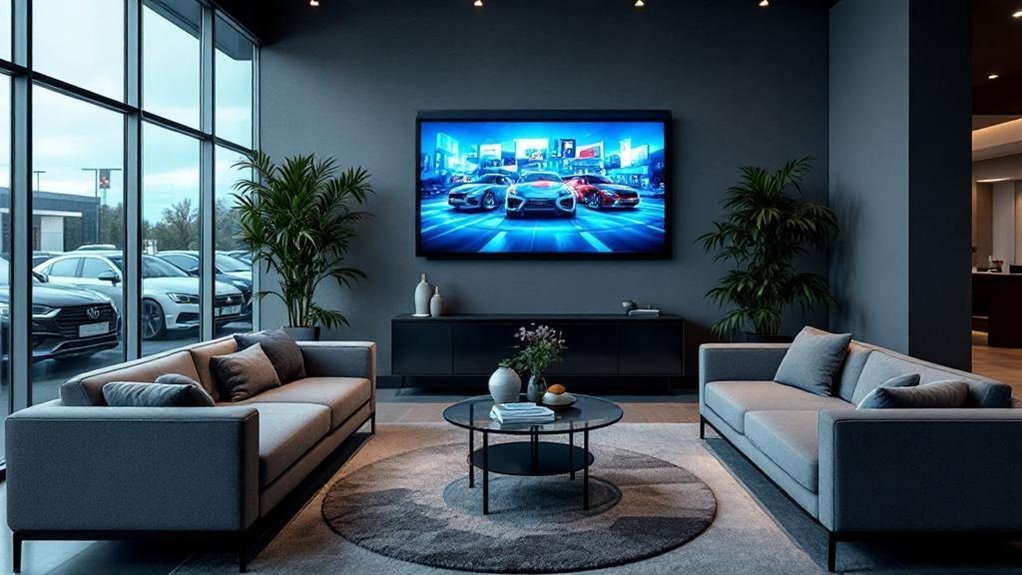
Although effective deployment hinges on durable hardware and smart content workflows, you’ll get the best ROI by combining high-brightness, weatherproof displays with a cloud-based content management system that supports real-time updates, dynamic scheduling, and interactive touch capabilities. You’ll deploy screens where visibility and dwell time align with conversion opportunities, and use remote content management to push targeted promotions and inventory updates across lots without site visits. Schedule content by traffic patterns and time of day to increase relevance; studies show regular content refresh reduces perceived wait times by up to 33%. Add interactive features for self-service lookups and lead capture. Measure engagement, iterate weekly or monthly, and tie content performance to sales KPIs to justify spend and scale deployment.
Frequently Asked Questions
What Is a Common Way for a Dealership to Generate More Revenue on the Sale of a Vehicle?
You can use upsell strategies like premium maintenance packages and financing options to boost transaction value; by driving customer engagement with targeted offers and urgency, you’ll often increase average sale revenue by 10%–30% through add-ons.
What Is Features on Demand Automotive?
Think of a car as a smartphone: features on demand automotive lets you subscribe to features benefits and automotive technology upgrades, so you’ll get tailored, data-driven options that boost convenience, revenue potential, and owner satisfaction.
What Do Consumers Want in a Car?
You want fuel efficiency and advanced safety features above all, plus tech-rich connectivity, customization, strong safety ratings, eco-friendly options and driver-assist systems; data shows these factors most influence purchase decisions and willingness to pay premium prices.
Conclusion
You’re turning idle minutes into measurable profit: a lounge TV cuts perceived wait time by up to 40% while boosting upsell recall and service add-on conversion. Instead of bored customers, you get engaged shoppers who see targeted promos tied to real-time inventory and CRM data. It’s low-effort tech that yields high-margin returns — think small screen, big lift. Deploy reliable hardware, link workflows, measure conversions, and keep content fresh to scale revenue.