
You need a clear comeback-rate and first-time-fix (FTF) leaderboard that ties advisor intake, diagnostics, and coaching to measurable outcomes. Capture timestamped intake, symptom, parts and tech assignments, and proof of resolution (test drives, logs). Calculate comeback rate as returns ÷ service orders and FTF as issues resolved with no return within the defined window. Update the leaderboard daily, link to coaching actions, and track trends to cut comebacks and boost retention — keep going to learn how.
Key Takeaways
- Define “first-time fix” and comeback windows (e.g., 7–30 days) with strict evidence rules for consistent leaderboard comparisons.
- Track advisor intake accuracy, technician assignment, diagnostic logs, and timestamped verification steps to make results auditable.
- Calculate comeback rate as comeback cases divided by total service orders and target industry-standard <10%.
- Use a real-time leaderboard showing FTFR and comeback KPIs, updated daily, to drive accountability and coaching.
- Pair leaderboard insights with targeted training, scripts, and mandatory checklists to reduce advisor-driven comebacks and improve retention.
What Is Comeback Rate and Why It Matters

When you track comeback rate, you’re measuring the percentage of service repairs that require rework or follow-up visits—an objective indicator of how effective the initial diagnosis, repair and communication were. You’ll compare comeback rate against first-time fix rate to quantify technician performance and spot trends. Start by calculating comeback cases divided by total service orders, then benchmark against the industry standard (under 10%). Use monthly dashboards to flag spikes, correlate with customer satisfaction scores, and estimate added operational costs from rework. Prioritize areas for improvement by service bay, advisor, and vehicle type. Implement targeted coaching, parts quality checks, and clearer repair scopes. Lowering comeback rate reduces costs, raises service quality and customer satisfaction, and boosts dealership profitability.
Defining First-Time-Fix for Service Advisors
You’ll start by agreeing on what “fixed” means — e.g., customer-reported symptom resolved without follow-up visit within X days — so your FTFR denominator and numerator are consistent. Then list advisor responsibilities (accurate intake, correct technician assignment, documented diagnoses) and the exact tracking rules for the leaderboard (time window, exclusions, data sources). Finally, define reporting cadence and acceptance criteria so performance is reproducible, auditable, and comparable across advisors.
What Qualifies as “Fixed
Although a “fixed” issue might seem straightforward, for FTFR purposes it means the customer’s reported problem is fully resolved during the initial service visit with no follow-ups required, and that resolution is verifiable through customer confirmation or diagnostic evidence. You’ll treat qualification as procedural: document symptom, confirm fix with customer or diagnostics, and close the job. Key checkpoints you follow:
- Clear protocols: intake captures root cause and required skills so the right technician is dispatched.
- Technician performance: verification steps and sign-off confirm repair completeness.
- Monitoring these metrics: calculate first-time fix rates and review cases where follow-ups occurred.
This approach boosts customer satisfaction, lowers operational costs, and relies on service advisors’ effective communication to sustain high FTFR.
Advisor Responsibilities Defined
Think of FTFR as a measurable promise: as a service advisor, your responsibility is to capture accurate, complete symptom and history data, confirm the correct parts and technician skillset are assigned, and document verification steps so fixes can be validated without a return visit. You’ll use standardized intake checklists to reduce omissions, assign technician assignments based on documented skills, and pre-check parts availability to avoid delays. Track first-time fix rate as a key performance metrics item and link it to customer satisfaction outcomes. Use digital tools—especially the Fixed Ops Leaderboard—to monitor cases, spot trends, and prioritize training and feedback. Regular coaching sessions should target intake accuracy, assignment decisions, and documentation to raise FTFR and lower comebacks.
Tracking and Reporting Rules
When defining Tracking and Reporting Rules for FTFR, be precise about what counts as a “first-time fix” — specify included service types, time windows for follow-up, and acceptable resolution evidence (test drives, diagnostic logs, parts confirmations) — so your data capture is consistent and auditable. You’ll implement clear tracking and reporting rules that tie first-time fix rate to documented outcomes, enabling objective evaluation of service advisors and customer satisfaction.
- Capture: timestamped interactions, diagnostic logs, parts used.
- Validate: test-drive notes, customer sign-off, warranty checks.
- Audit: follow-up window closure, exception reasons, corrective actions.
Follow a data-driven cadence for reporting, review improvement trends, and link performance to training and the FTFR leaderboard.
How Comebacks Impact Customer Satisfaction and Profitability
Track how comeback frequency moves retention rates so you can quantify lost repeat business and forecast lifetime value impact. Calculate profit per comeback by adding direct rework costs and indirect losses (lost service revenue, lower CSI-driven spend) to prioritize fixes. Use the First-Time-Fix Leaderboard to target advisors with higher repeat rates, implement training, and measure reductions in repeat visits over fixed intervals.
Effect on Retention Rates
If customers have to return for the same repair, you’ll see measurable drops in satisfaction and loyalty: studies show 80% of customers get frustrated by multiple visits, and a 10% rise in comeback rates can cut retention by about 5%, directly reducing long-term revenue. You should prioritize reducing comeback rates through targeted steps: maintain a Fixed Ops Leaderboard, monitor technician performance, and mandate effective training for service advisors. Follow this three-step checklist:
- Track first-time fix percentage weekly and flag declines.
- Deliver focused coaching to technicians and service advisors tied to leaderboard rankings.
- Report customer retention and customer satisfaction trends monthly to leadership.
Lower comeback rates raise customer retention, boost satisfaction, and stabilize recurring revenue.
Profit Per Comeback
Because repeat visits eat into margins and erode trust, you should quantify profit per comeback to see the true cost of failed first-time fixes: research links comebacks to a 15–20% drop in satisfaction and shows each return visit typically costs $100–$300 in extra labor, parts, and lost sales opportunity. Calculate profit per comeback by summing direct costs (labor, parts), indirect costs (lost upsell, admin) and customer satisfaction impact expressed as retention risk. Track comeback rate and first-time fix rate weekly in the service department dashboard. Audit technician workpacks and failure modes for patterns. Use the metric to prioritize training, parts inventory, and dispatch decisions that improve service outcomes. Report profit per comeback alongside customer experiences metrics to justify investments that reduce comebacks and restore margins.
Preventing Repeat Visits
You measured profit per comeback to show how repeat visits erode margins; now focus on preventing those repeat visits because they directly affect both customer satisfaction and profitability. You’ll target comeback rate reduction by standardizing steps, tracking first-time fix outcomes, and aligning service departments on root-cause resolution. Follow this procedural plan:
- Audit: quantify comeback rate, customer satisfaction impact, and added operational costs per repeat visit.
- Train: implement checklist-driven diagnostics and a First-Time Fix Leaderboard to improve effective problem resolution and show performance metrics.
- Monitor: set KPIs for first-time fix, rollback repeat visits, and report churn risks tied to high comeback rates.
This data-driven approach lowers operational costs, raises customer satisfaction, and preserves revenue by minimizing repeat visits.
Common Causes of Advisor-Driven Comebacks
When advisors miss or miscommunicate key customer symptoms, technicians often arrive without the right diagnosis, parts, or tools, driving a disproportionate number of comebacks and lowering First-Time Fix Rate (FTFR). You need a procedural audit: log symptom detail, confirm parts/tool needs, and set customer expectations before dispatch. Common causes include miscommunication, incomplete documentation, and weak follow-up by service advisors, all of which leave the technician unprepared. Address these via brief standardized intake forms, mandatory checklists, and targeted training opportunities tied to advisor-driven comebacks metrics.
| Cause | Corrective Action |
|---|---|
| Miscommunication | Standardized intake + verification |
| Incomplete documentation | Mandatory fields + audits |
| Poor expectation setting | Scripts + confirmation calls |
Track outcomes, coach consistently, and iterate.
Measuring and Tracking Comeback Rate and First-Time-Fix Performance

Fixing advisor-driven causes of comebacks is only the first step; you also need a rigorous way to measure outcomes so improvements stick. You’ll track comeback rate and first-time fix rate as core performance metrics, tying them to customer satisfaction and service operations. Set measurement cadence, data sources, and validation rules so the numbers’re reliable. Publish a leaderboard for service advisors to create a competitive environment and visibility into trends that require training improvements or process changes.
- Daily data ingestion to compute comeback rate and FTFR.
- Weekly leaderboard updates highlighting variances and root causes.
- Monthly reviews linking metrics to customer satisfaction and cost impacts.
Use this procedural approach to spot patterns, assign corrective actions, and measure ROI.
Strategies to Improve First-Time-Fix With AI and Training
Because improving First-Time-Fix Rate (FTFR) depends on both skills and information flow, start by combining AI-driven training, smarter triage, and mobile knowledge access into a single, measurable program: You’ll implement AI-driven training for service technicians, use AI triage to match skills to jobs, and provide mobile resources to enable effective problem resolution. Measure FTFR, identify performance gaps, and run targeted interventions. Maintain clear communication between dispatchers, technicians, and support to improve customer service and reduce comebacks.
| Step | Action | Metric |
|---|---|---|
| 1 | Deploy AI-driven training | Completion % |
| 2 | Smart triage matching | Match accuracy |
| 3 | Mobile knowledge access | Resolution time |
| 4 | Analyze FTFR data | FTFR % |
Using a Leaderboard to Motivate Advisors and Reduce Comebacks
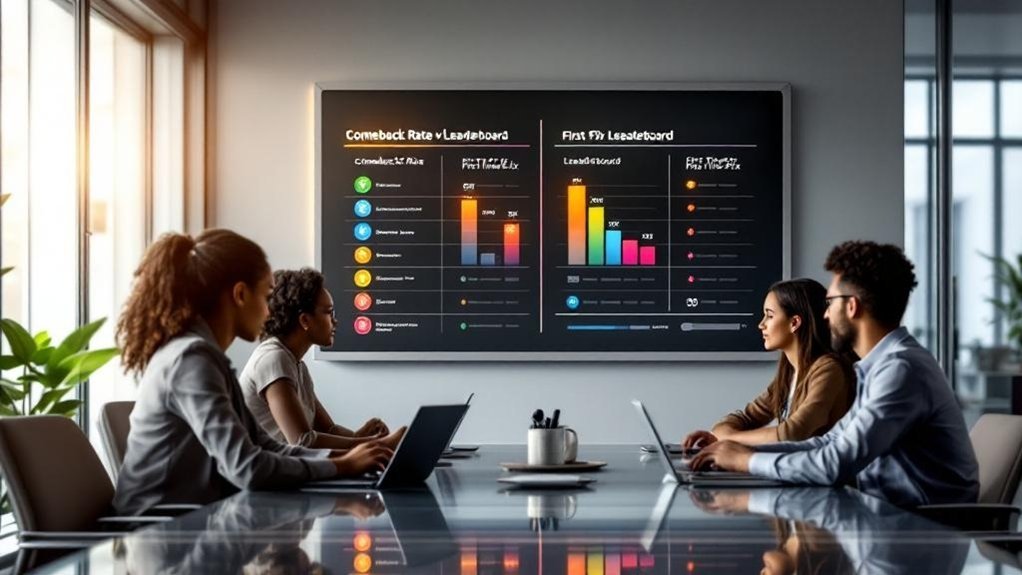
If you want advisors to take measurable ownership of comeback and first-time-fix outcomes, implement a real-time leaderboard that displays FTFR and comeback-rate KPIs, updates frequently, and ties to clear coaching actions; this creates visibility into performance gaps, drives accountability, and highlights high performers for recognition. You’ll use service advisor performance data to set targets for first-time fix rate and comeback rate, then publish performance metrics so advisors can self-correct. Update the board daily, pair with brief coaching, and recognize top contributors to motivate advisors and sustain quality service. Visual cues and simple goals spur healthy competition and reinforce continuous improvement. Example viewable items:
- Daily FTFR by advisor
- Weekly comeback rate trend
- Coaching actions logged per advisor
Frequently Asked Questions
What Is the Industry Standard for First Time Fix?
The industry standard for first-time fix is around 70%, though top performers exceed 90%. You should use industry benchmarks, customer satisfaction, service efficiency, repair processes, technician training, performance metrics, cost analysis, and service quality.
What Is the First Time Fix Rate?
The first-time-fix rate is the percentage of issues resolved on first visit; you should track it as a performance metric to drive service efficiency, customer satisfaction, repair quality, technician training, problem diagnosis, workflow optimization, and service excellence.
What Is the First Time Repair Rate?
The first-time repair rate is the percentage of repair success on the initial visit, showing customer satisfaction and service efficiency. You’ll improve it via technician training, diagnostic accuracy, workflow optimization, feedback analysis and continuous process improvement.
How to Improve First Time Fix Rate?
You’ll improve first time fix rate by standardizing processes: deploy diagnostic tools, train technicians on troubleshooting techniques and communication skills, optimize scheduling for service efficiency, monitor performance metrics, and iterate using data to boost customer satisfaction.
Conclusion
You’ve seen how comeback rate and first-time-fix drive satisfaction and profit, so act on the data: measure, analyze, train, iterate. “An ounce of prevention is worth a pound of cure” — prioritize diagnostics, standardize procedures, and apply AI to surface likely failure points. Track advisors on a leaderboard, set clear KPIs, and coach based on root causes. Do this consistently and you’ll cut comebacks, boost first-time-fix, and improve margins.