
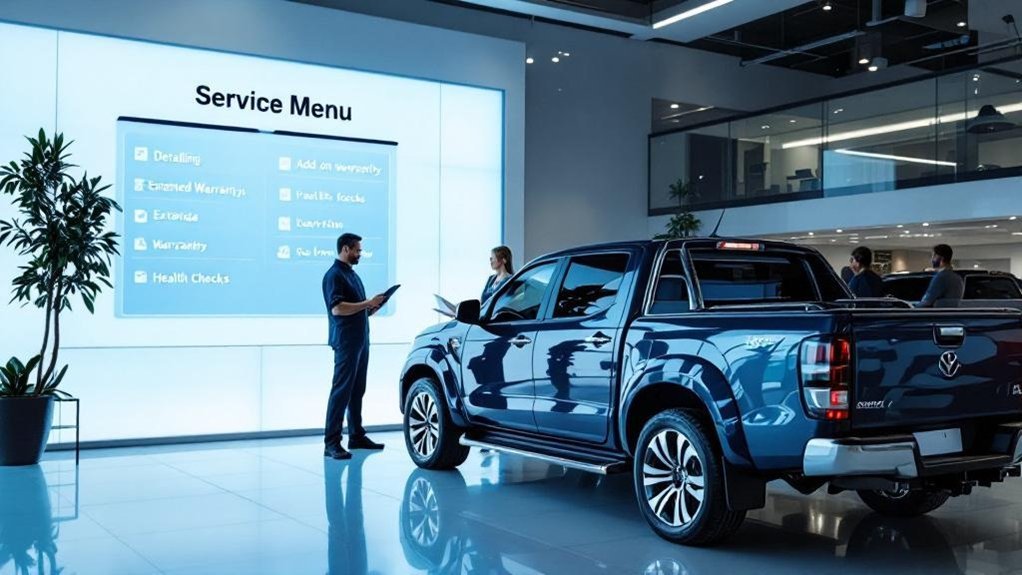
Use a digital service menu to present itemized add-ons with transparent pricing, warranty details, and data-driven recommendations tied to vehicle history so customers see relevant bundles and conversion rises (~30%). Surface high-value options with clear CTAs, scarcity cues, and real-time inventory. Offer integrated payments and status updates to cut friction and boost average ticket (~25%). Track upsell rates, A/B test messages, and optimize layouts for measurable ROI—keep going for tactical examples and implementation steps.
Key Takeaways
- Surface personalized, high-value add-ons based on vehicle history and customer preferences to increase relevance and conversions.
- Itemize services with exact costs, warranty details, and clear CTAs to build trust and speed decision-making.
- Offer interactive package builders and real-time inventory/pricing to let customers customize and see total cost instantly.
- Use targeted, time-bound promotions and scarcity signals during service windows to boost urgency and uptake.
- Track engagement and upsell metrics, A/B test offers, and iterate using data to improve conversion and average ticket value.
Key Benefits of Promoting Add-On Services Digitally
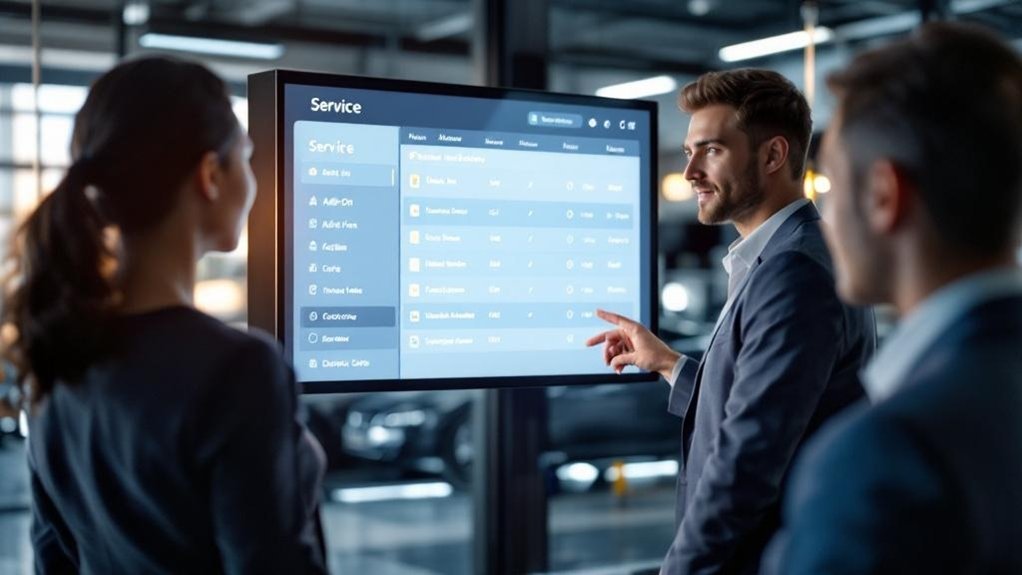
When you move add-on promotions into a digital service menu, you get measurable gains: tailored bundles and vehicle-history recommendations boost upsell rates by about 30%, clear itemization and transparent pricing make customers 80% more likely to contemplate extras, and real-time updates plus targeted promos lift average transaction value roughly 25%. You’ll convert more by presenting service bundles that match past repairs and owner preferences, using data to recommend timely add-ons. Transparent line-item pricing builds customer trust and shortens decision time. Real-time progress messages and targeted promos nudge acceptance at peak moments. Interactive customization increases perceived value and average ticket size, while usage metrics let you refine offers. The result: higher upsell conversion, improved retention, and repeat business gains approaching 20%.
Designing an Engaging Service Menu Interface
Because customers respond to clarity and control, your digital service menu should present itemized services, exact costs, and warranty details up front so decisions get made faster and with more confidence. Use a strong visual hierarchy to guide attention: prioritize must-do items, then optional add-ons, and display savings or warranty length with consistent iconography. Include interactive features like package builders and real-time status updates so users can customize offers and see repair timelines instantly. Track engagement metrics (click-through, selection rate, time-on-item) to iterate layout and pricing presentation. Design for self-service to cut advisor talk time and redeploy staff to complex tasks. Surface targeted promotions contextually, leveraging vehicle history to raise conversion without disrupting the buyer’s flow.
Strategies for Highlighting High-Value Add-Ons
After designing a clear, interactive service menu, you’ll want to spotlight high-value add-ons in ways that drive measurable uptake: use vehicle history and preferences to surface tailored bundles (raising upsell rates up to 30%), show real-time inventory and pricing so customers see availability and total cost instantly, and apply targeted promotions during peak windows to boost conversions. You should leverage customer preferences and service trends to prioritize add-ons, use interactive controls for instant cost visibility, and present analytics-backed bundles. Track purchase behavior and feedback to refine offers. Use clear CTAs and scarcity signals for high-demand services.
| Feature | Impact |
|---|---|
| Tailored bundles | +30% upsell |
| Targeted promos | Higher conversion |
| Feedback loop | Optimized offerings |
Integrating Real-Time Updates and Payment Options
While customers track their vehicle’s progress in real time and view up-to-the-minute pricing and promotions on their devices, integrated payment options let them complete transactions immediately—reducing wait times and increasing conversion. You should deploy real time notifications to signal status changes, estimate completion, and push timely add-on offers when customers are most likely to convert. Combine multiple payment methods—cards, digital wallets, contactless terminals—to remove friction and shorten checkout. Measure click-to-pay rates, average time-to-payment, and add-on attachment lifts to quantify impact. Prioritize payment security: use tokenization and advanced encryption, display trust signals, and log audit trails to reduce chargebacks. These data-driven moves make the service menu a seamless revenue channel while improving customer satisfaction and operational efficiency.
Personalization and Targeted Promotions

Integrated payments and real-time updates set the stage for more precise customer targeting: once you can track service status and payment behavior, you can use that data to serve personalized service bundles and timely promotions that match a customer’s vehicle history and preferences. You’ll present offers informed by service history and explicit customer preferences, increasing relevance and conversion likelihood. Deliver targeted promotions as real-time notifications during appointments to capture impulse add-ons, and include clear descriptions, costs, and warranty details to build trust. Use analytics to identify which bundles drive the best responses and to refine segmentation rules. Timely reminders and offers based on behavior and history boost experience and loyalty, with projected uplifts in upsells and repeat patronage.
Measuring Performance and Optimizing Upsell Campaigns
Because you’ll need clear metrics to prove ROI, start by tracking upsell rates and average transaction value in real time—set targets like a minimum 30% increase in upsells and a 25% lift in transaction value—and use dashboards to monitor conversion by offer, channel, and customer segment. Use upsell analytics to spot high-performing bundles and underperforming offers; feed those insights into A/B testing on messaging and bundling. Measure results against targets and adjust price, placement, or creative within the menu. Regularly review service history and customer feedback to personalize offers and reduce friction. Treat campaign refinement as iterative: test, measure, and re-deploy rapidly. Report KPI trends to stakeholders and allocate spend to channels delivering the best incremental revenue.
Frequently Asked Questions
What Is the Four Square Trick at a Car Dealership?
The four square is a dealership strategy that splits negotiations into trade-in, purchase price, down payment, and monthly payment; you’ll see figures adjusted to steer choices, so you should verify exact costs and financing terms independently.
What Is a Red Flag in a Dealership?
A red flag in a dealership is any warning sign—red flag indicators like inflated pricing, hidden fees, aggressive sales, frequent negative reviews, or unclear itemized costs—that shows poor dealership transparency and risks trust, satisfaction, and long-term retention.
How Do You Attract Customers to Auto Repair?
You attract customers by offering targeted customer incentives and clear service packages, using data to personalize offers, showcasing transparent pricing, promoting loyalty rewards, and sending real-time deals that boost conversion and repeat business.
What Are the Four P’s of Car Sales?
Like a compass, the four P’s are Product, Price, Place, Promotion; you’ll use Sales Strategies and Customer Engagement to optimize offerings, set competitive pricing, target locations/channels, and run precise promotions based on data-driven, strategic insights.
Conclusion
You’ll drive more revenue when your digital service menu promotes the right add-ons at the right time — and data proves it: dealerships using personalized upsell tech see average add-on attach rates rise by 20–30%. Use clear UI, prioritize high-margin items, enable real-time updates and payments, and run A/B tests to refine offers. Stay metric-focused: monitor attach rate, conversion, and LTV to keep your strategy lean, measurable, and scalable.