

You should spotlight long-term value—reliability, fuel economy, warranties, and resale—rather than temporary discounts. Use clear metrics (MPG savings, warranty repair $ saved, 5‑yr resale %) and trusted badges to build credibility. Show monthly payment and total cost of ownership side-by-side with sticker price, plus brief customer outcomes or short testimonial clips. Keep visuals minimal, brand-consistent, and test variants for CTR and conversion lift. Scroll down for tactical examples and testing guidance.
Key Takeaways
- Display total cost of ownership (monthly payments, fuel, maintenance, resale value) alongside sticker price to show long-term savings.
- Highlight quantifiable feature benefits (MPG, warranty savings, safety scores) with simple metrics and annualized dollar impacts.
- Use trusted third-party badges and concise customer testimonials to build credibility and measurable trust signals.
- Present financing options and payment comparisons visually to demonstrate value versus temporary discounts.
- A/B test messaging variations, track CTR and conversion lift, and iterate based on CRM and survey feedback.
Why Value Messaging Beats Price Cuts on Comparison Boards
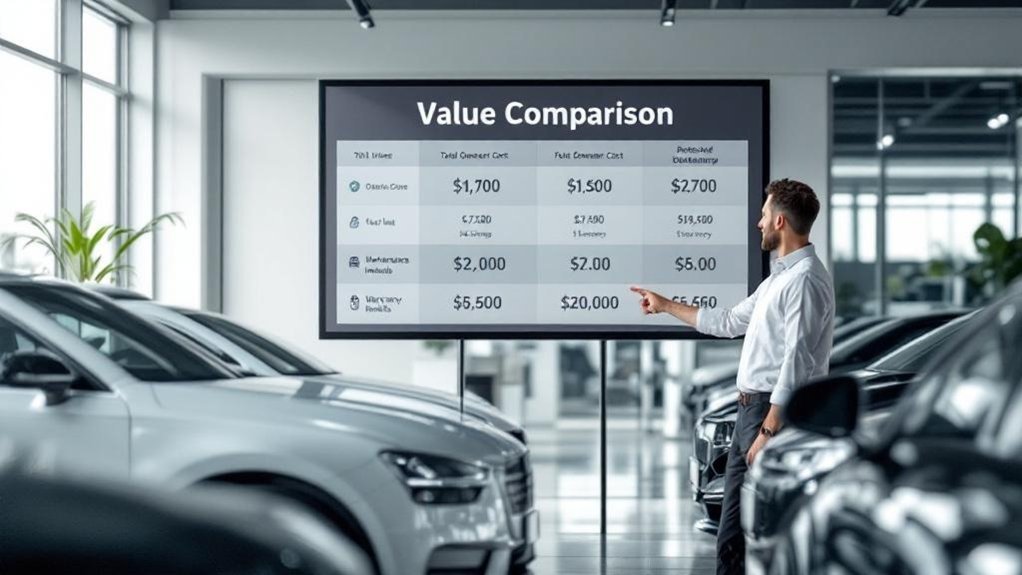
Why focus on value instead of just slashing prices? You’ll drive stronger value perception by emphasizing long-term benefits—reliability and advanced features—that shape buying decisions more than temporary discounts. Data shows 82% of consumers want value context, and boards that surface those benefits boost customer engagement by up to 50%. Strategically, you differentiate your brand in a crowded market: 67% of buyers will pay more for superior quality or experience. Prioritizing value messaging builds loyalty, with 73% saying they’d return to a dealership that explains benefits rather than just cuts prices. On your digital comparison board, lead with clear, measurable propositions tied to outcomes; that approach converts better and protects margins while reinforcing a premium, trust-based brand position.
Highlighting Vehicle Features That Drive Long-Term Savings
When you foreground features that cut ownership costs—like superior fuel economy, extensive warranties, strong resale value, and advanced safety tech—you’re selling a measurable financial story, not just a car. Position clear metrics: show fuel savings with MPG differentials (30 MPG vs 20 MPG → >$1,000/year) and quantify potential insurance reductions from ADAS (10–20% annually). Highlight warranty benefits and maintenance packages that research ties to roughly $1,200 in repair savings over a vehicle’s life. Frame high resale rates (60%+ after five years) as ROI for brand-conscious buyers. Include emissions-related incentives that translate into direct rebates. On your digital comparison board, present these data points as brand-strength indicators that shift focus from transient discounts to durable, calculable ownership value.
Designing Visuals That Communicate Quality and Reliability

Start with a clean visual hierarchy that lets customers instantly read quality: use crisp, high-resolution imagery that frames craftsmanship, infographics that call out reliability metrics (low maintenance costs, safety scores), and trusted third‑party badges (Consumer Reports, J.D. You’ll design visuals that use visual storytelling to make data feel tangible — vehicle close-ups, materials detail shots, and side-by-side feature comparisons that highlight safety tech and fuel efficiency. Use gold and blue accents to signal luxury and trust while keeping layouts minimal so metrics and badges pop. Infographics should present maintenance cost projections and safety ratings clearly to support purchase rationale. By focusing on brand consistency, measurable reliability cues, and subtle emotional appeal, you’ll shift attention from discounts to long-term value.
Using Customer Testimonials and Real-World Outcomes
You should lead with real-world performance evidence that quantifies how higher-value packages improve vehicle performance and longevity. Use before-and-after metrics and side-by-side comparisons to make those gains instantly comparable for shoppers. And include peer video testimonials that narrate the measurable savings and satisfaction customers experienced, reinforcing your brand’s value proposition.
Real-World Performance Evidence
Because buyers trust peers more than promises, integrating real-world performance evidence like customer testimonials and measurable outcomes becomes a strategic lever that boosts credibility and conversions. You should surface real world data and performance benchmarks on your digital price board — short quotes, star ratings, and quantified outcomes — so shoppers see verified results alongside price. Cite that 92% of buyers read reviews and that testimonials can lift conversions by up to 80% to make a data-driven case for higher-value models. Use concise video clips and one-line case summaries emphasizing performance and service satisfaction to humanize claims without distracting from pricing. This brand-focused approach reframes value: you’re selling proven ownership experiences, not just discounts.
Before-And-After Metrics
When you show before-and-after metrics alongside short customer testimonials, you turn abstract claims into verifiable outcomes that justify premium pricing and long-term service relationships. Use concise before after comparisons to highlight measurable gains—fuel efficiency, safety upgrades, or reduced downtime—and pair each with a 1–2 sentence customer quote that quantifies impact. Present retention lifts (for example, a 20% increase) and satisfaction rates (85% recommendation) as clear KPIs on your digital price comparison board. Employ metrics visualization—simple bar charts or percentage callouts—so shoppers quickly grasp value versus one-time discounts. Also show average savings from maintenance packages compared to a la carte options to reinforce lifetime cost benefits and strengthen your brand’s quality-first positioning.
Peer Video Testimonials
Although visuals alone won’t close every sale, peer video testimonials combine emotional resonance with hard data to drive decision-making—studies show they can lift conversions by up to 80% and tap into the 92% of buyers who read reviews before deciding. You should prioritize short, branded clips that surface peer experiences and measurable outcomes: mileage improvements, ownership-cost reductions, or lifestyle impact. Pull verified reviews from Google or Yelp to boost credibility, and weave emotional storytelling with before-and-after metrics so prospects see tangible value beyond price. Place these videos on the digital price comparison board near competing offers to shift attention from discounts to real-world benefits. Measure engagement and conversion lift per clip to iterate toward the highest-performing narratives.
Integrating Financing and Ownership Cost Comparisons
One clear way to increase conversions is to integrate financing and ownership cost comparisons directly into your digital price boards so customers can immediately see monthly-payment estimates, interest rates, and projected total cost of ownership alongside sticker prices. You’ll present financing options and ownership costs side-by-side, using concise figures and visual aids like graphs to compare monthly payments, APRs, and estimated fuel and maintenance expenses. Showing financing rates and terms reduces confusion and builds trust, while TCO comparison metrics shift focus from discounts to long-term value. This data-driven approach lets your brand position itself as transparent and consultative, increasing buyer confidence and conversion rates by helping customers quickly evaluate affordability and lifecycle expense differences between models.
Placement, Timing, and Context for Maximum Impact
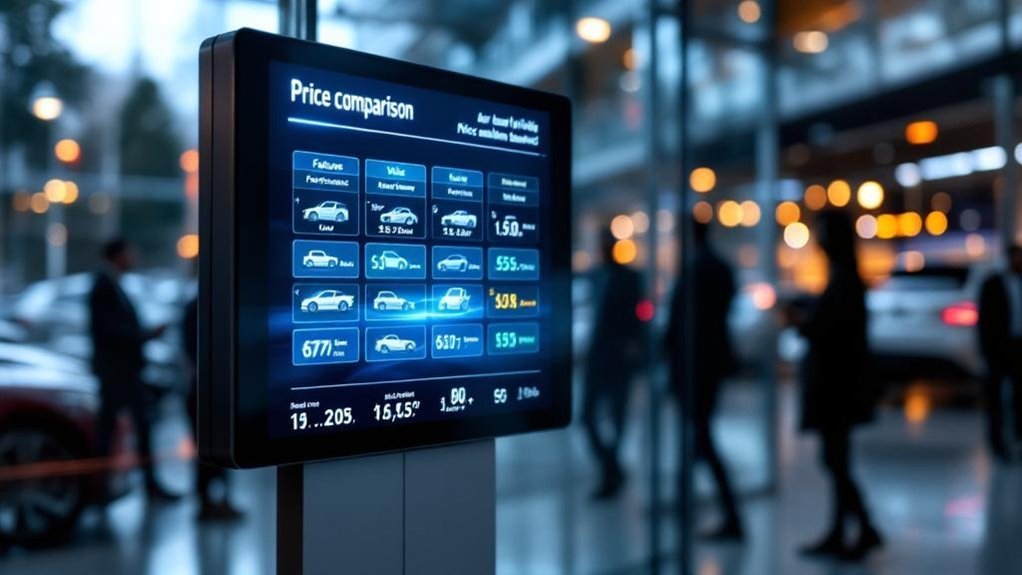
After showing customers clear financing and total-cost comparisons on your price boards, you’ll want to make sure that content is seen at the right place and time to drive decisions. Use placement strategies that prioritize high-traffic zones—entrances, showroom sightlines, and waiting areas—so comparisons and testimonial snippets reach shoppers naturally. Apply timing considerations by scheduling value-focused content for peak shopping windows (weekends, promo events) and rotating seasonal offers to remain relevant. Contextualize price with visuals: feature vehicle benefits, long-term savings infographics, and customer success stories alongside limited-time value-adds like maintenance or financing perks. That combination reinforces brand positioning, increases engagement during decision moments, and turns data-driven messaging into persuasive, trust-building experiences.
Measuring Performance and Iterating on Value-Focused Content
When you start measuring performance, treat value-focused content like any other marketing channel: define clear KPIs (click-throughs, dwell time, conversion lift, inquiry volume, retention rates) up front, instrument displays and CRM for reliable attribution, and use A/B tests plus customer feedback to rapidly iterate on messaging so you can scale what demonstrably moves purchase and loyalty metrics. You’ll rely on customer analytics to track engagement—CTR, time on content, and downstream conversions—and tie those signals to CRM retention and repeat purchase data. Run systematic A/B tests of value propositions, apply rigorous content optimization workflows, and prioritize variants that lift both short-term inquiries and long-term loyalty. Use surveys and sales-team feedback to validate quantitative findings, then iterate until messaging aligns with your brand promise and sales goals.
Frequently Asked Questions
What Is the Four Square Trick at a Car Dealership?
The Four Square Trick is a negotiation strategies framework where you compare price, trade-in, financing, and monthly payment to shape value perception; you’ll use data-driven talk, strategic framing, and brand-focused messaging to influence decisions.
How Much Lower Than MSRP Is a Dealer Invoice?
Like a familiar tune, you’ll find dealer invoice is typically 2%–5% lower than MSRP; invoice pricing often sits $1,000–$2,000 beneath MSRP comparison, so you’ll use that data to negotiate smarter, brand-aware deals.
How to Get Car Dealers to Lower Their Prices?
You get car dealers to lower prices by using data-driven price negotiation, exposing dealership tactics with transparent comparisons, leveraging engagement analytics, and emphasizing brand-focused value propositions so they’ll adjust offers to stay competitive and protect reputation.
How to Get Around Dealer Markup?
You bypass dealer markup by researching MSRP and market value, using dealer incentives to negotiate, showcasing competitive pricing strategies, leveraging financing offers, and highlighting total value (warranties, service) backed by data to compel fair pricing.
Conclusion
You’ll still see competitors slashing prices like confetti, and you’ll smile — because your board quietly shows what actually matters. By spotlighting fuel economy, warranty length, maintenance schedules and real customer savings, you turn impulse hunting into informed buying. Design, placement and finance comparisons do the heavy lifting; testimonials and outcome data close the trust gap. Keep measuring engagement and iterate: your value message won’t be loud, but it’ll be unignorable — and more profitable.