
You want a video wall that drives impressions and sales, so pick the tech to match your showroom and goals. Thin‑bezel LCDs deliver crisp, close‑up detail, lower upfront cost, and a sleek look for walk‑around inspections. LED walls give higher brightness, seamless canvases, and longer lifespans for distant impact or bright bays. Consider pixel pitch, sightlines, and maintenance to calculate true ROI — keep going to see layout, cost, and installation tradeoffs.
Key Takeaways
- Thin-bezel LCDs deliver high-resolution, close-view clarity ideal for up-close vehicle spec walkthroughs and showroom floor interactions.
- LED walls provide unmatched brightness and contrast for large-format impact and visibility from across lots or through glass fronts.
- Match pixel pitch to typical viewing distance (ideal ≈ pixel pitch × 10) to ensure image sharpness and ROI.
- Choose thin-bezel LCDs for lower upfront cost and tight alignment; choose LED for longevity, modularity, and seamless large canvases.
- Plan mounts, ventilation, and cable routing early to minimize installation cost, service time, and downtime.
Why a Video Wall Elevates Your Dealership Showroom
Because first impressions drive purchases, a video wall instantly upgrades your showroom into an experience that sells—its ultra-thin bezels and high-resolution panels deliver seamless, vivid visuals that highlight vehicle features and trim levels, hold attention, and shorten decision cycles. You’ll use video wall displays to present dynamic promos, walkaround footage, and spec overlays that make comparisons effortless and reduce hesitation. Thin bezels create a nearly continuous canvas for immersive viewing, reinforcing premium positioning and brand visibility. Modular layouts let you swap content by model, season, or campaign, so messaging stays relevant and boosts conversions. The result: a measurable uplift in foot traffic, longer dwell time, stronger customer experience, and a faster path from interest to purchase.
How LCD Thin-Bezel Video Walls Work
When you step up to an LCD thin-bezel video wall, what you’re seeing is a synchronized array of lightweight panels whose slim frames minimize gaps so imagery reads as one continuous canvas—ideal for showing detailed close-up shots, walkarounds, and spec overlays. You’re looking at LCD displays that use liquid crystal layers and a backlight to produce crisp, high-resolution images suited to close viewing. Ultra-low bezel thickness keeps visuals immersive, maintaining color consistency and wider viewing angles across the grid. These panels deliver high brightness in nits so content stays visible under showroom lighting, and their lighter weight and energy-efficient operation cut installation and operating costs. The result: a seamless display that maximizes visual impact and ROI for your dealership.
How LED Video Walls Work and When They Shine
An LED video wall lights up your showroom with directly emissive panels that snap together into seamless, bezel-free canvases, giving you limitless shapes and sizes, extreme brightness, and contrast that cut through ambient light to grab customer attention. You get vivid, high-contrast imagery because each panel emits its own light, so promos stay bright even in sunlight. Seamless displays let you brand irregular walls or wrap pillars without distracting bezels. Pay attention to pixel pitch — smaller pitches deliver crisper detail for close inspection, larger pitches suit distant focal points — and match it to typical viewing distance to maximize ROI. High refresh rates keep motion smooth for walkthrough videos and rotating inventory, improving engagement and converting attention into test drives.
Viewing Distance, Pixel Pitch, and Image Quality
If you want showroom visuals that sell, match pixel pitch to viewing distance so images stay sharp without wasting budget on overly dense LED panels. You’ll plan layout around the rule of thumb: ideal viewing distance ≈ pixel pitch × 10, minimum ≈ pixel pitch × 3. That keeps image quality crisp for customers walking close to vehicles while avoiding visible pixelation on an LED video wall. Thin-bezel LCDs work when you need very close inspection; LED walls win for impact from a few meters back. Choose pixel pitch to align with traffic patterns and sales goals so every display drives engagement, not returns.
- Closer walkthroughs: smaller pixel pitch for tight viewing distance
- Drive-by impact: larger pitch, bold visuals on LED video wall
- Cost vs. clarity: right pitch = max ROI and image quality
Brightness, Color Accuracy, and Ambient Light Considerations
You’ll want to prioritize brightness and visibility first—LED walls often exceed 1,500 nits so your showroom images stay vivid even in strong ambient light, while thin-bezel LCDs can wash out. Color accuracy matters for selling cars, and LEDs’ wider color gamut preserves true paint hues under varied lighting. Evaluate each option in your specific showroom to balance upfront cost against the ROI of clearer, more faithful visuals.
Brightness and Visibility
Because showroom lighting can make or break how a car looks, pick a display that keeps imagery crisp and true under any ambient light—LED walls typically deliver 1,000+ nits and wide contrast so paint, trim, and video pop even in bright spaces, while thin-bezel LCDs (300–700 nits) may wash out or lose color fidelity in direct sunlight; also factor pixel pitch for viewing distance so details stay sharp during close-up product demos. You want maximum brightness and visibility to protect perceived value. LED gives superior color accuracy and sustained punch in daylight, plus adjustable pixel pitch for close interactions. LCDs save cost but risk muted visuals in high-ambient environments. Match display to your showroom’s light levels for best ROI.
- High ambient: LED for uncompromised visibility and vibrancy
- Close demo areas: fine pixel pitch for sharp detail
- Budget: LCD acceptable for controlled lighting
Color Accuracy in Ambient
Having picked a display based on brightness needs, next focus on how ambient light affects color accuracy—it’s what determines whether a car’s paint and trim look true to life or subtly off. You want color accuracy to drive trust and sales: thin-bezel LCDs deliver precise reproduction in controlled or low ambient light conditions, minimizing distortion. LED walls win in bright showrooms, but watch saturation up close; calibration and 4000K–5000K LED daylighting preserve neutrality. Regardless of choice, routine calibration is non-negotiable to maintain ROI through reliable vehicle representation.
| Scenario | Recommendation |
|---|---|
| Low ambient light conditions | Thin-bezel LCDs for accurate hues |
| Bright showrooms | LED walls with calibration and daylight LEDs |
| Close viewing | Calibrate to reduce LED saturation |
Installation, Mounting, and Space Planning
When planning your install, think through mounting options and required clearances to protect screen integrity and simplify maintenance. Map cabling and power routes early to avoid costly rework and keep sightlines from showroom focal points clear. The right layout boosts ROI by minimizing downtime, easing service access, and maximizing visual impact on the sales floor.
Mounting Options and Clearances
If you want a clean, durable installation that maximizes return on floor space, plan mounting and clearances early—thin-bezel video walls demand precise alignment, specialized mounts, and sometimes extra structural support, while modular LED walls give you more flexible configurations and easier fit into odd layouts. You’ll balance upfront cost vs. longevity: thin-bezel mounting options often raise labor and support costs but deliver razor‑thin seams; LED walls reduce custom mounting time and adapt to curved or split installations. Maintain 2–3 inches minimum clearances for ventilation and service access, and design sightlines and viewing distances into your floor plan to protect ROI and customer experience.
- Heavy-duty wall studs or steel frames for thin-bezel video walls
- Modular rigging and lightweight panels for LED walls
- Planned service clearances and viewing sightlines
Cabling and Power Routing
Because cabling and power routing make or break uptime and appearance, plan them before you pick panels or mounts: run labeled, service‑looped power and data trunks to each mounting zone, reserve conduit and access panels for future expansion, and separate low‑voltage signal runs from mains to reduce interference. You’ll save installation hours and cut long‑term service costs if you map load centers and use dedicated circuits for LED walls while keeping thin-bezel displays on simpler runs. Use accessible junctions and color‑coded ties so techs can swap modules fast.
| Benefit | Action |
|---|---|
| Reduced downtime | Labeled, looped trunks |
| Lower install cost | Reserve conduit |
| Cleaner look | Separate low/high voltage |
Prioritize serviceability and ROI when planning cabling and power routing.
Space Layout and Sightlines
Cabling plans set the backbone, but your showroom’s layout and sightlines determine whether that tech actually sells cars. You’ll size the installation space to pixel pitch and recommended viewing distances so the video wall experience reads crisply from service desks, walkways, and vehicle bays. Thin-bezel walls demand precise alignment and careful mounting; LED walls give you more mounting flexibility for angled or curved arrays. Plan sightlines so no vehicle or pillar blocks the focal plane, and route cables for discreet access and easy maintenance.
- Map primary customer paths and sightlines to place the video wall where it captures attention without obstructing displays.
- Choose a configuration that fits installation space and optimizes the video wall experience across angles.
- Include service access and cable routes for fast, low-impact maintenance.
Cost, Total Cost of Ownership, and Maintenance Tradeoffs
When you’re sizing up display options for a dealership, don’t just compare sticker price—factor in lifespan, maintenance, and energy costs to see real ROI. You’ll find thin-bezel setups have lower upfront cost, letting you deploy striking visuals on a tighter budget, but their total cost of ownership can climb as delicate panels need frequent, costly service and replacements. LED Walls cost more to buy, yet their 50,000–100,000 hour lifespans, easier module swaps, and better energy efficiency typically cut operational and maintenance spend over time. Visually map break-even: estimate installation, annual energy, and scheduled repairs to compare multi-year expenses. Choose based on cashflow versus long-term ROI—short-term savings versus predictable, lower-maintenance ownership.
Aesthetic Impact: Thin Bezels Versus Thicker Frames
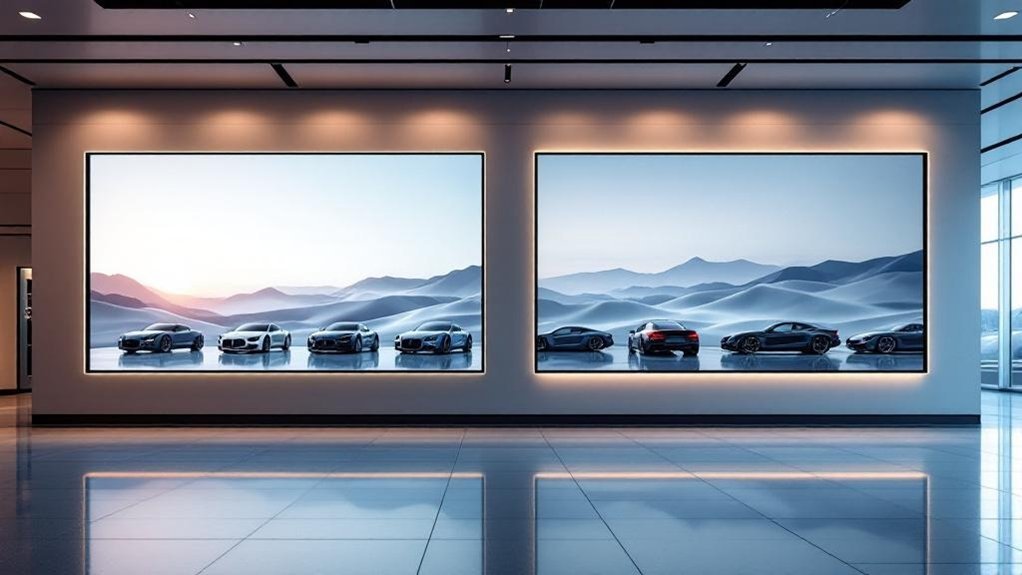
While thin bezels give your showroom a near-seamless, high-end look that elevates vehicle presentation and supports premium branding, thicker frames can be a practical choice where durability and lower maintenance matter more than visual continuity. You’ll notice bezel width immediately — ultra-thin bezels boost aesthetic appeal and visual continuity, making cars pop and photos/video content more immersive. Thicker frames break that continuity but often cut upfront expense and simplify repairs.
Ultra-thin bezels create a cinematic, premium showroom feel; thicker frames prioritize durability and cost-effective maintenance.
- Ultra-thin bezels: cinematic, premium backdrop that reinforces brand perception and drives engagement.
- Thicker frames: rugged, cost-effective solution for service bays or high-traffic zones where impact resistance matters.
- Mixed approach: place ultra-thin where presentation sells, thicker where function protects ROI.
Choosing the Right Solution for Your Dealership Goals
Thinking about what you want your showroom to accomplish will quickly narrow whether a thin‑bezel LCD or an LED wall is the smarter investment: do you need ultra‑clean, close‑range imagery to reinforce a luxury brand and drive sales at eye level, or higher brightness, larger canvases and long‑term durability to dominate big floor space and cut maintenance costs? Decide by audience distance and lighting: Thin-bezel displays give a seamless viewing experience up close, perfect for luxury detail and polished brand imagery, though precise alignment raises installation time and cost considerations. LED video walls win for ambient light, expansive visuals and lower upkeep over time, with pixel pitch guiding detail at distance. Match tech to showroom scale, customer sightlines and ROI targets.
Frequently Asked Questions
What Is the Difference Between LED Wall and Videowall?
LED walls use LED technology for seamless, bright panels with superior display brightness and wide viewing angles; videowalls use thin-bezel LCDs, cheaper installation costs upfront but narrower viewing angles and lower brightness, affecting long-term ROI.
Which Is Better LCD or LED Video Wall?
Think of Goldilocks: you’ll pick LCD technology for tight, high-resolution showroom views and cost-effective display resolution, but choose LED brightness when you need bold, large-scale video wall applications and stronger long-term ROI.
What Is an LCD Video Wall?
An LCD video wall’s a multi-panel display using LCD technology to deliver high display resolution, offering video wall benefits like crisp imagery and energy efficiency; you’ll consider installation considerations, ROI, mounting, calibration, and maintenance for showroom impact.
Conclusion
A video wall can transform your showroom ROI by drawing attention, showcasing inventory, and speeding sales. Choose thin‑bezel LCDs for close, crisp visuals and lower upfront cost; pick LED for massive, bright, seamless impact from across large spaces. For example, a midsize Toyota dealer swapped a 4×2 thin‑bezel LCD for a 2×2 fine‑pitch LED and saw walk‑ins rise 18% in three months—proof that the right wall drives visits and conversions.