
You need a digital service menu because it delivers measurable operational and financial gains: clearer pricing boosts customer trust and cuts disputes, packages and targeted add‑ons lift repair order value and repeat business, and real‑time DMS integration automates job ticketing and warranty checks to reduce errors and cycle time. It standardizes presentation for consistent margins, enables data‑driven promotions, and supports touchless pickup/delivery—keep going to see the KPIs and rollout tactics that drive ROI.
Key Takeaways
- Increases repeat business by ~20% through transparent, easy-to-access service options that encourage return visits.
- Boosts customer retention by 30% with clear pricing and package visibility that builds trust and lowers disputes.
- Raises average repair order value by standardizing bundles, showcasing savings, and promoting targeted add-ons.
- Automates RO sync, job ticketing, and parts mapping to reduce errors, cycle time, and manual data entry.
- Enables data-driven promotions, staff scripts, and KPI tracking for continuous improvement and measurable ROI.
The Business Case for a Digital Service Menu
When you implement a digital service menu, you’re not just modernizing communication—you’re opening measurable revenue and retention gains: studies show a roughly 20% lift in repeat business and a 30% improvement in customer retention, while customers are 80% more likely to come back to shops that offer clear, digital pricing. You’ll see a direct business case: consistent pricing removes disputes, increases repair order averages, and scales loyalty offers without manual effort. By presenting packages and add-ons digitally, you standardize margins and capture upsell opportunities tied to current service trends. You’ll also collect structured customer feedback that drives iterative menu optimization and targeted promotions. The result is predictable revenue growth, higher profitability per RO, and operational efficiency across fixed ops.
How Digital Menus Improve Customer Confidence and Retention
You’ll boost trust and reduce disputes by showing a transparent price breakdown that lets customers see exactly what they’re paying for. Displaying loyalty program visibility alongside service options reinforces repeat behavior and makes rewards tangible. Combined with consistent service expectations, these features drive measurable increases in retention and revenue.
Transparent Price Breakdown
Because clear cost visibility removes guesswork, digital service menus give customers a straightforward breakdown of every charge—parts, labor, taxes and optional add-ons—so they can quickly assess value and make informed decisions. You’ll meet rising customer expectations by delivering pricing transparency that’s consistent and easy to verify, reducing disputes and accelerating approvals. Data shows clear pricing can boost repeat business by about 20% and that roughly 96% of customers prefer upfront costs, so you’ll see measurable retention gains. With streamlined, itemized displays you’ll minimize misunderstandings and shorten transaction cycles, which directly impacts revenue—implementations report up to 30% increases tied to retention and satisfaction. For fixed ops leaders, transparent breakdowns are a tech-driven lever for trust and predictable growth.
Loyalty Program Visibility
Building on clear price breakdowns, integrating loyalty program visibility into digital service menus gives customers a single, data-rich view of both costs and rewards so they can immediately see how discounts, points and package benefits affect their out-the-door price. You’ll boost trust and customer engagement by showing loyalty program benefits alongside transparent pricing — 96% of customers value that transparency, and visibility drives an 80% higher return likelihood. Clear presentation converts: a 20% rise in repeat business when service packages and rewards are shown, and up to 30% higher retention when loyalty details are integrated. Use analytics to surface personalized rewards, real-time discounts, and points balances so customers make confident decisions and you capture long-term value.
- Points balance
- Applied discounts
- Package savings
- Retention lift
Consistent Service Expectations
When digital service menus present consistent, up-to-date pricing and package details, customers get a reliable baseline that reduces confusion and sets clear expectations for every visit. You’ll see transparency—96% of customers value pricing breakdowns—which directly boosts confidence and loyalty. With consistent communication across web, app, and in-dealer displays, misunderstandings drop and trust rises, translating into measurable retention: customers are 80% more likely to return when menus are digital. Operationally, regular updates keep offerings competitive and cut dispute resolution time. Expect a roughly 20% increase in repeat business as clear service descriptions align with customer expectations and post-service satisfaction. For fixed ops, that means predictable revenue, streamlined workflow, and analytics-ready data to optimize packages and pricing.
Transparent Pricing: Building Trust and Reducing Disputes
You’ll see exact, itemized costs on the digital menu so customers know upfront what they’ll pay for each service and add-on. That clarity cuts billing disputes by aligning quotes with final invoices and builds consistent pricing across every interaction. The result is stronger trust, higher return rates, and measurable revenue gains.
Clear Upfront Costs
A clear digital service menu gives customers upfront, itemized pricing that removes guesswork and immediately establishes trust—96% of buyers say they appreciate transparent pricing, and dealerships that do this see fewer disputes and a measurable uplift in loyalty. You’ll use upfront pricing to set expectations, align quotes with invoices, and drive customer satisfaction through predictability. Digital menus let customers compare options and pick confidently, which boosts repeat visits and revenue.
- Itemized labor and parts displayed clearly
- Comparable service tiers side-by-side
- Real-time pricing synced to quotes/invoice
- Visual cost breakdowns for common repairs
This approach is data-driven: expect a ~20% lift in repeat business and up to 30% revenue growth from enhanced trust and streamlined decision-making.
Fewer Billing Disputes
Having set clear upfront costs, the next payoff is fewer billing disputes—digital menus make price components visible and consistent from quote to invoice, so customers aren’t surprised by line items. You get billing transparency that maps service packages, labor, and parts in real time, reducing ambiguity that sparks complaints. Data shows 96% of customers value clear pricing; by eliminating hidden fees you cut dispute triggers and boost customer satisfaction. The system enforces consistency between estimates and final invoices, so frontline staff can’t unintentionally vary charges. That predictability not only lowers dispute resolution time and operational friction but also drives repeat business—transparent pricing correlates with a measurable uptick in loyalty and a leaner reconciliation process for your fixed ops team.
Increasing Repair Order Value With Service Packages and Add‑Ons
When dealerships present bundled services and targeted add‑ons through a digital service menu, you’ll see repair order values climb because customers understand combined benefits and perceived savings immediately. You’ll use service package optimization and customer engagement strategies to increase upsell rates: digital menus layout packages, discounts, and loyalty perks so choices are obvious and trusted. The result is measurable: higher average repair orders, better retention, and clearer value communication.
- Visualized bundles showing savings and included items.
- Targeted add‑ons suggested based on service history.
- Highlighted discounts and loyalty incentives.
- Clear pricing to reduce hesitation and disputes.
Be data-driven: test packages, track conversion, and iterate to maximize revenue uplift.
Integrating Digital Menus With Your DMS and Shop Management Tools
When you integrate your digital menu with the DMS and shop tools, real-time RO sync lets service advisors and techs see current repair orders and pricing instantly, cutting errors and cycle time. Automated job ticketing pushes selected menu items into the shop workflow, reducing manual entry and improving technician utilization. Mapping warranties and parts between systems preserves compliance, speeds approvals, and gives you clearer KPIs on repair order value and menu conversion.
Real-time RO Sync
Because your digital service menu is synced in real time with your DMS and shop tools, pricing, service availability, and repair orders update instantly across systems, cutting manual entry errors and speeding technician and advisor workflows. You get real time updates that keep customers informed and enable automated customer notifications tied to RO status. Integration reduces discrepancies, accelerates decisioning, and surfaces tailored upsell opportunities based on vehicle history.
- Reduced manual entry — fewer data errors, faster throughput.
- Transparent RO access — advisors share live status with clients.
- Dynamic pricing — menus reflect current parts and labor costs.
- Actionable analytics — track trends, optimize promotions.
This sync drives measurable revenue uplift, operational efficiency, and a tech-forward customer experience.
Automated Job Ticketing
One clear win from automated job ticketing is that it ties your digital service menu directly into the DMS and shop tools, so creating, updating and tracking repair orders happens automatically with accurate pricing and labor times. You’ll see reduced errors and faster RO creation as service advisors pull verified menu items into job tickets via automated workflows, eliminating manual re-entry. Real-time availability and pricing updates flow both ways, so customers get reliable quotes and your team avoids surprise adjustments. The result is measurable operational efficiency: fewer admin hours, higher throughput, and clearer data for performance analysis. With integrated tracking you’ll spot trends, optimize labor allocation, and drive continuous improvements in service delivery.
Warranty & Parts Mapping
A precise integration of your digital service menu with the DMS and shop management tools gives you real‑time warranty visibility and parts mapping, so advisors can present accurate service options without guesswork. You’ll get automated warranty analysis tied to each VIN and synced parts inventory for immediate availability checks. API-driven connections reduce pricing discrepancies and speed decisioning, lifting conversion and revenue.
- Visualize warranty coverage per customer in seconds.
- Map OEM and aftermarket parts to job codes automatically.
- Surface parts inventory counts and lead times in the advisor view.
- Trigger shop workorders when warranty claims are approved.
This setup slashes advisor lookup time, reduces order errors, and drives measurable efficiency and profitability.
Training Staff to Present Menus Effectively and Consistently
When staff consistently present digital service menus alongside vehicle features, you’ll see clearer customer understanding and higher service uptake, so training must focus on repeatable behaviors, measurable outcomes, and tech fluency. You’ll train every technician and advisor on menu presentation scripts, touchscreen navigation, and timing cues that drive staff engagement and uniform delivery. Management must model and enforce menu usage, making it a non-negotiable step in each visit to build accountability. Use short refresher modules and role-play tied to acceptance-rate targets so learning is actionable and measurable. Incorporate live customer feedback into updates, adapting content and delivery to real preferences. Regular evaluations reveal gaps, letting you deploy targeted coaching that improves conversion, satisfaction, and operational consistency.
Measuring Success: KPIs and Performance Metrics to Track

Because digital service menus turn transparency into measurable outcomes, you should anchor success tracking to a concise set of KPIs that tie customer behavior to profit and accountability. You’ll measure customer-paid gross profit (some dealers see up to 57% lift), monitor penetration rates for F&I and extended service contracts, and track repair orders, total dollar sales, and menu sales per day to quantify impact. Aim for 100% menu presentation to boost customer satisfaction and service efficiency; use audits and feedback loops to enforce it. Regularly review metrics to pinpoint bottlenecks and coach staff. A focused dashboard makes trends actionable, links presentation to revenue, and enforces accountability so you can scale consistent, data-driven gains across fixed ops.
Anchor success to a tight KPI set—customer-paid gross profit, penetration rates, repair orders, and 100% menu presentation.
- Customer-paid gross profit
- Penetration rates (F&I, ESC)
- Repair orders / day
- Menu presentation rate
Adapting Menus for Touchless Service and Pickup/Delivery Options
If you want to meet customer expectations and boost revenue, adapt your digital service menu to include touchless scheduling, online payment, and integrated pickup/delivery workflows that make the entire service experience contact-free and transparent. You’ll leverage touchless technology to let customers book, authorize work, and pay without visiting the counter, directly improving customer convenience and operational throughput. Clearly defined pickup and delivery procedures in the menu remove friction and set expectations, increasing utilization of contactless options. Data shows integrating these features can lift revenue by ~30% and boost loyalty by ~20% as customers keep vehicles longer and value transparency. Implementing APIs for routing, secure payments, and real-time status updates turns the menu into a profit-driving, customer-centric system.
Strategies for Promoting Your Digital Service Menu Online
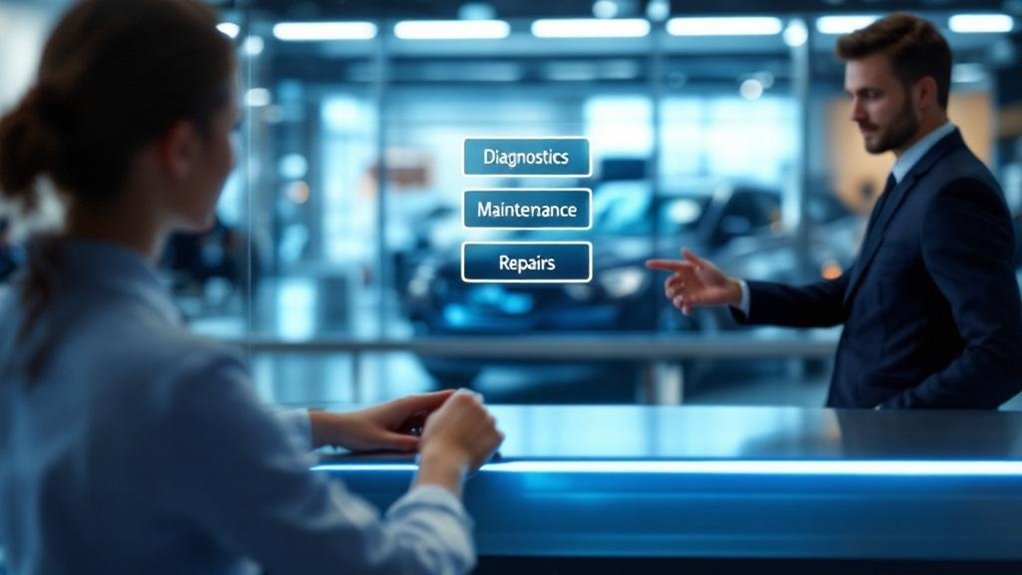
How will you drive traffic and conversions to your digital service menu? Use data-driven digital marketing to boost customer engagement and trust by showcasing transparent pricing (96% approval) and service packages that lift repeat business by 20%. Target ads to service-specific landing pages, optimizing for conversion and higher average repair orders. Create FAQ-centered content to improve visibility and long-term relationships.
Drive conversions with data-driven marketing: transparent pricing, targeted service pages, FAQ content, and loyalty packages to boost repeat business.
- Geo-targeted ads linking to tailored service pages
- SEO and FAQ content to capture search intent
- Email and SMS campaigns promoting loyalty packages
- A/B testing landing pages and CTAs
Measure KPIs—traffic sources, conversion rates, repeat-rate lift—and iterate frequently. That analytical, tech-savvy loop maximizes ROI while keeping your menu current and compelling.
Scaling and Updating Menus for New Vehicle Technologies
You’ve set up targeted campaigns and optimized pages to drive customers to your digital service menu—now keep that momentum by scaling the menu to match rapid advances in vehicle tech. You’ll use menu customization strategies to add electric and hybrid-specific services, interactive guides, and detailed explanations that build trust and reduce incoming service questions. Apply technology integration approaches to enable real-time pricing updates tied to parts inventory and labor rates so customers see accurate costs for novel systems. Regularly review feedback and service data to iterate offerings for new models, prioritizing high-demand procedures. Measurable outcomes—reduced call volume, higher booking conversion, improved satisfaction scores—confirm that proactive, data-driven menu updates are essential for competitive fixed ops performance.
Frequently Asked Questions
What Does a Fixed Operations Director Do at a Car Dealership?
You oversee fixed ops management, optimizing service workflows, staffing, training, and metrics to boost dealership efficiency; you deploy tech-driven tools, analyze financials, coordinate parts and sales, and drive measurable revenue, retention, and customer satisfaction.
What Is a Red Flag in a Dealership?
Right off the bat, a red flag in a dealership’s anything but small potatoes: it’s observable red flag behaviors causing customer dissatisfaction, like opaque pricing, poor communication, or high turnover—track metrics, deploy tech, fix root causes fast.
What Is the Highest Paid Position at a Car Dealership?
The highest paid position is typically the General Manager, though compensation varies; you’ll find highest paying dealership roles also include Fixed Ops Directors and Sales Managers, driven by performance, bonuses, and tech-enabled operational efficiencies.
What Three Departments Comprise the Fixed Operations of a Dealership?
They’re Service, Parts, and Body Shop. You’ll assess service department roles, tackle fixed ops challenges with data-driven workflows, optimize parts inventory, and streamline collision repairs using tech-savvy tools to boost efficiency, revenue, and customer retention.
Conclusion
You’ll see the ROI fast: a digital service menu cuts disputes, lifts average repair orders, and feeds your DMS with cleaner data — and by coincidence the same clarity customers crave also makes your bays run smoother. Adopt it, measure the KPIs, and tweak packages for EVs and contactless pickup; the tech pays for itself. Stay analytical, stay results-driven, and treat the menu as a live product that evolves with your shop’s needs.