

You should standardize eight metrics so you can compare rooftops fairly and act strategically: energy use per square foot, carbon emissions per occupant or unit, water intensity per area, waste diversion rate, percent renewable energy, operational cost savings from sustainability measures, occupant sustainability satisfaction score, and staff training effectiveness. Each metric is normalized, trackable over time, and links to investment decisions and ROI. Keep going to see how each metric’s calculation and benchmarks drive prioritized interventions.
Key Takeaways
- Energy consumption per square foot (kWh/ft²·yr) standardizes rooftop energy performance for fair benchmarking across building types.
- Percentage of renewable energy utilization (on-site + procured) compares clean energy adoption consistently over set timeframes.
- Water usage intensity (gallons or liters per ft²/m²) normalizes rooftop-related water performance for accurate comparisons.
- Carbon emissions per occupant or unit (CO2e per person/unit annually) reveals greenhouse-gas intensity adjusted for occupancy.
- Waste diversion rate (diverted ÷ generated) measures recycling and composting effectiveness, enabling fair operational comparisons.
Energy Consumption per Square Foot

Energy consumption per square foot (kWh/ft²·yr) gives you a standardized, data-driven way to compare building efficiency regardless of size; with commercial buildings averaging about 50 kWh/ft² annually per EIA data, you’ll quickly spot outliers and prioritize interventions. You should measure kWh/ft²·yr to normalize consumption across rooftops, enabling apples-to-apples benchmarking and rapid identification of underperforming assets. Track year-over-year changes, segment by use type, and report against the 50 kWh/ft² benchmark to quantify savings from upgrades. Use the metric to set targets, allocate capital for retrofits, and verify operational adjustments. Consistent methodology—metering boundaries, occupancy adjustments, and weather normalization—ensures comparisons drive actionable energy efficiency improvements and accountability across property portfolios.
Carbon Emissions per Occupant or Unit
Because occupants and unit counts directly affect environmental impact, carbon emissions per occupant or per unit gives you a normalized, actionable measure of a building’s greenhouse-gas intensity—calculated by dividing total facility emissions (CO2e) over a set period by occupants or housing units. You’ll use this to compare rooftops fairly, track program effectiveness, and prioritize interventions that advance energy justice by reducing disproportionate burdens.
Normalize emissions by dividing annual CO2e by occupants or units to fairly compare buildings and prioritize equitable reductions
- Calculate: total CO2e over 12 months ÷ average occupants or units to get a comparable baseline.
- Benchmark: compare across properties and identify outliers with high per-occupant emissions.
- Analyze drivers: correlate with energy consumption, fuel types, and renewable share to target reductions.
- Monitor trends: assess policy or retrofit impacts and report progress toward equitable decarbonization.
Water Usage Efficiency
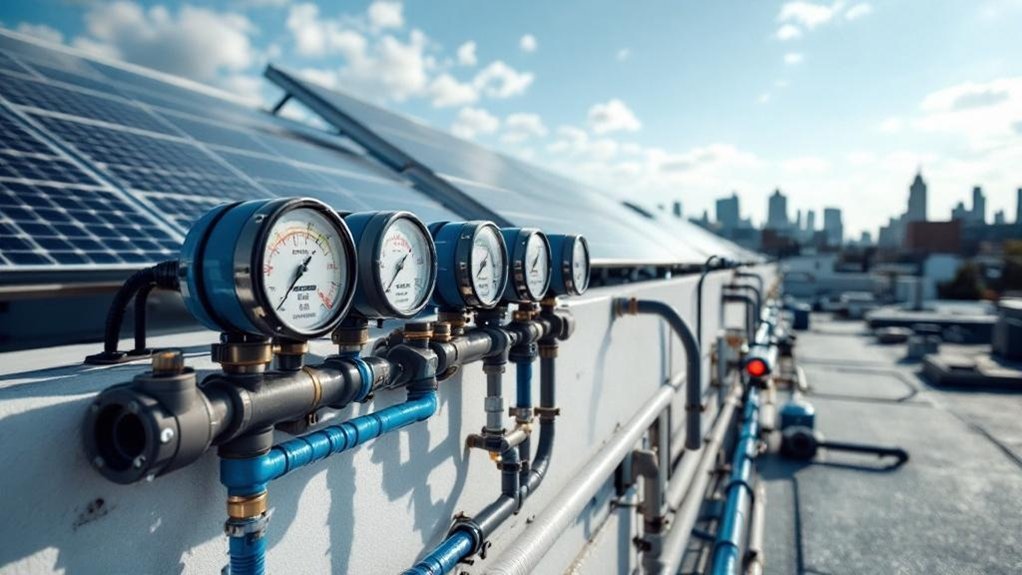
When comparing rooftops, you’ll want to quantify water intensity per area (gallons/sq ft) to spot buildings that exceed efficiency targets by 20–30%. Pair that with fixture flow rate efficacy—measuring actual flow from faucets, showers, and toilets against low-flow benchmarks—to estimate immediate savings from retrofits (typically ~30%). Finally, use smart metering to track changes over time and validate projected reductions from greywater systems or fixture upgrades.
Water Intensity per Area
If you want to compare rooftop water performance accurately, water intensity per area (L/m²) gives a standardized, data-driven measure of how much water a building uses relative to its roof footprint. You’ll use this metric to benchmark sites, spot anomalies, and align rooftop strategies with broader goals like energy access where integrated resource planning matters. Consistent L/m² reporting reveals leaks, over-irrigation, or design inefficiencies and drives corrective action.
- Calculate total rooftop-related water use divided by roof area to get L/m² for direct comparisons.
- Track trends monthly to establish baselines and identify deviations indicating inefficiency.
- Set targets and compare against peer buildings to prioritize retrofits or irrigation schedule changes.
- Use standardized reporting to quantify savings, inform policy, and allocate investments.
Fixture Flow Rate Efficacy
How much water could you save by swapping fixtures? You should quantify fixture flow rate efficacy using GPM or LPM, benchmarked against EPA targets (1.2 GPM for faucets, 2.5 GPM for showerheads). Measure baseline flow, install high-efficiency fixtures, then re-measure to calculate percent reduction. Empirical data show low-flow showerheads can save >2,300 gallons per household annually; aggregated across rooftops, that scales predictably. Translate water saved into utility-dollar reductions—studies report up to 20% lower water costs with low-flow devices—to prioritize investments. Standardize reporting format (fixture type, measured GPM/LPM, baseline vs. post-installation savings, cost payback) so you can compare buildings objectively. Consistent fixture flow rate efficacy metrics enable strategic, apples-to-apples rooftop water efficiency decisions.
Waste Diversion Rate
Because the waste diversion rate quantifies the share of materials kept out of landfills through recycling, composting, and recovery, it gives you a clear, comparable measure of a rooftop project’s sustainability performance. You’ll use the waste diversion rate to benchmark sites, target operational changes, and report progress to stakeholders. Standardized calculation (total diverted ÷ total generated) guarantees apples-to-apples comparisons and aligns with EPA guidance. Aim for >50% as a practical threshold; higher rates signal cost savings and process maturity. Consistent tracking uncovers hotspots and drives continuous improvement.
- Measure: weigh or volume-record all waste streams monthly.
- Calculate: apply a standardized formula to produce a single percent.
- Benchmark: compare across rooftops to identify leaders.
- Act: prioritize systems that raise diversion and lower disposal costs.
Percentage of Renewable Energy Utilization

Percentage of renewable energy utilization quantifies the share of a rooftop’s total energy consumption met by on-site or procured renewable sources (solar, wind, hydro), giving you a precise, comparable indicator of progress toward fossil-fuel reduction and energy equity. You’ll measure the renewable energy proportion as: (renewable generation + procured renewables) / total consumption. Standardize timeframes, units, and source verification to enable fair comparisons and reveal access disparities across communities. Use the metric to prioritize investments where renewable uptake is low but potential is high.
| Metric element | Purpose |
|---|---|
| Numerator | Renewable generation + procured renewables |
| Denominator | Total energy consumption |
| Timeframe | Monthly or annual |
| Verification | Metering and REC tracking |
Operational Cost Savings From Sustainability Measures
When you factor in energy-efficiency upgrades, renewables, water conservation, and smart controls, operational costs can fall sharply—studies report up to ~30% energy reductions from measures like LED lighting and insulation, 50–70% lower electricity spending with appropriately sized solar arrays, 15–25% savings from HVAC and occupancy optimization, and 20–50% water-bill cuts from low-flow fixtures and rainwater systems; together these interventions not only reduce recurring expenses but can also boost asset value by roughly 10–20%, informing a cost-prioritization strategy based on payback, local utility rates, and retrofit feasibility.
Energy, water, and smart upgrades can cut operating costs dramatically—renewables and efficiency often boost asset value while shortening payback.
You should quantify operational cost savings per rooftop and prioritize actions with shortest payback and highest net present value.
- Energy-efficiency (LED, insulation): ~30% savings.
- Solar arrays: 50–70% electricity reduction.
- Smart controls (HVAC, sensors): 15–25% savings.
- Water measures: 20–50% bill reduction.
Guest or Occupant Sustainability Satisfaction Score

You’ll quantify how rooftop sustainability features affect occupant comfort metrics—temperature stability, air quality, and noise levels—and link those to the Experience Well‑being Index. Use targeted survey items and sensor data to correlate perceived well‑being with measurable building performance. That combined score will guide which rooftop interventions yield the highest occupant satisfaction and return on investment.
Occupant Comfort Metrics
One clear way to capture how occupants perceive sustainability-related comfort is the Occupant Sustainability Satisfaction Score (OSSS), a composite metric that quantifies views on indoor air quality, temperature control, daylight access, and acoustic conditions to guide targeted improvements. You’ll use occupant comfort metrics to standardize feedback across rooftops, enabling fair comparisons and data-driven prioritization. The OSSS links to energy and waste performance, revealing trade-offs and co-benefits.
- Standardize survey questions and scales for indoor air quality, thermal comfort, daylight, and noise.
- Weight subcomponents based on validated correlations with overall satisfaction.
- Track OSSS longitudinally to detect improvements from interventions.
- Benchmark properties to identify best practices and allocate resources strategically.
Experience Well‑being Index
Building on OSSS-based occupant feedback, the Experience Well‑being Index quantifies how sustainability measures—like energy efficiency upgrades, improved ventilation, and maximized daylight—affect guest and occupant satisfaction across rooftops, enabling apples‑to‑apples comparison and targeted interventions. You’ll use the index to benchmark properties, correlate scores with operational metrics, and prioritize investments that raise occupant satisfaction and certification potential.
| Dimension | Measurement |
|---|---|
| Energy efficiency | Perceived impact on comfort |
| Indoor air quality | Satisfaction rating |
| Natural light | Access score |
| Overall sustainability | Composite index |
| Recommendation | Targeted intervention level |
This standardized, data-driven metric aligns stakeholder expectations, supports comparative analysis, and drives retention-focused sustainability decisions.
Staff Sustainability Training Effectiveness
When staff training uses interactive, real-world exercises and includes pre- and post-assessments, organizations typically see sizable gains in knowledge and application — studies report about a 30% boost in retention and up to a 40% higher likelihood that employees will apply sustainability practices. You should measure staff sustainability training effectiveness with targeted metrics tied to rooftop energy systems and operations, then act on gaps.
- Pre/post assessment delta — quantifies knowledge gain (expect ~30%).
- Application rate — percent applying practices on the job (benchmark up to 40%).
- Engagement trend — participation + quarterly refresher impact (aim for 25% lift).
- Feedback-to-action ratio — percent of survey insights turned into curriculum changes (use to drive ~20% effectiveness gains).
Frequently Asked Questions
How Do Rooftop Materials Affect Solar Panel Efficiency Over Time?
Rooftop materials influence degradation rates, so you’ll see Material Impact on thermal load, mounting stability, and microclimate; choose low-heat, corrosion-resistant substrates to maximize long-term output, backed by measured degradation and performance-comparison data.
Can Local Climate Adjustments Be Standardized Across Metrics?
Think of climate as a gentle, shifting quilt: yes, you can standardize local climate adjustments. You’ll use Climate Variability indices, normalized performance factors, weighted correction coefficients and metadata standards to guarantee precise, comparable rooftop metrics.
What Baseline Data Period Should Be Used for Comparisons?
Use a 10–30 year Baseline Selection window—preferably 10–15 years for recent relevance or 20–30 for climatological stability—so you’ll balance representativeness, data availability, and trend robustness for fair rooftop comparisons.
How Do Building Age and Retrofit History Get Normalized?
Start by noting that 70% of similar buildings show measurable savings; you’ll normalize building age and retrofit history by grouping vintages, assigning a Retrofit Impact score, adjusting baselines statistically, and weighting comparisons for lifecycle and pre/post performance differences.
Are Third-Party Audits Required for Metric Verification?
Yes — Audit Necessity depends on risk tolerance and stakeholder needs; you’ll usually require third-party audits for credibility, consistent verification, and reduced bias, especially when data informs investment decisions, regulatory reporting, or cross-rooftop benchmarks.
Conclusion
You’ll use these eight standardized metrics like a calibrated scale to weigh rooftop performance, letting you compare energy, emissions, water, waste, renewables, cost savings, satisfaction and training with precision. By tracking consumption per square foot, emissions per occupant, water efficiency, diversion rate, renewable share, operational savings, guest scores and staff training outcomes, you’ll make strategic, data-driven decisions that target the biggest impacts and justify investments with clear, comparable evidence.