

You get faster, clearer updates because service-drive digital signs pull live status, ETAs and alerts directly from your shop management and CRM. That real-time feed eliminates manual calls, syncs progress bars and timestamps, and pushes targeted promos or warnings instantly. Customers see measurable ETA changes and fewer surprises, so perceived wait drops and staff spend less time on status calls. The system’s secure, low-latency APIs and centralized content control speed ops — continue for deployment and integration specifics.
Key Takeaways
- Real-time integration with service-management systems pushes live status and ETAs directly to displays.
- Dynamic alerts and progress bars update instantly, reducing customer uncertainty and repeat status calls.
- Centralized content control enables rapid timeline and promotion changes across all service-drive screens.
- Visual status updates cut perceived wait times by over 35%, improving customer satisfaction and throughput.
- Secure, low-latency APIs automate feeds so staff focus on repairs instead of answering update requests.
How Service Drive Digital Signs Improve Real-Time Communication

When you’re waiting at the service drive, digital signs give real-time status updates and estimated wait times so you don’t have to ask staff for information. You get real time alerts that push status changes, ETA revisions, and promotional messages instantly, cutting perceived wait by over 35% and improving customer engagement. Remote content management lets operators modify timelines and offers centrally, ensuring displayed data matches shop reality. Visuals and concise messaging streamline information transfer, freeing technicians and advisors to handle higher-value, personalized tasks. The system reduces repetitive inquiries, lowers front-desk load, and creates measurable satisfaction gains. Implementation focuses on latency, content accuracy, and integration with service management systems for reliable, actionable communication.
Reducing Wait Times With Live Service Status and Estimated Completion
One clear benefit of live service-status displays is they cut perceived wait times by delivering real-time progress and ETA updates directly to customers, reducing anxiety and repetitive status inquiries by staff. You get continuous live updates that reflect actual workflow stages and dynamically adjusted ETAs, so expectations are set and customer anxiety drops. That transparency reduces status calls and lets technicians focus on diagnostics and repairs, increasing throughput. Data shows perceived wait reduces by over 35% when customers see current progress and reliable completion estimates, improving operational efficiency. Deploying synchronized digital signage tied to shop management systems guarantees consistent messaging, fewer manual touchpoints, and predictable service cadence, giving you measurable time-savings and higher staff productivity.
Enhancing Customer Satisfaction Through Clear Visual Updates

Because clear visual updates give customers immediate, actionable information, you’ll see anxiety drop and satisfaction rise as service progress and ETAs are displayed in real time; that transparency reduces uncertainty, fewerens status calls, and lets staff spend more time on high-value interactions. You’ll deploy digital signage that presents concise progress bars, timestamps, and ETA adjustments so customers get unambiguous status at a glance. Measurable gains follow: perceived wait times fall by over 35%, customer confidence increases, and overall throughput improves as fewer interruptions disrupt technicians. Visual engagement elements — color-coded stages, succinct text, and predictable update cadence — maintain attention without cognitive overload. The result is a streamlined service drive where informed customers are calmer, trust grows, and staff can prioritize personalized service delivery.
Integrating Digital Signs With Service Management and CRM Systems
Connect your digital signs to service management and CRM platforms to push real-time vehicle status, ETAs, and targeted offers directly to customers in the service drive. With digital signage integration, you’ll automate status feeds so displays reflect appointment schedules, work progress, and inventory-driven promotions without staff intervention. That reduces perceived wait times up to 35% and frees technicians and advisors for higher-value tasks. Use CRM data to segment visitors and render personalized messages, increasing customer engagement and conversion of service upsells. Capture interaction and request metrics from the signage ecosystem to analyze behavior, refine targeting, and optimize content cadence. Architect integrations with robust APIs, event-driven webhooks, and secure authentication to guarantee accuracy, low latency, and compliance while maintaining operational efficiency.
Best Practices for Deploying and Maintaining Service Drive Displays
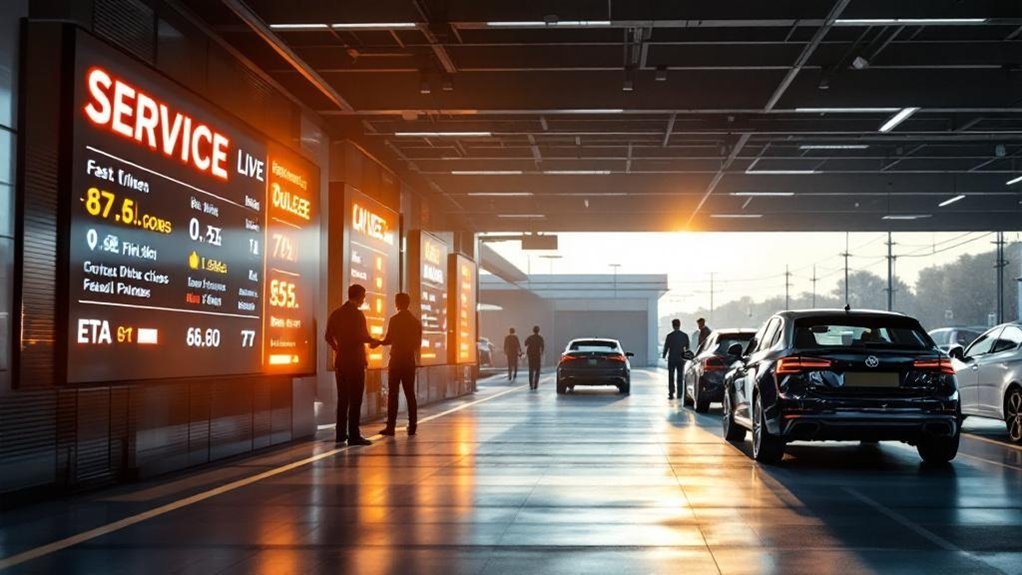
Successful deployment and maintenance of service-drive displays hinges on a few practical priorities: choose high-brightness, weatherproof hardware sized for sightlines; enforce automated content updates tied to your CRM and service-management feeds; implement secure, low-latency APIs and webhooks for status and promotion pushes; and train staff on basic ops, troubleshooting, and customer-facing messaging. You’ll standardize a content strategy that prioritizes real-time service-status, ETA, and actionable promotions to reduce perceived wait times by over 35%. Automate feeds from inventory and CRM to remove manual updates and guarantee relevance. Schedule firmware and content-refresh windows, monitor display health with remote diagnostics, and log incidents for continuous improvement. Conduct focused staff training so technicians and advisors can interpret screens, escalate issues, and use displays to improve customer interactions.
Frequently Asked Questions
What Is a Red Flag in a Dealership?
A red flag in a dealership is when you encounter opaque pricing, hidden fees, poor dealership transparency and inconsistent communication that erodes customer trust; those signs indicate unreliable practices, limited vehicle info, or unresolved negative reputation issues.
How Much Does a Car Salesman Make on a $30k Car?
You’d typically earn about $3,000–$4,500 in sales commission on a $30k car, depending on profit margins; with base salary and bonuses you’ll often add $30k–$50k annually, plus incentives on add‑ons.
Why Are Car Dealership Websites so Slow?
Your dealership website’s slow because unoptimized media, outdated code, excessive plugins, limited server resources and poor mobile design degrade website performance, hurting customer experience; you’ll need optimization, CDN, streamlined integrations and upgraded hosting to fix it.
What Is the Main Advantage of Digital Marketing in Automobile Sales?
Like a telegraph, the main advantage is that digital marketing boosts consumer engagement by delivering targeted, real-time offers and analytics-driven insights, so you’ll optimize reach, track behavior, and improve conversion rates with technical precision and speed.
Conclusion
You’ll see results fast: service drive digital signs act like a pit‑crew radio, delivering live status, ETAs, and targeted messages so technicians, advisers, and customers stay aligned. Integrating these displays with your service management and CRM reduces uncertainty, cuts perceived and actual wait times, and boosts satisfaction. Deploy them with centralized content control, robust network security, and routine maintenance to guarantee uptime and accurate, actionable updates that drive measurable operational improvements.