

You’ll boost conversions by embedding timed, targeted coupons directly into your digital price comparison board, since offers can lift conversions up to 30%. Prioritize clear hierarchy, concise CTAs, and visible expiration dates to speed decisions. Use unique codes or QR barcodes to track redemptions, tag coupons by service/vehicle/season for relevance, and sync real‑time updates with inventory and appointments. Measure redemption rates and A/B test creatives. Keep going and you’ll see practical implementation steps and metrics to optimize.
Key Takeaways
- Display active coupons prominently on the comparison board with clear discount amounts, service names, and expiration dates for immediate clarity.
- Use unique barcodes or redemption codes per coupon and log redemptions to accurately measure conversion and ROI.
- Tag coupons by service, vehicle type, and season to enable targeted filtering and improve relevance in comparisons.
- Sync coupons with real-time inventory, appointment slots, and automated start/end dates to prevent expired or unavailable offers.
- Implement one-click claim or QR-code redemption workflows and train staff on verification procedures for fast, auditable checkouts.
Why Integrating Coupons Into Price Comparison Boards Drives Conversions

When you integrate coupons directly into your price comparison board, you create immediate, measurable incentives that drive action—research shows personalized offers displayed alongside vehicle prices can raise conversion rates by as much as 30%. You’ll boost customer engagement by surfacing clear, relevant savings like “$20 off your next oil change” next to listings, which increases perceived purchase value. Clear expiration dates introduce urgency, shortening decision cycles and improving conversion rates further. Dynamic, visible coupons reinforce brand awareness and satisfaction—dealerships report 99% satisfaction when pricing and specials are combined. You’ll get measurable uplifts in traffic-to-sale metrics, higher average transaction value from add-on redemptions, and stronger retention as buyers associate your brand with transparent savings. Quantify results to optimize offers.
Designing a User-Friendly Interface for Specials and Coupons
You’ll boost conversions by applying a clear visual hierarchy that prioritizes discount amounts, expiration dates, and vehicle relevance so users scan offers in under two seconds. Pair that with a simple redemption flow—one-click claims, visible terms, and instant confirmation—to cut abandonment rates based on A/B test benchmarks. Consistent branding and high-quality visuals keep trust high while the streamlined path drives faster action.
Clear Visual Hierarchy
Clarity drives conversion: establish a strict visual hierarchy that separates standard prices from discounted coupon rates using bold headings, contrasting colors, and larger fonts for specials so customers can scan and act quickly. You’ll maintain visual consistency by using a limited palette and consistent typography scales, which improves user engagement and reduces cognitive load. Make special offers immediately scannable with larger type, badges or icons signaling savings or urgency, and clearly labeled sections like “Current Specials” and “Coupons.” Display expiration dates and discount details prominently to prevent confusion. Measure click-through and redemption rates to validate hierarchy choices and iterate. Keep layouts modular so the brand looks cohesive across screens while maximizing attention to high-value promotions.
Simple Redemption Flow
Although a streamlined redemption flow may seem small, it directly lifts conversion — simplify the path from discovery to redemption with a prominent CTA, concise coupon details, and a minimal form so customers can claim offers in three taps or fewer. You’ll prioritize a clear call-to-action and visible expiration dates to drive urgency and measurable customer engagement. Use high-quality images plus short value statements to communicate offer benefit in one glance, reducing decision time. Keep the redemption process to a single, pre-filled form with only essential fields (name, contact, VIN or stock number) and a confirm button that generates a scannable code or auto-applies the discount. Track click-to-redemption rates to iterate and optimize UX for brand conversion.
Selecting Coupon Types and Promotion Formats for Dealerships
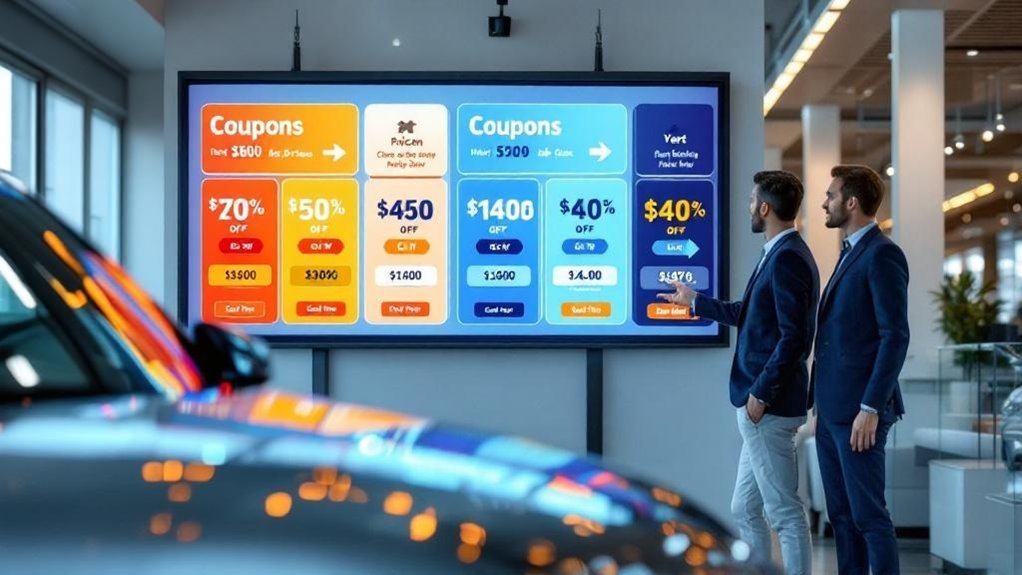
You should choose coupon types—cash off, percentage, and fixed-price offers—based on conversion data and typical transaction sizes to maximize perceived value and margin control. Pair those with promotion formats like time-limited banners, service-specific callouts (e.g., “$20 off synthetic oil change”), and branded image cards to boost urgency and visual appeal. Track redemptions with barcodes or unique codes to measure which combinations drive appointments and refine your mix.
Coupon Type Selection
Which coupon type will move the needle for your lot: a straight cash discount, a percentage off, a fixed-price bundle, or a service package tied to maintenance? You’ll choose based on coupon effectiveness data and promotional diversity goals: cash discounts drive quick showroom traffic, percentages communicate perceived value on higher-priced vehicles, fixed-price bundles simplify decision-making, and service packages build retention. Tag each coupon for targeted discovery, use crisp images and concise descriptions to boost engagement, and customize CTA text to steer prospects (schedule test drives, join loyalty). Always set clear expiration dates to create urgency and lift conversion. Track redemptions and A/B test types to quantify ROI and refine your brand-focused promotion mix.
Promotion Format Options
When mapping promotion formats to your sales goals, pick the coupon type that aligns with the metric you want to move—cash discounts for immediate showroom traffic, percentage-off for perceived value on higher-ticket vehicles, fixed-price bundles to simplify purchase decisions, and service packages to boost retention—then tag offers for targeted discovery, pair them with high-quality images and concise CTAs, and always include clear expirations so you can A/B test redemption rates and quantify ROI. You’ll use promotion strategies that combine measurable formats with tagging and tailored CTA text to drive customer engagement and retention. Prioritize formats that produce clear KPIs (redemptions, visits, service bookings), track imagery performance, and iterate fast based on ROI data.
- Cash discount: immediate traffic
- Percentage-off: perceived value
- Fixed-price bundle: decision simplicity
- Service package: retention-focused
Tagging, Categorization, and Targeting for Relevant Offers
Because precise tagging and categorization let you surface the right specials to the right customers, implement a multi-tag system (service, parts, vehicle, seasonal, etc.) that supports multiple selections per offer; this improves discovery on your price board, boosts relevance in digital comparisons, and, backed by customer data, increases engagement and conversions. You’ll use tagging strategies tied to customer segmentation to map offers to behaviors and service history, improving CTR and conversions. Keep categories simple and consistent, audit tag performance monthly, and prioritize high-ROI segments. Below is a compact reference for tag-targeting use.
| Category | Example Tags | Target Segment |
|---|---|---|
| Service | oil, brake, inspection | recurring maintenance owners |
| Parts | battery, tires | DIY or value shoppers |
| Vehicle | SUV, electric | model-specific buyers |
| Seasonal | winter, summer | time-sensitive needs |
Mobile Redemption and Seamless In-Store Pickup Workflows

Tagging and targeted offers set the stage, but mobile redemption and streamlined pickup turn those moments of interest into completed sales by removing friction at the point of arrival. You’ll increase mobile accessibility and customer engagement by letting shoppers access coupons on smartphones, scan QR codes, and trigger appointment-based pickup workflows. Integrate your coupon engine with the dealership’s scheduling and POS so staff see promotions in real time and fulfill orders faster. Track redemption rates and pickup wait times to optimize processes and reduce abandonment.
- Sync coupons with appointment slots to predict arrivals and allocate staff.
- Use QR-enabled mobile coupons for sub-30-second checkout scans.
- Centralize promotions so every salesperson has current offer visibility.
- Monitor KPIs: redemptions, dwell time, conversion uplift.
Visual Design Best Practices for High-Impact Coupon Displays
Although strong visuals grab attention in under a second, design choices should be driven by measurable impact: use high-resolution images and bright, on-brand colors to lift click-through and redemption rates, display clear value statements like “$20 off synthetic oil change” to reduce decision time, and include logos, service icons, CTAs, and expiration dates so offers build trust, prompt action, and feed clean data for A/B testing and KPI tracking. You should enforce visual consistency across coupon templates so customers instantly recognize offers and you can compare variant performance. Prioritize branding elements—logo placement, type hierarchy, and color contrast—to protect legibility on varied screens. Use concise CTAs and explicit benefits to raise conversions, and capture metadata (expiry, offer ID) for accurate tracking and optimization.
Real-Time Updates and Scheduling for Time-Sensitive Specials

When you set up real-time updates and scheduling on your digital price board, you’ll guarantee time-sensitive specials are accurate, urgent, and actionable—start/end dates create scarcity, live pushes let you respond to market shifts instantly, and synced appointment booking turns interest into visits. You’ll use real time synchronization to keep coupons current, reduce staff confusion, and maintain brand credibility. Scheduling enforces urgency creation via automated countdowns and gated redemption windows, driving immediate customer action. Quick edits let you react to competitor moves or inventory changes without delay. Integrate appointment booking so visitors redeem offers seamlessly and visits convert.
- Automate start/end dates to prevent expired offers.
- Push live updates for market-driven adjustments.
- Sync team alerts to streamline customer responses.
- Link bookings to specials for measurable conversion.
Measuring Performance: Metrics and A/B Testing Strategies
Because measurable results separate assumptions from profitable decisions, you’ll want to define a tight set of KPIs—coupon redemption rate, traffic to the price-comparison board, click-throughs on offers, and conversion lift—to evaluate how coupons and specials actually move customers and revenue. Use A/B tests (board A with prominent coupons, board B without) to isolate impact on user engagement and conversion lift. Track clicks, sessions, and post-visit purchases to build performance benchmarks and quantify ROI. Iterate creative, placement, and offer cadence based on statistically significant differences. Combine quantitative metrics with qualitative feedback to refine targeting and messaging.
| Metric | Goal | Tool |
|---|---|---|
| Redemption rate | +X% | Analytics + POS |
| CTR | +Y% | Tagging & heatmaps |
| Conversion lift | +Z% | A/B platform |
Compliance, Redemption Security, and Operational Procedures
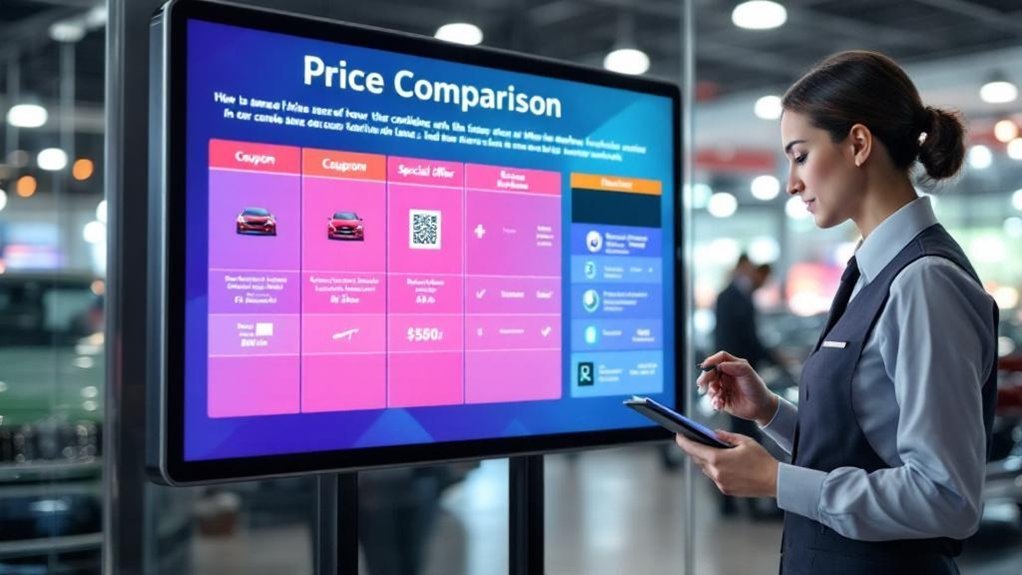
If you want coupon programs to drive measurable revenue without exposing the dealership to fraud or legal risk, you’ll need tightly defined redemption security, clear operational procedures, and ongoing compliance checks. You’ll implement redemption codes or barcodes to track conversions and meet data privacy requirements, and you’ll log redemptions for ROI analysis. Establish operational guidelines that staff follow at point of sale to prevent misuse and protect pricing integrity. Train employees on procedures so redemptions are fast and auditable. Use digital signage to push real-time updates and surface policy changes.
- Use unique codes/barcodes for secure, traceable redemptions.
- Schedule periodic compliance checks tied to privacy rules.
- Document operational guidelines and staff training completion.
- Integrate digital signage updates with redemption logs.
Frequently Asked Questions
What Is the Four Square Trick at a Car Dealership?
The four square is a negotiation tactics framework you’ll see at dealerships: it breaks the deal into price, trade-in, financing, and monthly payment, letting you compare variables transparently while guiding discussions toward closing with measurable options.
How Much Commission Does a Car Salesman Make on a $30,000 Car?
You’d typically earn $600–$900 on a $30,000 car if gross profit is $3,000 and your commission structure pays 20–30%; sales incentives or flat fees can raise earnings, so check dealership policies and bonus thresholds.
How to Increase Sales in a Car Dealership?
You’ll boost sales by using data-driven sales strategies and improving customer engagement: personalize offers, train staff on consultative selling, optimize digital touchpoints, track conversion metrics, and run targeted campaigns aligned with your brand promise.
Can You Negotiate With 0% Car Finance?
Yes — you can’t change 0% interest itself, but you can negotiate price, add-ons, or trade-in value. Use negotiation strategies and compare financing options; be data-driven, concise, brand-focused to reduce total cost effectively.
Conclusion
You’ll boost conversions when your comparison board makes coupons impossible to ignore: dealers that personalize offers see up to 20% higher redemption rates, so imagine one in five shoppers walking into your lot with a deal in hand. Focus on clean visuals, targeted tags, secure mobile redemption, and A/B test placements. Track redemptions, lift, and time-to-purchase, and you’ll turn specials into predictable, measurable revenue rather than sporadic foot traffic.