

Use digital price comparison boards to show real-time tire prices, 4‑tire bundle savings and service add‑ons side‑by‑side so shoppers compare and convert faster. Target local driving profiles and high‑ownership zip codes, sync feeds with your website and CRM, and run dynamic promos tied to seasonality and competitor moves. Measure lift via clicks, store visits and tire sales, then iterate offers weekly. Keep displays concise, eye‑level and aligned with lot signage — continue and you’ll get tactics, metrics and placement tips.
Key Takeaways
- Display real-time, side-by-side tire prices and package details to simplify comparisons and speed purchase decisions.
- Rotate targeted seasonal and bundle promotions (service add-ons, new-vehicle discounts) with countdown timers to create urgency.
- Sync digital boards with website and CRM via APIs to ensure price accuracy and capture leads automatically.
- Place high-resolution boards at eye level near tire racks and exterior lots, mirroring offers across channels to drive foot traffic.
- Monitor click-throughs, store visits, sales lift, and dwell time to iterate offers and protect margins against competitor moves.
Why Digital Price Comparison Boards Work for Tire Promotions

Because customers compare prices quickly and often online, digital price comparison boards give your tire promotions an immediate, measurable advantage: they let you display real-time, side-by-side pricing and package details so shoppers can see exactly how your offers stack up, which increases conversion rates and shortens decision time. You’ll deploy dynamic pricing feeds that update promotions instantly, reducing mismatches and lost sales. Visual clarity boosts digital engagement and drives foot traffic; measurable impressions and click-throughs link displays to conversions. Showcasing bundled tire-and-service specials differentiates you from competitors and reinforces customer trust via transparency. Integration with your POS and inventory systems streamlines campaign execution, lowers administrative overhead, and provides actionable analytics so you can iterate offers based on real-world performance.
Identifying Your Target Audience for Tire Offers
You should map local driving profiles — commute lengths, road types, and seasonal mileage — to prioritize tire offers where wear risk and demand are highest. Pair that with purchase intent signals from search behavior, service bookings, and past tire buys to target high-propensity customers. Doing both lets you allocate promotional spend precisely and lift conversion rates on your digital price comparison boards.
Local Driving Profiles
When you combine demographic data (age, income, vehicle ownership) with geographic and behavioral insights, you can pinpoint the customer segments most likely to buy tires and tailor offers that convert. Use demographic analysis to prioritize high-ownership zip codes and income bands that afford premium or value tire options. Layer geographic segmentation — urban commuters, rural drivers, mountainous routes — to match tread and durability messaging. Incorporate behavioral signals like maintenance frequency and seasonal driving to schedule targeted promotions for winter or all-season tires. Factor local climate metrics (snow, rain) to justify safety-focused creatives. Finally, leverage customer feedback and service history to personalize price comparisons on your digital boards, increasing relevance and measurable conversion rates without wasting impressions.
Purchase Intent Signals
Anyone browsing tire-spec pages, clicking tire promos, or asking about fitment is signaling purchase intent you can act on. Use behavior data — site visits, promo interactions, spec inquiries — to flag high-propensity prospects. Cross-reference purchase trends and past buys to predict which tire families convert best, and segment by vehicle type, age, and income to tailor offers. Monitor social engagement on tire posts and feed responses into your targeting rules to refine messages and timing. Deploy brief surveys to capture explicit customer preferences and pain points, then A/B test promotions on your digital price board. Measure lift by conversion rate, average order value, and retention to iterate rapidly and maximize ROI on tire campaigns.
Designing Clear and Compelling Tire Pricing Displays
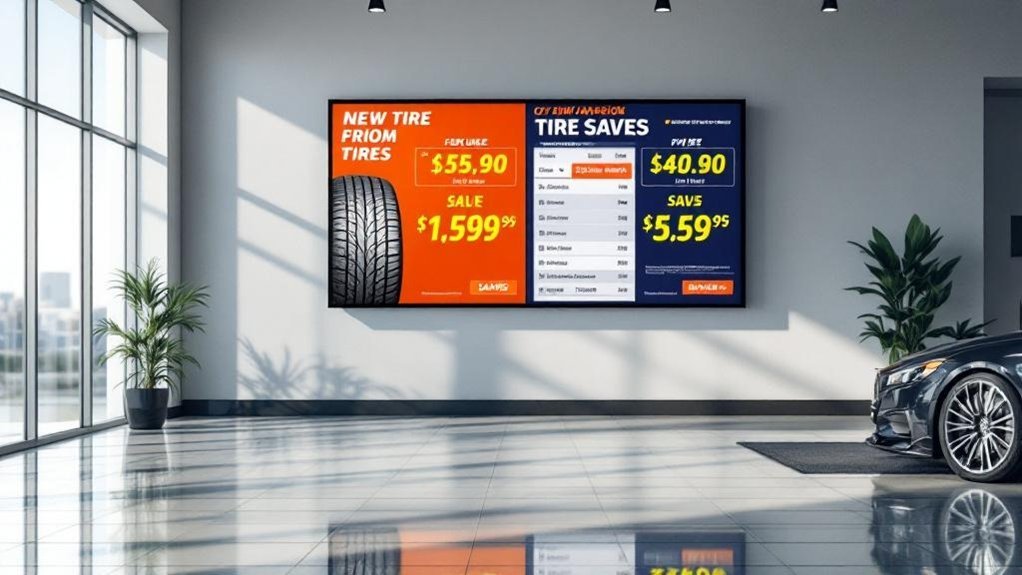
3 design principles will make your tire pricing boards far more effective: high-resolution visuals, real-time pricing updates, and concise benefit-driven messaging. You’ll use tire display design to boost pricing visibility—high-res screens and vibrant colors let customers compare options instantly, reducing decision time by up to 40% in tests. Real-time pricing updates sync promotions and inventory, preventing price-discrepancy fallout and increasing conversions. Keep copy tight: headline (price), subhead (key benefit), and a single CTA like “Visit us today for exclusive tire deals!” Show financing options succinctly to lower purchase friction. Segment displays for demographics to raise relevance and conversion probability. Measure lift via click-throughs, store visits, and sales; iterate displays weekly based on those metrics.
Bundling Tires With Vehicle Purchases and Service Packages
You’ll boost conversion by clearly advertising bundle discounts that tie tire sets to new-vehicle purchases, showing exact dollar or percentage savings. Offer service-package tire add-ons (rotations, alignments, seasonal swaps) with projected lifetime maintenance savings to increase average ticket and repeat visits. Use digital boards to rotate seasonal tire-and-service deals in real time, measuring uplift in foot traffic and attachment rates.
Bundle Discounts With Purchases
Bundle discounts that tie tires to vehicle purchases or service packages can raise average transaction value measurably: offering a fixed-dollar or percentage discount when customers buy tires with a new car or service increases take-up and perceived value, with studies showing about 70% of consumers prefer bundled deals. You should deploy customer engagement strategies that surface these offers on digital price comparison boards, using targeted promotional messaging techniques to display savings clearly. Present headline savings, example bundles, and ROI metrics to make decisions fast. Track conversion lift, average order value, and retention rates to quantify impact. Use A/B tests on discount levels and messaging to optimize uptake. When you show transparent, comparative pricing, bundled tire deals become a measurable growth lever.
Service Package Tire Add-ons
When you tie a tire package to a vehicle purchase or service plan, dealers can lift overall sales by up to 20% while boosting average transaction value and long-term retention; digital price comparison boards make that impact visible in real time by surfacing cost savings, limited‑time offers, and clear ROI metrics that speed purchasing decisions. Use boards to display bundled pricing, projected savings, and the incremental profit per sale so you can measure lift immediately. Highlight tire maintenance schedules and included services to reduce post-sale churn, and pair visuals with concise customer education points that explain safety and value. Time‑limited bundle prompts drive urgency; integrated analytics confirm higher average tickets and improved loyalty when tires are offered as service add-ons.
Seasonal Tire-and-Service Deals
How can seasonal tire-and-service deals move the needle on both conversions and lifelong value? You can use digital price comparison boards to spotlight bundled tire-and-service packages at purchase, driving urgency with limited-time discounts and clearer value messaging. Data shows visible bundles boost conversion and simplify decisions, improving satisfaction and repeat service revenue. Include tire selection tips and aggregate customer feedback on performance to reduce purchase friction and increase trust.
- Display matched tire packages with each vehicle trim to upsell at point-of-interest.
- Rotate seasonal promotions to create scarcity and track lift in conversion rates.
- Highlight percentage savings and estimated lifetime cost to frame value.
- Surface service schedule inclusions to promote retention.
- Use customer feedback snippets to validate quality and reduce objections.
Leveraging Seasonal Promotions and Limited-Time Offers
One timely seasonal promotion can turn passersby into buyers by using digital price comparison boards to spotlight limited-time tire offers—like spring “Buy 3 Get 1 Free” deals—with real-time pricing and countdown timers that create urgency and drive conversions. You’ll align seasonal trends and promotional strategies by displaying targeted rebates, financing options, and time-limited bundles when demand spikes. Track interactions and dwell time to quantify engagement and conversion lift, then A/B test creative and timer lengths to find the highest-performing offer. Present clear comparisons against regular prices so shoppers see immediate value; include concise calls to action to reduce decision friction. Use analytics to refine cadence, message, and inventory focus each season to maximize foot traffic and sales on peak days.
Integrating Comparison Boards With Your Website and CRM

You’ll want your comparison boards to sync prices in real time with your website so shoppers always see accurate tire rates and promotions. Auto-import leads into your CRM to capture prospects from on-screen interactions and route them into targeted follow-ups. Then track promotion performance centrally to measure conversion rates, optimize offers by location, and prove ROI.
Sync Prices in Real-Time
Because real-time syncing ties your website and CRM to the digital price comparison board, tire prices stay accurate and reflect inventory changes, promotions, and market shifts the moment they occur. You’ll get real time updates that improve price accuracy and customer trust while cutting manual update errors. Use API connections to push pricing from inventory to the board and CRM, triggering automatic adjustments when stock or promotions change. That reduces admin time and boosts conversion rates by showing current offers.
- Connect inventory system APIs for direct pricing feeds
- Map SKU and promotion rules between systems
- Schedule health checks and monitoring for sync failures
- Log changes for audit trails and performance analysis
- Measure engagement and conversion lift from updated pricing
Auto-Import Leads
Integrating your digital price comparison board with your website and CRM lets you auto-import leads the moment shoppers interact with specific tire prices or promotions, ensuring prompt follow-up and higher conversion potential. You’ll use an API to sync pricing so online and in-store displays match, reducing friction and building trust. Auto-imported leads get tagged and segmented automatically by tire model, price interest and promo type, enabling targeted lead nurturing workflows that increase conversion probability. Captured interaction metadata feeds your CRM and data analytics pipeline, so you can quantify which price points trigger inquiries and which segments convert. Expect faster response times, cleaner segmentation, and measurable lift in conversions when your comparison board, website and CRM operate as a single, automated lead engine.
Track Promotion Performance
When your digital price comparison board is synced with your website and CRM, you’ll get real-time visibility into which tire promotions actually drive clicks, inquiries, and sales — letting you measure ROI down to the promotion, SKU, and customer segment. You can feed promotion analytics into dashboards, tie clicks to inventory, and trigger CRM workflows for follow-ups. Use customer feedback to refine offers and messaging.
- Capture real-time clicks and conversion rates per promotion.
- Map promotions to SKUs and inventory velocity.
- Segment customers by engagement and personalize outreach.
- Automate CRM follow-ups for engaged prospects.
- A/B test pricing and messaging, then iterate on results.
This integration turns signal into action: data-driven adjustments that optimize stock, pricing, and conversion.
Using Dynamic Pricing and Competitor Monitoring

If you want to stay ahead of local rivals and convert more showroom traffic, dynamic pricing tied to competitor monitoring gives you real-time control over tire prices; by automatically adjusting offers based on demand signals and nearby prices, your digital price boards can always show the most competitive, up-to-the-minute deals that drive higher click‑throughs and in-store purchases. Use dynamic pricing and competitor analysis to ingest live market data, flag undercuts, and trigger price updates on your boards. Display comparative savings visually so shoppers see value instantly. Feed competitor monitoring into campaign rules to protect margins while matching market expectations. Iterate offers based on observed competitor moves and demand spikes to optimize promotion timing and guarantee your dealership remains the go-to local price leader.
Measuring Campaign Performance and Key Metrics
Measurement starts with defining the right metrics: track interactions with your digital price comparison boards, click-through rates on promotions, and changes in tire sales to quantify impact; combine analytics data with customer surveys and inquiry counts to tie engagement to real-world conversions and refine which offers drive foot traffic and purchases.
- Monitor customer engagement: interactions, dwell time, and inquiries per promotion to spot high-interest offers.
- Measure click-through rates on board promotions via analytics software to prioritize top-performing creatives.
- Calculate sales conversion by comparing tire sales before and after campaigns to quantify ROI.
- Collect surveys to link satisfaction and reported influence to actual purchases, validating attribution.
- Compare promotion types to identify which offers increase foot traffic and inquiry counts for iterative optimization.
Best Placement Strategies for In-Store and Lot Signage

Because placement directly affects visibility and conversion, prioritize mounting digital price comparison boards at eye level in high-traffic zones—entrances, service waiting areas, and beside tire displays—so shoppers see and act on promotions within seconds; exterior lot signage at the entrance should mirror in-store offers to drive immediate foot traffic, and regular updates confirm the messages reflect current inventory and incentives that have been shown to boost inquiry and sales rates. Place boards adjacent to tire racks to reduce friction for comparison shopping and increase customer engagement; measure dwell time and lift in inquiries by testing alternate locations. Use bold, consistent layouts for signage effectiveness and guarantee exterior signs are readable from street speed. Update content daily to avoid stale offers and maximize conversion.
Training Sales and Service Teams to Convert Comparison Leads
Start by arming your sales and service teams with precise product, pricing, and promotion knowledge tied to the digital comparison boards so they can convert curiosity into purchases: regular, data-driven training sessions—anchored by lead follow-up protocols, role-played customer scenarios, and analytics on board engagement—raise conversion rates by making every customer interaction timely, relevant, and persuasive.
You’ll run concise modules that combine tire specs, pricing, and promotion scripts with measured follow-up KPIs. Use customer engagement data from boards to prioritize leads and tailor offers. Implement role playing scenarios weekly to sharpen objection handling and upsell timing. Track conversion lifts and iterate.
- Teach exact tire specs and promo terms for consistent answers
- Enforce rapid, documented lead follow-up protocols
- Use analytics to segment and prioritize leads
- Run role playing scenarios focused on objections and upsells
- Align service visits to convert comparison interest into appointments
Frequently Asked Questions
What Is the Four Square Trick at a Car Dealership?
The four square is a sales strategy where you see vehicle price, trade-in, down payment, and monthly payment on one sheet; it simplifies negotiations, lets reps manipulate monthly figures, and often pressures you toward quicker decisions.
How to Promote Tire Business?
Think David beating Goliath: you’ll drive tire discounts and seasonal promotions via targeted ads, digital boards and local SEO, track engagement metrics, A/B test offers, optimize pricing, and measure conversion rates to boost foot traffic and revenue.
Why Is It Essential to Focus on Local SEO in Digital Marketing for Car Dealerships?
You must focus on local SEO because local keyword optimization boosts search engine visibility, driving nearby customers; verified GBP and reviews increase views and trust, delivering measurable traffic and higher click-through rates that convert into tire sales.
What Are the Four P’s of Car Sales?
About 78% of buyers compare prices online. The four P’s are Product, Price, Place, Promotion. You’ll use pricing strategy and sales techniques to optimize product offers, distribution channels and promotional tactics for measurable, data-driven results.
Conclusion
Digital price comparison boards boost tire promo conversion by making savings obvious and urgent. You should target value-conscious shoppers and bundle tires with purchases or services to lift average ticket; studies show dynamic pricing can increase conversion rates by up to 15%. Prioritize prominent lot and service-lane placement, real-time competitor feeds, and quick sales training to act on leads. Track impressions-to-sale and AOV to optimize offers and measure ROI continuously.