
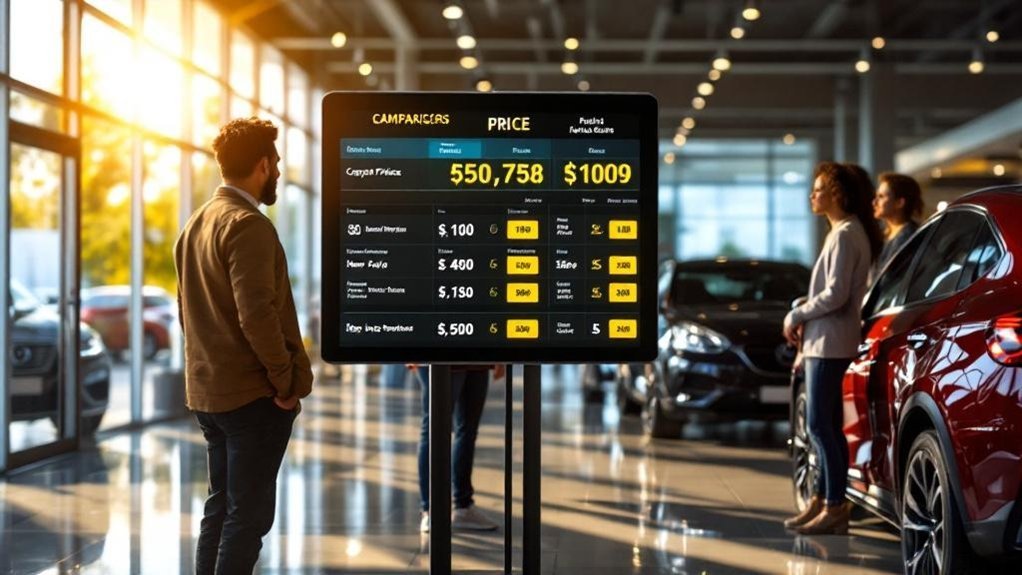
You’ll instantly defuse three common objections: fear of hidden fees by showing true out‑the‑door pricing, “I can get it cheaper” by displaying real‑time competitor rates, and distrust of dealership transparency by making incentives and fees visible. That clarity boosts engagement and trust, cuts negotiation friction, and drives more test drives and conversions. Want to see the specific metrics and workflow wins that make sales reps close faster?
Key Takeaways
- “Hidden fees” concern: shows total out-the-door price including taxes, add-ons, and dealer charges to eliminate surprise costs.
- “I can get it cheaper elsewhere” objection: displays real-time competitor rates to validate your pricing instantly.
- “I don’t trust dealer pricing” doubt: provides transparent, visible proof of fair offers to build trust and reduce perceived risk.
- “Long negotiation process” frustration: updates promotions and totals in real time, speeding decisions and reducing back-and-forth haggling.
- “Unclear trade-in or deal value” confusion: presents side-by-side comparisons of offers and incentives, clarifying the true customer value.
Hidden Fees and Unclear Pricing

One clear advantage of a digital price comparison board is that it removes hidden fees by showing the total out-the-door cost up front, including taxes, add-ons and dealer charges, so you’re not surprised at signing. You get pricing clarity immediately, which cuts confusion and builds trust—70% of buyers prefer dealers who display straightforward pricing. By surfacing the total cost, the board eliminates hidden costs that create anxiety and stalled deals. Real-time updates reflect current promotions and discounts, so you and your customers see the best offers without manual recalculation. The result: faster decisions, fewer objections, higher conversion rates. Implementing this tech reduces negotiation friction and positions your dealership as transparent and consumer-focused.
I Can Get It Cheaper Elsewhere
Anyone shopping around will tell you they’ve heard “I can get it cheaper elsewhere,” but a digital price comparison board turns that objection into a checkpoint rather than a deal-killer. You get immediate price validation by displaying real-time competitor rates, shrinking friction and stopping speculative discounts dead. Data shows transparent comparisons boost engagement and lower price objections, so your sales team converts more leads. Use the board for continuous competitive analysis, highlighting where you match or beat rivals and where added value justifies a premium. That combination of verified pricing and value messaging shifts discussions from cost alone to total proposition, increasing confidence and shortening decision cycles — measurable outcomes that directly improve your dealership’s conversion metrics.
Lack of Trust in Dealership Transparency

Because 70% of shoppers doubt traditional dealership pricing, you need visible proof that your offers are fair — and a digital price comparison board does exactly that. You’ll reduce perceived risk and boost perceived value by showing competitive pricing and real-time data, proving pricing fairness and eliminating hidden-fee concerns. Studies show a 20% uptick in engagement when you adopt transparent digital signage; 80% of buyers prefer open pricing. Use the board to convert skepticism into trust with measurable impact.
| Metric | Impact | Conversion signal |
|---|---|---|
| Engagement +20% | Higher showroom visits | Lead form starts |
| Trust +70% | Reduced objections | Test-drive bookings |
Integrate it into sales workflows to close more deals.
Frequently Asked Questions
What Are the 3 F’s for Handling Objections?
The 3 F’s are Feel, Felt, Found: you acknowledge fear factors, cite feedback frameworks showing others felt the same, then show data-driven outcomes they found, boosting conversion by reducing objections and building trust.
How Do You Overcome Price Objections in Car Sales?
You overcome price objections by shifting from price negotiation to proving value perception: show comparative data, quantify savings and features, use real-time pricing visuals, address concerns with transparency, and close by aligning benefits to the buyer’s priorities.
What Are the Most Common Objections in Car Sales?
You’ll face price, transparency, time, necessity, and negotiation objections; car buyer psychology shows distrust, value-seeking, and urgency influence decisions, so use data-driven negotiation tactics, clear pricing, faster service, and benefit-focused evidence to convert.
What Are the Three Main Types of Customer Objections?
70% of buyers cite price or trust as deal-breakers. The three main types are budget objections, trust obstacles, and need impediments; they cause customer hesitation, so you’ll prioritize trust building and data-driven rebuttals to convert.
Conclusion
Picture a clear digital price board like a storefront window: no hidden tags, real-time comparisons, and numbers you can verify. You’re cutting through noise—customers see transparent fees, instant competitor checks, and consistent quotes that build trust. Data shows clarity lifts conversions; this board turns skepticism into fast decisions. In a market where every click counts, you’re not guessing—you’re proving value, closing deals, and turning wary shoppers into confident buyers.